

Paper
Christopher S. Chivvis, Rohan Mukherjee, Milan Vaishnav
{
  "authors": [
    "Milan Vaishnav"
  ],
  "type": "legacyinthemedia",
  "centerAffiliationAll": "dc",
  "centers": [
    "Carnegie Endowment for International Peace"
  ],
  "collections": [],
  "englishNewsletterAll": "ctw",
  "nonEnglishNewsletterAll": "",
  "primaryCenter": "Carnegie Endowment for International Peace",
  "programAffiliation": "SAP",
  "programs": [
    "South Asia"
  ],
  "projects": [
    "India Elects 2019"
  ],
  "regions": [
    "South Asia",
    "India"
  ],
  "topics": [
    "Political Reform",
    "Democracy"
  ]
}
Source: Getty
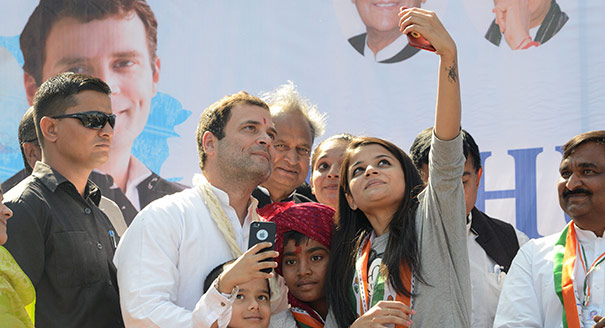
The precarious position in which the Congress Party now finds itself belies the tremendous effort that it invested in the recent campaign in Karnataka.
Source: Hindustan Times
For the last several months, Karnataka has continually confounded pundits who have struggled to discern the elusive election ‘hawa’. The counting of votes has done little to clarify the picture. Although the Bharatiya Janata Party (BJP) ended up with the single largest clutch of seats, it fell short of an outright majority. In an unexpected twist, the Congress and the Janata Dal (Secular), with a majority of seats between them, have joined hands in attempt to keep the BJP out of power. Now all eyes fall on Raj Bhavan to decide which side will be invited to prove its majority on the floor of the assembly. Regardless of how political machinations play out, the election offers several takeaways.
First, while the Congress-JD(S) combine may well have the numbers to prevail, the result substantiates Karnataka’s reputation as a state that is unkind toward incumbents. Since 1983, the state has witnessed regular alternation in power. Although the Congress will likely marginally increase its vote share, its seat tally will plummet by at least 40 seats. The BJP, on the other hand, will add more than 15 percentage points to its vote share and roughly 65 seats to its kitty.
Second, irrespective of whether the BJP forms the government, its leadership will not be too displeased with the result. Although the party recently lost its sole southern foothold in Andhra Pradesh — with the Telugu Desam Party’s (TDP) recent exit from the NDA — it has now erected its own gateway to the South. From the urban sprawl of Bengaluru to the mineral-rich hills of Ballari, the BJP now has a base from which it will launch its southern strategy for the 2019 general elections. Leaving aside the country’s eastern seaboard — that lengthy stretch of territory from West Bengal to Tamil Nadu, which the BJP has struggled to penetrate at the state-level — the increasing saffron hue of India’s political map is unmistakable.
Third, Tuesday’s victory confirms the obvious: if state assembly elections are any guide, Prime Minister Narendra Modi appears to be gaining rather than losing political capital as the clock winds down on his first term in office. Opinion surveys reaffirm the notion that Modi remains the most popular politician in India by some distance. At a time when the economy is facing potential headwinds, rural distress is on the rise, and the investment cycle remains moribund, Modi’s popularity remains the BJP’s saving grace. Today, Modi is punching above the weight of his party. While counter factuals are a dangerous game, the conventional wisdom is that Modi’s eleventh hour magic on the campaign trail lifted his party fortunes.
Fourth, Karnataka could prove a bittersweet victory for the Congress. This is a state in which the party hurled everything but the kitchen sink at the BJP, yet still finds itself at the mercy of a smaller coalition ally. Congress finally boasted a chief minister in Siddaramaiah who both had popularity and a stature independent of the Gandhi family. Unlike several recent elections in which the Congress organisation merely melted away (take the North-eastern states of Meghalaya, Nagaland, and Tripura, for example), the party left no stone unturned in its fight to retain power and yet still could not prevail. According to an Indian Express tally, in the final leg of the campaign,Congress president Rahul Gandhi addressed 18 rallies in the state across 16 constituencies (a hair shy of Modi’s 21 rallies in 19 constituencies). Whereas the Congress scion has often hesitated to expose himself on the campaign battlefield for fear of being tarred by an embarrassing defeat, in Karnataka he was all in. This was also an election in which Sonia Gandhi ended a two-year absence on the hustings and the usually taciturn Manmohan Singh delivered some of his sharpest barbs.
Fifth, however diminished its standing, a coalition government in which the Congress is a prominent part will help it both substantively and materially. Without Karnataka in its kitty, Congress clings to power in just three states: Mizoram, Punjab, and Puducherry. Karnataka was the last major state — in both demographic and economic terms — the Congress could lay claim to; the former’s Gross Domestic Product (GDP) is two-and-a-half times that of Punjab. To paraphrase prime minister Modi, if the Congress loses Karnataka, it will be reduced to a “PPP” party - Punjab, Puducherry, and parivaar (family).
In material terms, the Congress is hurting for money and Karnataka is a cash cow it cannot afford to lose. Big business has steadily migrated away from the Congress — a combined result of the United Progressive Alliance (UPA)’s tarnished second-term legacy, the party’s left-wing economic rhetoric, its dwindling hold on state capitals, and the outright fear of crossing the Modi-Shah duo. The BJP maintains a sizeable fundraising advantage over its competitors — a gap that is likely to grow if Congress loses access to India’s IT industry hub, the megalopolis of Bengaluru, and considerable natural resource rents. If the Congress is outwitted by the BJP, the loss will leave many party insiders asking how its finances will be bailed out before 2019.
In the hours and days ahead, Karnataka will experience furious politicking that will see an abundance of allegations, favours, and money being exchanged. Once the Karnataka poll is in the rear view mirror and the four-year anniversary of the Modi government is duly celebrated, next year’s general election campaign will soon begin in earnest. Notwithstanding the Karnataka verdict, the 2019 race is not a foregone conclusion with three major Hindi belt states going to the polls at the end of the calendar year — all states in which the BJP will be playing defence rather than offence. After all, if Karnataka teaches us anything about Indian elections, it is that uncertainty is the only certainty.
This article was originally published in the Hindustan Times.

Director and Senior Fellow, South Asia Program
Milan Vaishnav is a senior fellow and director of the South Asia Program and the host of the Grand Tamasha podcast at the Carnegie Endowment for International Peace. His primary research focus is the political economy of India, and he examines issues such as corruption and governance, state capacity, federalism, and electoral behavior. He also conducts research on the Indian diaspora.
Recent Work


Christopher S. Chivvis, Rohan Mukherjee, Milan Vaishnav



Sophia Besch, Eric Ciaramella, Steve Feldstein, …
Carnegie India does not take institutional positions on public policy issues; the views represented herein are those of the author(s) and do not necessarily reflect the views of Carnegie, its staff, or its trustees.

In any defense establishment, change is an ongoing process. However, despite the best of intentions, existing bureaucracies, bound by habit and years of socialization, have their limits in implementing transformative change.

Anit Mukherjee

As AI grows more sophisticated, as the supply chains that power it become more contested, and as access to frontier models becomes geopolitically charged, India must begin to ask a different set of questions. Not what applications it can build on someone else’s infrastructure but what the world needs.

Konark Bhandari

The Indian Ocean Region hosts one of the densest concentrations of subsea cables in the world. Yet, despite accounting for a significant share of global internet traffic, India’s participation remains limited.

Charukeshi Bhatt

How is AI reshaping space security, creating governance challenges, and where does international diplomacy stand today?


Tejas Bharadwaj, Almudena Azcárate Ortega

After the chill in ties between 2020 and 2024 that brought India–China relations to their lowest point in several decades, the two countries have engaged each other afresh. This paper argues that there are predominantly four imperatives guiding India’s approach to China, and they exist in an order of priority.

Saheb Singh Chadha