

Research
- +10
Rosa Balfour, Frances Z. Brown, Yasmine Farouk, …
{
  "authors": [
    "Moisés Naím"
  ],
  "type": "legacyinthemedia",
  "centerAffiliationAll": "",
  "centers": [
    "Carnegie Endowment for International Peace"
  ],
  "collections": [],
  "englishNewsletterAll": "",
  "nonEnglishNewsletterAll": "",
  "primaryCenter": "Carnegie Endowment for International Peace",
  "programAffiliation": "",
  "programs": [],
  "projects": [],
  "regions": [
    "North America",
    "South America"
  ],
  "topics": [
    "Global Governance",
    "Foreign Policy"
  ]
}
Source: Getty
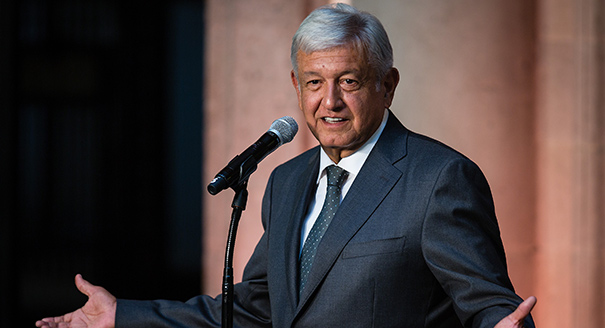
Mexican President-elect Andres López Obrador’s landslide victory was a huge success for his coalition, gaining control of most of the state legislatures. It has been decades since any Mexican government has had this level of political control.
Source: El País
Mexico is not Venezuela and Andrés Manuel López Obrador is not Hugo Chávez. The differences are many and have already been fleshed out by others.
But that does not mean that Venezuela’s experience over the last 20 years has nothing to add to our understanding of the ways Mexico could change under López Obrador.
Perhaps the most important lesson from Venezuela is that prolonged mandates are a much more dangerous threat than populism. What sunk Venezuela was not so much Hugo Chávez and Nicolás Maduro’s populist policies, but how long they have stayed in place. Venezuela today – a failed state unable to feed or provide healthcare to its people, protect them from crime, or cut the highest inflation rate in the world – is what happens when a regime does the same thing over and over again for 20 years. Five or six years of bad policies will, of course, hurt any country. But decades of bad government from the same authoritarian clique will destroy it.
The danger, of course, is that he will be tempted to stay for six more years.
What does this have to do with Mexico? Hopefully nothing. Article 83 of the Mexican Constitution, in place since 1933, bans the president’s reelection. So far, no president has managed to change this rule. Not because they haven’t tried, but because that same Constitution imposes highly demanding requirements for amendments. Namely, a two-thirds majority in both the Chamber of Deputies and the Senate, as well as a simple majority in the state legislatures and the government of Mexico City. It has been decades since any Mexican government has had that level of political control. Until now.
López Obrador’s landslide victory was so huge that his coalition would only need to “flip” a few deputies and senators to have enough votes to change the Constitution. They already have control of most of the state legislatures.
It is, therefore, likely that if President López Obrador so chooses, he can change Article 83. If he did, he would not be an exception, but rather one more in a long list of presidents who have changed the rules to extend their stay in power. Russia, Bolivia, Turkey, China, and South Africa are recent examples of what, unfortunately, is a global trend.
The rulers who propose a constitutional amendment usually justify it as an indispensable requirement to combat the country’s ills. Corruption, poverty and inequality are more effectively confronted with a new constitution, the people are told. In reality, these justifications often are just a trick to distract the public’s attention from the true motivation to change the constitution: allow for the president’s reelection. Hugo Chávez, for example, justified the elimination of term limits, and the adoption of other reforms that further concentrated power in his hands, by repeating ad nauseam that he could only eliminate social injustice if the Constitution was amended as he wished. As we now know, it did not turn out that way. In fact, it was this change that created the conditions that are currently decimating the same poor people whose interests Chávez claimed to champion.
Hugo Chávez never hesitated to do the exact opposite of what he had promised
It is possible that Mexico will not follow the same path as Venezuela and that President López Obrador will content himself with his six-year term. Perhaps he has no intention of taking more power than he already has. After all, as president he will be the head of state, the head of the government, and the head of the Armed Forces. He is also the leader of his party and the leader of the coalition that brought him to power, which will have an absolute majority in Congress. This guarantees the legislative approval of the new president’s initiatives. In addition, López Obrador will be able to appoint trusted allies in all key positions throughout the judiciary, including the Supreme Court.
The danger, of course, is that he will be tempted to stay for six more years. Paradoxically, international experience shows that the worse things get for a president, the more he tries to hang on to power. Another important lesson to keep in mind is that populist governments usually start well and end badly. After a few years, populist economic policies tend to be difficult to sustain, while the political costs of abandoning them becomes prohibitively high. Inevitably, the government’s need to stay the course only aggravates the disastrous consequences of populism.
None of this has to happen to Mexico. In fact, the conciliatory tone that López Obrador has adopted since winning the election has given great hope to the millions of Mexicans who did not vote for him. But the same thing happened in Venezuela after Chávez won his first election. He promised everything to everyone. Yet he never hesitated to do the exact opposite of what he had promised.
Hopefully this is not another lesson that Mexicans will have to learn.

Distinguished Fellow
Moisés Naím is a distinguished fellow at the Carnegie Endowment for International Peace, a best-selling author, and an internationally syndicated columnist.
Recent Work



Rosa Balfour, Frances Z. Brown, Yasmine Farouk, …
Moisés Naím
Carnegie India does not take institutional positions on public policy issues; the views represented herein are those of the author(s) and do not necessarily reflect the views of Carnegie, its staff, or its trustees.

After the chill in ties between 2020 and 2024 that brought India–China relations to their lowest point in several decades, the two countries have engaged each other afresh. This paper argues that there are predominantly four imperatives guiding India’s approach to China, and they exist in an order of priority.

Saheb Singh Chadha

This piece argues that India’s central challenge is not managing a single flashpoint but resolving the underlying tension between expansion and institutional coherency of the BRICS grouping.

Vrinda Sahai

A partnership between India, a country of subcontinental size, and Africa, a continent of fifty-four countries, may seem asymmetric until one notes that both are home to nearly the same number of people—1.4 billion. This essay spells out the existing challenges to the partnership, its optimal potential, and the possible pathways to realize it over the next quarter-century.

Rajiv Bhatia

The India–EU Free Trade Agreement (FTA) is shaping up to be one of the most consequential trade negotiations, both economically and strategically. But, what’s in the agreement, what’s missing, and what will determine its success in the years ahead
Vrinda Sahai, Nicolas Köhler-Suzuki

Trump 2.0 has unsettled India’s external environment—but has not overturned its foreign policy strategy, which continues to rely on diversification, hedging, and calibrated partnerships across a fractured order.



Milan Vaishnav, ed., Sameer Lalwani, Tanvi Madan, …