

Commentary
Alexander Gabuev
{
  "authors": [
    "Alexander Gabuev"
  ],
  "type": "legacyinthemedia",
  "centerAffiliationAll": "",
  "centers": [
    "Carnegie Endowment for International Peace",
    "Carnegie Russia Eurasia Center"
  ],
  "collections": [],
  "englishNewsletterAll": "",
  "nonEnglishNewsletterAll": "",
  "primaryCenter": "Carnegie Endowment for International Peace",
  "programAffiliation": "",
  "programs": [],
  "projects": [],
  "regions": [
    "North America",
    "United States",
    "Russia"
  ],
  "topics": [
    "Foreign Policy"
  ]
}
Source: Getty
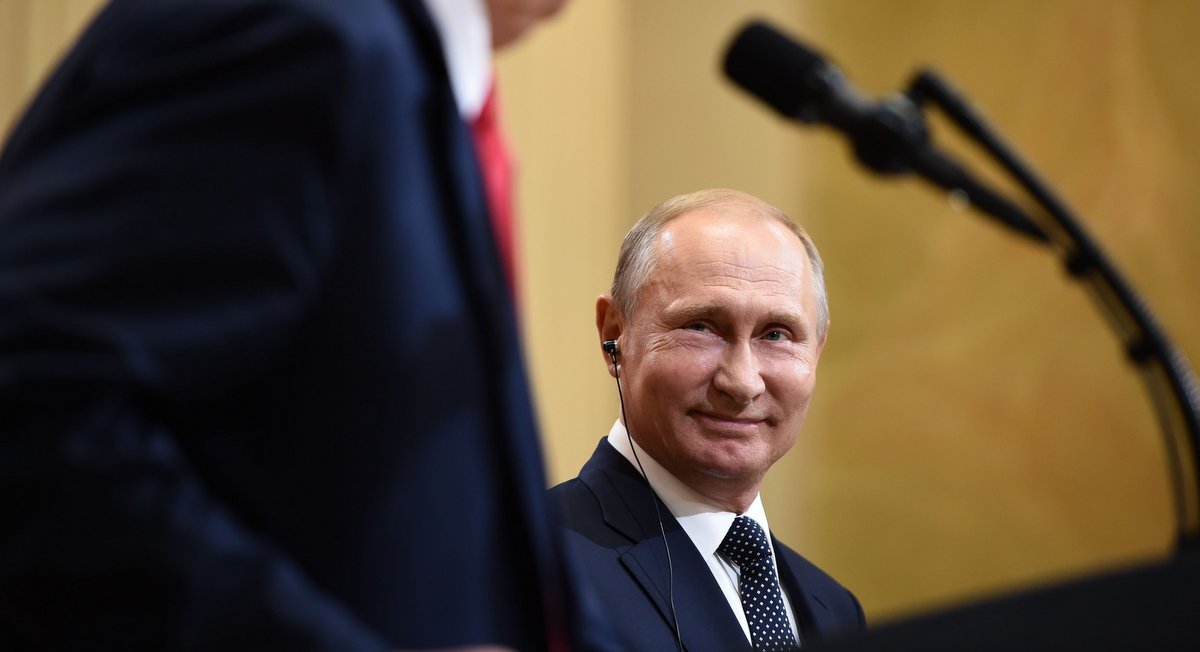
Vladimir Putin achieved his goal of embarrassing the United States. But Russians are already bracing for the backlash.
Source: Foreign Policy
“Awesome, better than super.” That was the initial assessment offered by Sergei Lavrov, the Russian foreign minister, of the summit meeting between U.S. President Donald Trump and Russian President Vladimir Putin in Helsinki. Putin did his own victory lap in a Fox News interview immediately after the meeting and a July 19 speaking appearance in front of the Russian diplomatic corps. “A full-fledged summit with an opportunity to talk directly has finally taken place,” Putin declared. “It was overall successful and led to productive agreements.” Russian state-controlled TV channels have been praising the summit outcome and Putin’s performance for five consecutive days now.
The reaction in Moscow was of a piece with the atmosphere after Trump’s victory in November 2016, when Russian officialdom celebrated for days. And it’s not hard to understand the current triumphant mood in Moscow. If the Kremlin’s entire goal for the meeting was simply to embarrass the United States, Trump couldn’t have done a better job. He publicly ridiculed the findings of the U.S. intelligence community about Russian interference in the 2016 presidential election and poured scorn on special counsel Robert Mueller’s investigation into the issue.
But the Kremlin may soon come to regret that it held the summit in the first place. Trump’s disastrous performance is likely to lead to unintended consequences that ultimately harm Russia.
Both sides went into the Helsinki summit on July 16 with low expectations, and actual deliverables from the meeting were sparse. Putin and his team know all too well that divisions between Russia and the West on issues such as Ukraine, Syria, and sanctions run deep and have no quick fixes. Going into Helsinki, the only area that appeared remotely promising involved restarting high-level dialogue on the badly damaged arms control regime, agreeing to renew the START agreement, and resolving mutual accusations of violating the Intermediate-Range Nuclear Forces Treaty.
That’s why the Kremlin’s game plan for the summit was simple: The goal was merely to leverage the symbolic benefits of putting Trump and Putin together on the world stage and to have the two presidents give a green light to long-overdue talks on strategic arms control. Follow-up efforts were geared primarily to the only functioning channel of communication, the military-to-military dialogue overseen by Chairman of the Joint Chiefs of Staff Joseph Dunford and Chief of the Russian General Staff Valery Gerasimov. Judging by Trump’s and Putin’s statesmanlike opening statements, these goals were achieved, though as always, the devil will reside in the details.
If the summit outcome had been limited to these achievements, there would have been plenty for Putin to celebrate. For status-conscious Russians, symbolic parity with the United States constitutes a huge victory—one that Trump, who so clearly desires another reset in U.S.-Russian relations, was happy to assist with, judging from one of his post-summit tweets: “I look forward to our second meeting so that we can start implementing some of the many things discussed, including stopping terrorism, security for Israel, nuclear proliferation, cyber attacks, trade, Ukraine, Middle East peace, North Korea and more. There are many answers, some easy and some hard, to these problems…but they can ALL be solved!” In a few keystrokes, Trump effectively reaffirmed Russia’s status as a superpower on par with either the United States or China.
Official Moscow had further reason to be pleased with Putin’s performance at the summit. Although the Russian president, when pressed by American journalists, had made an important mistake by saying that he had supported Donald Trump before the election because the Republican candidate had publicly advocated for improved relations with Russia, Putin acted far more calm, disciplined, and presidential than his U.S. counterpart. Putin once again trolled the U.S. establishment by flatly denying accusations of election interference, despite the detailed evidence contained in Mueller’s recent rounds of indictments. Putin disingenuously suggested that Mueller could even turn to the Russian government for help questioning some of the 12 GRU officers who have been indicted for their alleged roles in hacking the computer systems of the Democratic National Committee.
The televised images of Putin’s mocking performance in Helsinki also resonated with many average Russians. It should come as no surprise that in the public part of Putin’s July 19 address to senior Russian diplomats, he insisted that “there are forces in the United States are willing to sacrifice Russia-U.S. relations to promote their ambitions amid the domestic political strife in America.”
But Putin’s big win in Helsinki was undermined by its unexpectedly large margin. Trump’s remarks in Helsinki, which were far more deferential to Russia than anyone could have anticipated, have sent shockwaves through Washington and other Western capitals. Ironically, it is Trump’s over-the-top performance at the press conference that is likely to ruin the Kremlin’s gains from Helsinki. The post-meeting glow is already fading rapidly, and it appears that, before long, the Helsinki summit may be remembered as one of the most disastrous moments in Moscow’s long-running confrontation with the United States.
In recent days, the U.S. Congress has started to mobilize and think about ways to undo the damage created by a U.S. president whose behavior has triggered a dramatic firestorm of criticism. Trump’s clumsy efforts to correct the terrible impression he made have made things even worse. The U.S. Senate is now actively debating a bill introduced by Sens. Mark Rubio, a Republican, and Chris Van Hollen, a Democrat, back in January that would impose harsh economic sanctions if Russia interferes in the November midterm elections. On Wednesday, Sens. John Barrasso and Cory Gardner, both Republicans, introduced a bill that targets Nord Stream 2, a new Russian natural gas pipeline to Germany that bypasses Ukraine, which is one of Putin’s pet projects.
If recent history provides any guidance, it’s likely that Congress will pass at least one bill that will threaten the Russian economy. The U.S. government will also have greater motivation to ratchet up sanctions against Russia imposed by legislation last year. With the anti-Russian consensus that unites the American elite only gaining strength, Trump’s zeal for detente with Putin seems destined to achieve the exact opposite result.
The Kremlin is now starting to reckon with this very real risk. In his July 19 address at the Ministry of Foreign Affairs, Putin warned that members of the U.S. establishment “are not miserable or wretched people. No, they are powerful and strong people who can shove … unbelievable and illogical stories in the face of millions of their citizens. Yes, they can really do this. I am not saying this to scold or commend anyone. … I am saying this so that we take this into account in our practical work in the American direction.”
The problem, however, is that it isn’t only the Russophobic U.S. establishment that bears the blame for all the problems in the bilateral relationship. Rather, it’s Trump himself who has recently posed the biggest problem. Trump’s lack of discipline and inability to talk convincingly about even a moderately tough stance on Russia is again stirring up the hornet’s nest in Washington. That’s why, after watching Monday’s press conference, some wealthy and powerful Russians who know the West well have been exchanging text messages that have in common a variation on one phrase: “This moron is making things worse, and it’s going to end very badly.” Sooner rather than later, the Kremlin will come to regret its Helsinki triumph.

Director, Carnegie Russia Eurasia Center
Alexander Gabuev is director of the Carnegie Russia Eurasia Center. Gabuev’s research is focused on Russian foreign policy with particular focus on the impact of the war in Ukraine and the Sino-Russia relationship. Since joining Carnegie in 2015, Gabuev has contributed commentary and analysis to a wide range of publications, including the Financial Times, the New York Times, the Wall Street Journal, and the Economist.
Recent Work
Alexander Gabuev
Alexander Gabuev
Carnegie India does not take institutional positions on public policy issues; the views represented herein are those of the author(s) and do not necessarily reflect the views of Carnegie, its staff, or its trustees.

How is AI reshaping space security, creating governance challenges, and where does international diplomacy stand today?


Tejas Bharadwaj, Almudena Azcárate Ortega

After the chill in ties between 2020 and 2024 that brought India–China relations to their lowest point in several decades, the two countries have engaged each other afresh. This paper argues that there are predominantly four imperatives guiding India’s approach to China, and they exist in an order of priority.

Saheb Singh Chadha

This piece argues that India’s central challenge is not managing a single flashpoint but resolving the underlying tension between expansion and institutional coherency of the BRICS grouping.

Vrinda Sahai

A partnership between India, a country of subcontinental size, and Africa, a continent of fifty-four countries, may seem asymmetric until one notes that both are home to nearly the same number of people—1.4 billion. This essay spells out the existing challenges to the partnership, its optimal potential, and the possible pathways to realize it over the next quarter-century.

Rajiv Bhatia

The U.S.–India semiconductor cooperation story is well-stocked with top-level strategic intent. What remains unresolved, however, are some underlying challenges that will determine whether the cooperation actually functions. Three such friction points stand out.

Shruti Mittal