

Paper
Christopher S. Chivvis, Rohan Mukherjee, Milan Vaishnav
{
  "authors": [
    "Milan Vaishnav"
  ],
  "type": "legacyinthemedia",
  "centerAffiliationAll": "dc",
  "centers": [
    "Carnegie Endowment for International Peace"
  ],
  "collections": [],
  "englishNewsletterAll": "ctw",
  "nonEnglishNewsletterAll": "",
  "primaryCenter": "Carnegie Endowment for International Peace",
  "programAffiliation": "SAP",
  "programs": [
    "South Asia"
  ],
  "projects": [],
  "regions": [
    "South Asia",
    "India"
  ],
  "topics": [
    "Political Reform",
    "Economy"
  ]
}
Source: Getty
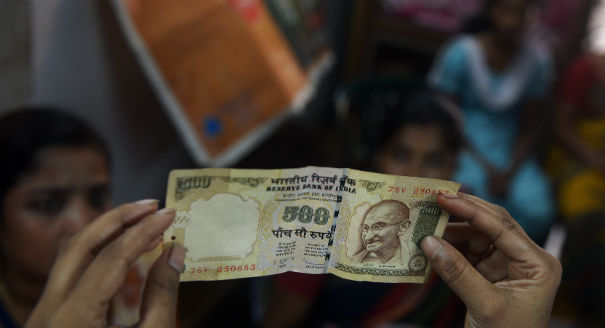
Why Prime Minister Modi’s demonetization gamble is unlikely to hurt his popularity ahead of the 2019 elections.
Source: Rediff News
The source of political funding remains a shady and opaque element in Indian politics.
Demonetisation was an attack on black money, yet huge amounts of cash is spent in elections.
The Karnataka assembly election in May was the most expensive in India.
Costs of Democracy, edited by Devesh Kapur, director, Asia Programs, Johns Hopkins University, and Milan Vaishnav, director, South Asia Program, Carnegie Endowment for International Peace, is a scholarly investigation into how money flows into Indian democracy."
Given the Modi government's uneven economic record, demonetisation allowed them to change the narrative. It is no longer about growth, jobs, and investment. It is about launching the most ambitious attack on black money since Indian Independence," Milan Vaishnav tells Rediff.com's Archana Masih in an e-mail interview.
In my view, demonetisation has not made a serious dent on illicit campaign cash.
As you rightly point out, cash seizures in the 2017 UP election (which took place just months after demonetisation) increased three-fold. The same was largely true of the other four states that went to the polls.
In speaking with politicians in India for the book, they privately suggested that demonetisation could have a small short-term impact, but that parties and politicians are pretty ingenious when it comes to laundering funds.
Senior officials with the Election Commission of India have said as much. Money power -- and the use of illicit cash -- remains a principal concern for them.
That is a very good question! I think the Modi government genuinely thought that a large proportion of outstanding currency would not come back into the system, which would allow the Reserve Bank of India to wipe those liabilities off their books and deliver a windfall to the government.
The government, in turn, would issue a cash transfer to all households in India.
In private conversations, senior economic officials have told me that they simply did not foresee the extent to which public sector bank managers would collude with those seeking to turn black money white.
In my view, the Modi government was just flabbergasted as most analysts that nearly all the money came back.
I do think there was a secondary motivation, which was political.
Demonetisation and the broader assault on 'black money' has given the Modi government a very powerful narrative with which they can go to the polls in 2019.
It is very hard for any political party to argue with steps taken against black money; it was Modi's 'either you're with us or against us' moment.
Furthermore, given the Modi government's uneven economic record, demonetisation allowed them to change the narrative. It is no longer about growth, jobs, and investment.
It is about launching the most ambitious attack on black money since Indian Independence.
Frankly, as far as 2019 concerned, I think the net effect will be minimal.
Modi will get credit in some quarters for taking a bold gamble to squeeze the fat cats who amassed ill-gotten wealth.
Others will mock him for unnecessarily damaging India's growth recovery and harming ordinary Indians for no reason.
On average, I think these effects will probably cancel each other out.
If the Modi government is successful in extraditing a high-profile fugitive such as Vijay Mallya or Nirav Modi before the 2019 election, the government will be able to link demonetisation to this and turn it into a positive.
Again, I think any negative effect is probably on the margins.
The government is working overtime (through the GST Council) to iron out the most severe kinks in the GST system.
It won't necessarily operate as a well-oiled machine by Spring 2019, but I think the worst will certainly be in the past.
Indeed, the most recent GDP numbers suggest that the economy is in fact recovering from the twin shocks of demonetisation and GST.
I think where these two actions do damage is when it comes to Modi's perceived competence. Remember that was supposed to be the calling card of this administration.
Whatever you might say about Modi and colleagues, they were supposed to be more competent that the UPA-2 regime.
Modi was the 'CEO CM-turned-PM'. I still think the electorate is willing to give him the benefit of the doubt, but the implementation of demonetisation and GST do not help in this regard.

Director and Senior Fellow, South Asia Program
Milan Vaishnav is a senior fellow and director of the South Asia Program and the host of the Grand Tamasha podcast at the Carnegie Endowment for International Peace. His primary research focus is the political economy of India, and he examines issues such as corruption and governance, state capacity, federalism, and electoral behavior. He also conducts research on the Indian diaspora.
Recent Work
Christopher S. Chivvis, Rohan Mukherjee, Milan Vaishnav



Sophia Besch, Eric Ciaramella, Steve Feldstein, …
Carnegie India does not take institutional positions on public policy issues; the views represented herein are those of the author(s) and do not necessarily reflect the views of Carnegie, its staff, or its trustees.

In any defense establishment, change is an ongoing process. However, despite the best of intentions, existing bureaucracies, bound by habit and years of socialization, have their limits in implementing transformative change.

Anit Mukherjee

As AI grows more sophisticated, as the supply chains that power it become more contested, and as access to frontier models becomes geopolitically charged, India must begin to ask a different set of questions. Not what applications it can build on someone else’s infrastructure but what the world needs.

Konark Bhandari

The Indian Ocean Region hosts one of the densest concentrations of subsea cables in the world. Yet, despite accounting for a significant share of global internet traffic, India’s participation remains limited.

Charukeshi Bhatt

How is AI reshaping space security, creating governance challenges, and where does international diplomacy stand today?


Tejas Bharadwaj, Almudena Azcárate Ortega

After the chill in ties between 2020 and 2024 that brought India–China relations to their lowest point in several decades, the two countries have engaged each other afresh. This paper argues that there are predominantly four imperatives guiding India’s approach to China, and they exist in an order of priority.

Saheb Singh Chadha