

Paper
Douglas H. Paal
{
  "authors": [
    "Douglas H. Paal"
  ],
  "type": "commentary",
  "centerAffiliationAll": "dc",
  "centers": [
    "Carnegie Endowment for International Peace",
    "Carnegie Russia Eurasia Center",
    "Carnegie China"
  ],
  "collections": [],
  "englishNewsletterAll": "asia",
  "nonEnglishNewsletterAll": "",
  "primaryCenter": "Carnegie China",
  "programAffiliation": "AP",
  "programs": [
    "Asia"
  ],
  "projects": [],
  "regions": [
    "North America",
    "United States",
    "East Asia",
    "China"
  ],
  "topics": [
    "Foreign Policy"
  ]
}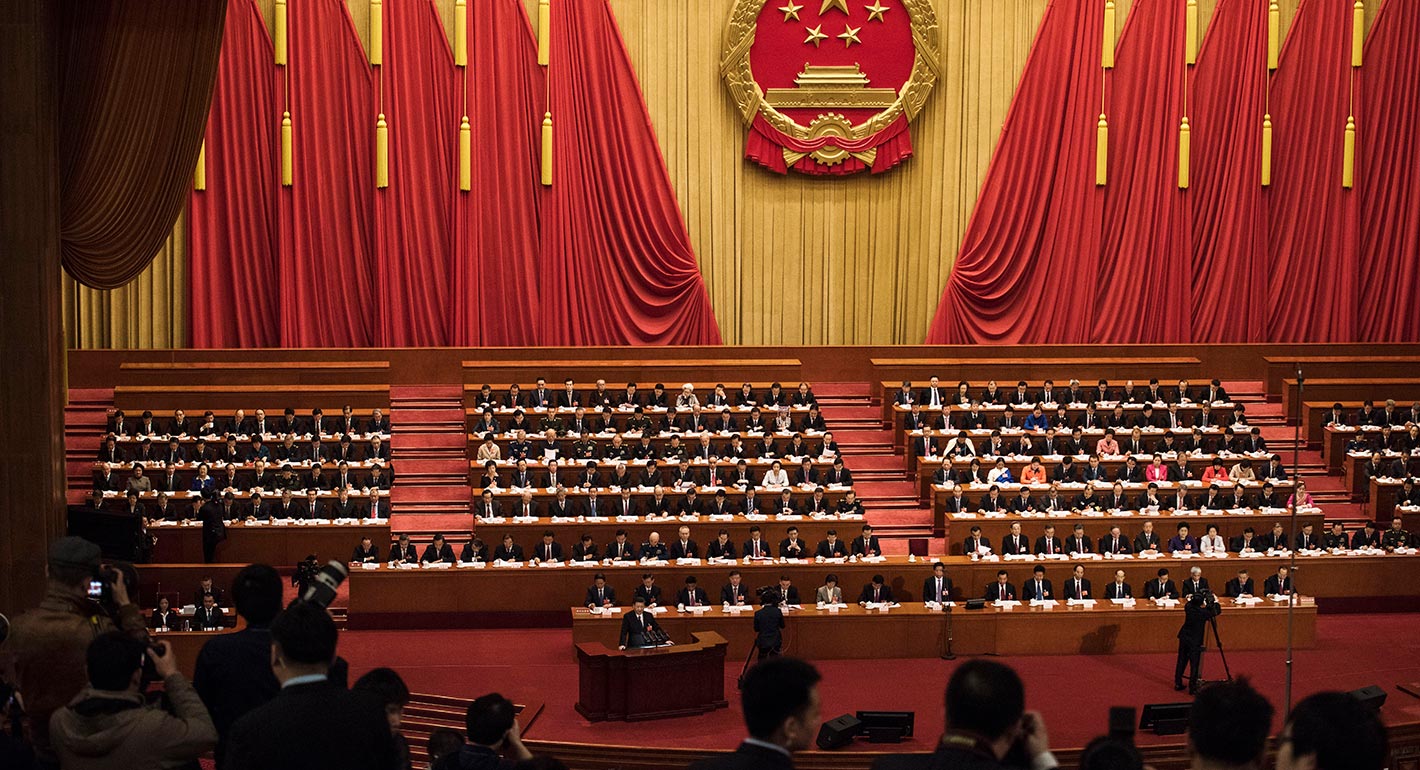
Source: Getty
Across the board, responsible American officials have lost patience with and understanding for China.
Source: South China Morning Post
As the trade war commences between the United States and China, many Western commentators are noting that Beijing can blame itself for a lot of the tension rising in economics and beyond. China’s authoritarian and mercantilist drift at home and aggressiveness abroad are discrediting American advocates of engagement and bolstering proponents of a new cold war across a broad political spectrum.
One aspect of this transition in relations that I have not seen noticed by my Chinese friends is something that was driven home to me vividly this past summer during seminars with officials who recently left the US government. An important generational milestone has been passed without drawing attention to itself.
Across the American government, in every agency and regardless of party identification, those with experience with pre-reform China have retired and been replaced by much younger officials with no personal memory of the “three communiqués” that are the foundation of US-China relations. They did not witness Deng Xiaoping’s “hide and bide” low-key approach to foreign affairs. They did not see how the Chinese people escaped the extremes of the Cultural Revolution.
Most serving American officials today have worked on China-related issues for about 10 years or less. The China they know started with the eye-popping Beijing Olympics in 2008, not with Nixon’s bold trip to open relations with an impoverished, backward nation. The context is not that of Nixon, seeking to counter the Soviet Union while extricating the US from Vietnam, but of a strong, rising China striving to reshape Asia at American expense.
In those 10 years, their experience has included the unfulfilled promise of continued economic reforms in China and rising complaints from the American business community about market exclusion and intellectual property theft. The long-standing business coalitions that repeatedly lobbied the administration and Congress to seek positive relations with Beijing over decades have deliquesced, leaving the floor primarily to critics.
The current generation of officials saw their own records stolen by Chinese cyber thieves from the Office of Personnel Management in 2015. For them, that makes the risks personal, not somebody else’s.
They watched Beijing coddle Pyongyang for years despite the latter’s pursuit of weapons of mass destruction. But when the US and South Korea responded by installing missile defences, Beijing decided to punish Seoul for the act of defending itself.
Beijing advocates adhering to international law, but only when it suits its interests. China endorsed the Law of the Sea, but rejected its arbitration panel’s judgment when it invalidated its claims in the South China Sea. The military built artificial islands in the sea, all the while claiming they were not for military purposes.
The new generation saw a Belt and Road Initiative that, in the name of doing good, seems to be undermining the financial health of vulnerable countries. They suspect that the initiative’s infrastructure projects are stalking horses for China’s geopolitical ambitions.
Beijing is chivvying Taiwan’s vibrant democracy diplomatically and militarily. In the past decade, no one has repeated China’s previous proposals to achieve a form of reunification that would assure Taiwan’s continued autonomy and refrain from deploying forces there. The last decade’s record in Hong Kong has reinforced this impression that China is effectively escalating its demands.
At this point, it is fair to observe that weakness of historical memory is not something new to America. Our election cycles and forward-looking culture reinforce a tendency to ask “what have you done for me lately” rather than “how can we build on past cooperation?” Not every American lapse in respect for the past or decorum should be forgiven.
But the troubles we are heading for now call for more than the usual dismissal of these foibles and pushing ahead as if nothing has happened. Across the board, responsible American officials have lost patience with and understanding for China. When combined with a vainglorious and shallow leader and his chorus, it is a dangerous combination.
The situation cries out for a fundamental re-evaluation of policy and discourse in China that asks how Beijing allowed itself to have this effect on a people and government who set out on a much more constructive course several decades ago. What can be done to reverse or remedy this? The same goes for China’s relations with Europe, Japan and Southeast Asia.
The closing of public space in China will make this sort of re-evaluation doubly difficult. Internal checks and balances on the leadership have been systematically dismantled, with the notable exception of anti-corruption measures. This means that those outside China have a heightened responsibility to call Beijing to account.
And, by this, I do not mean simply naming and shaming China for its actions. Rather, those who think we must avert conflict and manage differences should seek to use policy tools to push on doors that are already partially open, such as domestic economic reforms and international free-market improvements the regime has already proclaimed to be goals.
Personal appeals and leadership meetings will not be enough. The Chinese aphorism for the present situation is that “three feet of ice are not formed by one cold night”. The past 10 years of policy regression at home and assertiveness abroad need to be adjusted or corrected in a thorough, steady fashion.
The younger officials who now have our futures in their hands will need to see real change to be convinced that there is an alternative to confrontation.
This article was originally published by the South China Morning Post.

Distinguished Fellow, Asia Program
Paal previously served as vice chairman of JPMorgan Chase International and as unofficial U.S. representative to Taiwan as director of the American Institute in Taiwan.
Recent Work
Douglas H. Paal


Douglas H. Paal, Tong Zhao, Chen Qi, …
Carnegie India does not take institutional positions on public policy issues; the views represented herein are those of the author(s) and do not necessarily reflect the views of Carnegie, its staff, or its trustees.

How is AI reshaping space security, creating governance challenges, and where does international diplomacy stand today?


Tejas Bharadwaj, Almudena Azcárate Ortega

After the chill in ties between 2020 and 2024 that brought India–China relations to their lowest point in several decades, the two countries have engaged each other afresh. This paper argues that there are predominantly four imperatives guiding India’s approach to China, and they exist in an order of priority.

Saheb Singh Chadha

This piece argues that India’s central challenge is not managing a single flashpoint but resolving the underlying tension between expansion and institutional coherency of the BRICS grouping.

Vrinda Sahai

A partnership between India, a country of subcontinental size, and Africa, a continent of fifty-four countries, may seem asymmetric until one notes that both are home to nearly the same number of people—1.4 billion. This essay spells out the existing challenges to the partnership, its optimal potential, and the possible pathways to realize it over the next quarter-century.

Rajiv Bhatia

The U.S.–India semiconductor cooperation story is well-stocked with top-level strategic intent. What remains unresolved, however, are some underlying challenges that will determine whether the cooperation actually functions. Three such friction points stand out.

Shruti Mittal