

Commentary
How is AI reshaping space security, creating governance challenges, and where does international diplomacy stand today?
Tejas Bharadwaj, Almudena Azcárate Ortega
{
  "authors": [
    "Richard Sokolsky",
    "Yuri Lee"
  ],
  "type": "legacyinthemedia",
  "centerAffiliationAll": "",
  "centers": [
    "Carnegie Endowment for International Peace"
  ],
  "collections": [],
  "englishNewsletterAll": "",
  "nonEnglishNewsletterAll": "",
  "primaryCenter": "Carnegie Endowment for International Peace",
  "programAffiliation": "",
  "programs": [],
  "projects": [],
  "regions": [
    "North America",
    "United States",
    "East Asia",
    "South Korea",
    "North Korea"
  ],
  "topics": [
    "Nuclear Policy",
    "Arms Control",
    "Global Governance",
    "Foreign Policy"
  ]
}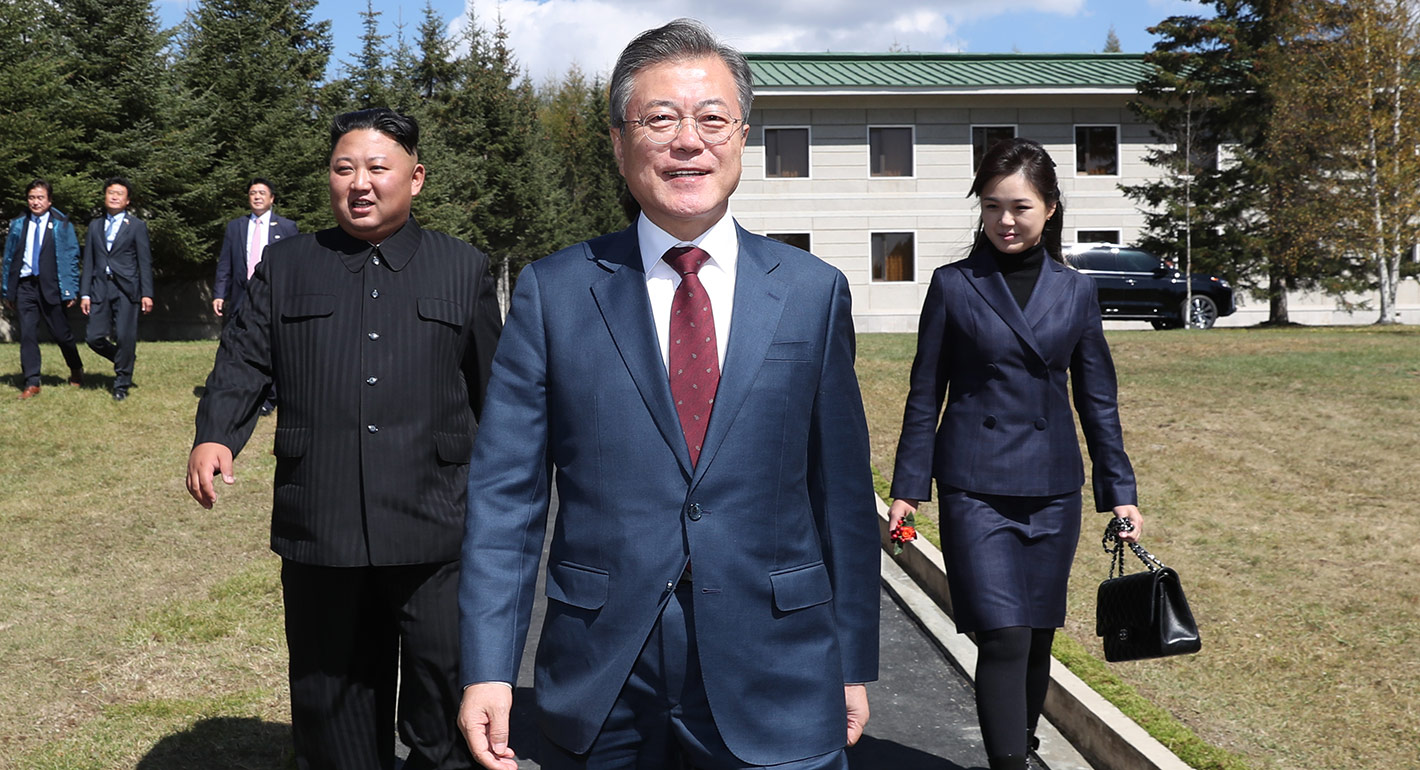
Source: Getty
In the event a peace and security regime for the Korean Peninsula leads to North Korean agreement to reduce its conventional weapons and equipment, Kim may want to convert portions of the North’s defense industries to production of civilian goods.
Source: 38 North
Kim Jong Un is committed to North Korea’s economic development and has prioritized this goal over military modernization. In the event a peace and security regime for the Korean Peninsula leads to North Korean agreement to reduce its conventional weapons and equipment, Kim may want to convert portions of the North’s defense industries to production of civilian goods. Re-purposing these facilities for civilian uses could give a boost to North-South normalization and reconciliation as well as present opportunities for closer North-South economic cooperation and possibly multinational participation in the conversion program. To date, Pyongyang and Seoul have not given much thought to cooperative North Korean defense conversion. But if inter-Korean relations move forward this subject could assume greater importance on their agenda for normalization and reconciliation.

Nonresident Senior Fellow, Russia and Eurasia Program
Richard Sokolsky is a nonresident senior fellow in Carnegie’s Russia and Eurasia Program. His work focuses on U.S. policy toward Russia in the wake of the Ukraine crisis.
Yuri Lee
Yuri Lee is a research freelancer supporting 38 North Director Joel Wit. Prior to her freelance work, she was a Research and Program Intern at the US-Korea Institute at Johns Hopkins School of Advanced International Studies. She currently works at Asian Americans Advancing Justice, a legal advocacy nonprofit dedicated to protecting the rights of immigrant communities and communities of color. She holds a B.A. in History from Dartmouth College.
Carnegie India does not take institutional positions on public policy issues; the views represented herein are those of the author(s) and do not necessarily reflect the views of Carnegie, its staff, or its trustees.

How is AI reshaping space security, creating governance challenges, and where does international diplomacy stand today?


Tejas Bharadwaj, Almudena Azcárate Ortega

After the chill in ties between 2020 and 2024 that brought India–China relations to their lowest point in several decades, the two countries have engaged each other afresh. This paper argues that there are predominantly four imperatives guiding India’s approach to China, and they exist in an order of priority.

Saheb Singh Chadha

This piece argues that India’s central challenge is not managing a single flashpoint but resolving the underlying tension between expansion and institutional coherency of the BRICS grouping.

Vrinda Sahai

A partnership between India, a country of subcontinental size, and Africa, a continent of fifty-four countries, may seem asymmetric until one notes that both are home to nearly the same number of people—1.4 billion. This essay spells out the existing challenges to the partnership, its optimal potential, and the possible pathways to realize it over the next quarter-century.

Rajiv Bhatia

The U.S.–India semiconductor cooperation story is well-stocked with top-level strategic intent. What remains unresolved, however, are some underlying challenges that will determine whether the cooperation actually functions. Three such friction points stand out.

Shruti Mittal