

Commentary
Andrew Miller
{
  "authors": [
    "Andrew Miller"
  ],
  "type": "legacyinthemedia",
  "centerAffiliationAll": "dc",
  "centers": [
    "Carnegie Endowment for International Peace"
  ],
  "collections": [],
  "englishNewsletterAll": "menaTransitions",
  "nonEnglishNewsletterAll": "",
  "primaryCenter": "Carnegie Endowment for International Peace",
  "programAffiliation": "MEP",
  "programs": [
    "Middle East"
  ],
  "projects": [],
  "regions": [
    "North Africa",
    "Libya"
  ],
  "topics": [
    "Political Reform",
    "Security",
    "Military",
    "Foreign Policy"
  ]
}
Source: Getty
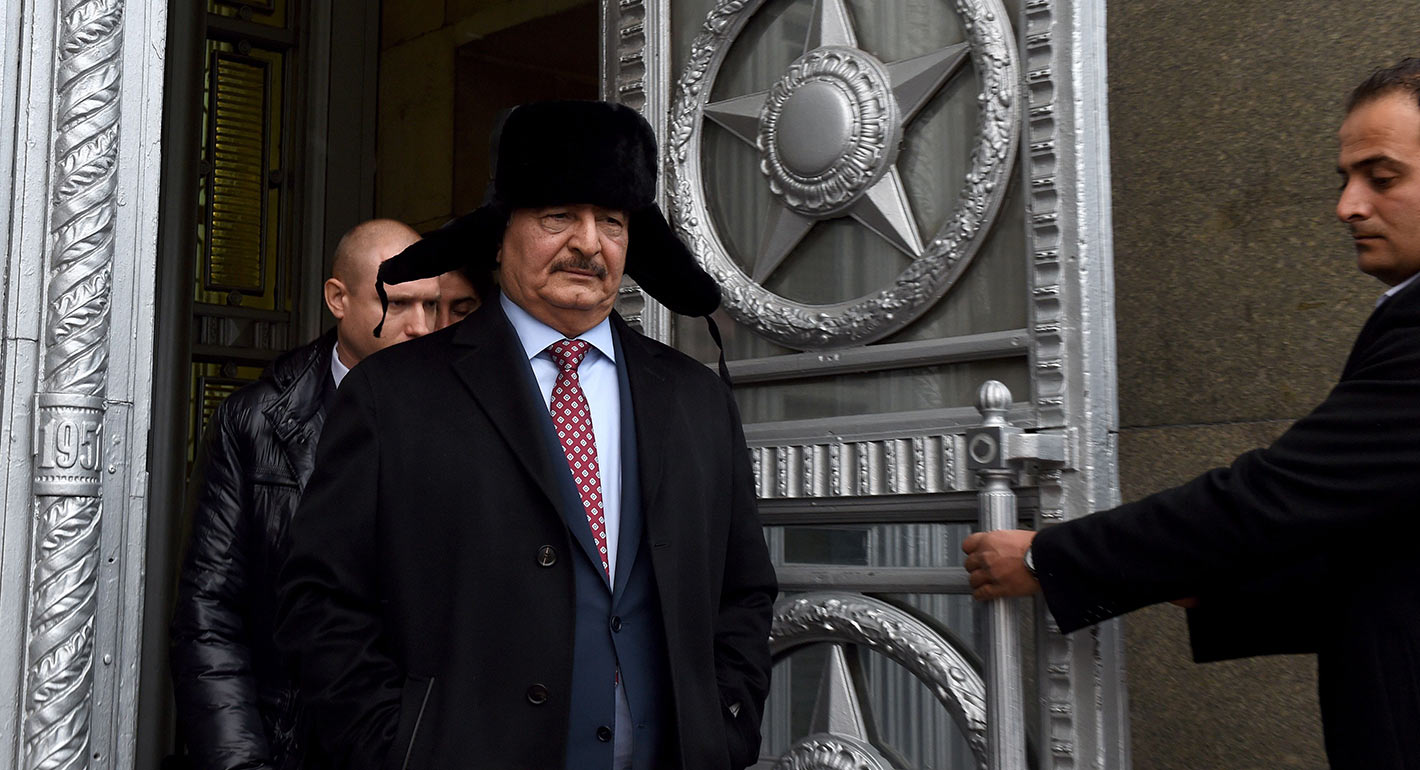
The United States should be working to help negotiate peace in Libya rather than fanning the flames of another failed war.
Source: Foreign Policy
With most of Washington focused on special counsel Robert Mueller’s long-awaited report last week, U.S. President Donald Trump made a little-noticed but potentially consequential foreign-policy move: He placed a phone call to the retired Libyan general—and self-declared field marshal—Khalifa Haftar.
According to the White House, the purpose of the call was to recognize Haftar’s “significant role in fighting terrorism and securing Libya’s oil resources,” and the two leaders “discussed a shared vision for Libya’s transition to a stable, democratic political system.” During the conversation, Trump backed Haftar’s military assault on Libya’s capital city of Tripoli, U.S. officials told Bloomberg. The campaign has escalated in recent days, with multiple airstrikes and ground attacks, leading so far to over 250 deaths and more than 1,000 wounded, including numerous civilians and children.
By lending support to Haftar, Trump once again overruled, and caught off guard, his top national security advisors, who until that point vigorously opposed the general’s latest military offensive. Only two weeks ago, Secretary of State Mike Pompeo said that the United States had urged an “immediate halt” to Haftar’s military operations, which he rightly said were “endangering civilians and undermining prospects for a better future for all Libyans.” Acting Defense Secretary Patrick Shanahan subsequently agreed. “[A] military solution is not what Libya needs,” he said.
The White House announcement was a drastic reversal of U.S. policy in the region—but such reversals are not without precedent. In June 2017, for example, Trump suddenly tweeted his support for a Saudi Arabia-led boycott of Qatar while his secretaries of state and defense were still expressing their support for the enduring U.S.-Qatar strategic relationship. In fact, Trump himself had just met with Qatar’s emir, called him a friend of the United States, and declared his desire to sell Qatar lots of “beautiful military equipment.” Similarly, late last year, Trump announced a total and immediate withdrawal of U.S. troops from Syria only days after his top foreign-policy officials had insisted those troops would remain there indefinitely.
Another part of the pattern: a major Trump policy decision made in the absence of a coordinated National Security Council process, instead influenced by the president’s unscripted conversations with regional leaders. It was hardly a coincidence that Trump expressed his support for Haftar less than two weeks after speaking with Egyptian strongman Abdel Fattah al-Sisi, Saudi Crown Prince Mohammed bin Salman, and Crown Prince of Abu Dhabi Mohammed bin Zayed—all strong military and financial supporters of Haftar’s campaign. After all, Trump’s turnaround on Qatar came within a few weeks of his lavish reception in Riyadh by Saudi King Salman and Mohammad bin Salman, and his policy reversal on Syria came one day after a phone call with Turkish President Recep Tayyip Erdogan.
Trump’s vision for a Libya in which Haftar crushes terrorists, works closely with the United States and its partners, and leads Libya to a “stable, democratic political system” is understandable, given the instability that has plagued the country since the NATO military intervention there in 2011. That intervention toppled the longtime dictator Muammar al-Qaddafi. A security vacuum and persistent fighting among rival militias and tribes have followed.
But the vision of Haftar imposing stable democracy in Libya is also a fantasy. Far from stabilizing the country, Haftar’s escalation is likely to fuel renewed fighting, create more terrorists and refugees, drive up oil prices, and exacerbate the geopolitical tensions already raging in the region.
Contrary to Trump’s statement, it is safe to say that establishing Libyan democracy is not on Haftar’s mind. On the contrary, he is an overt proponent of military dictatorship, arguing that Libya is not ripe for democracy. Indeed, his campaign, launched just days ahead of a United Nations-sponsored conference designed to negotiate a power-sharing pact and organize elections, was timed to avert such an outcome.
Nor does Haftar possess military forces capable of imposing stability. His track record on the battlefield is mixed at best, and his past offensives have been heavily dependent on external military assistance, including in the form of airstrikes from the United Arab Emirates. His Libyan National Army is a grab bag of rival militia groups working together only out of expediency, and Tripoli has seen few signs of the defections that have eased Haftar’s entry elsewhere in the country. His army’s opponents, moreover, including the highly capable Mistratan militias, can count on getting more funding and arms from Turkey and Qatar in response to the Egypt and Gulf-backed intervention. In what could be a preview of the Tripoli campaign, it took Haftar three years to seize full control of Benghazi, another populous, urban city. Even if the Libyan National Army somehow were to seize Tripoli, after what would surely be a bloody battle, the most likely result would be a prolonged insurgency that would cause an increased number of refugees to flee their homes for both neighboring countries and Europe—which would further fan the flames of European populism.
Haftar’s campaign is also a liability for U.S. counterterrorism interests. The fighting in Tripoli has already forced the Pentagon to withdraw U.S. soldiers working with local Libyan militias against the Islamic State. Given Haftar’s uncompromising stance toward Islamists of all stripes—he has said the only place for them is “in prison, under the ground, or out of the country”—his assault will drive Libya’s political Islamists into tactical cooperation with actual terrorists, not unlike what Syrian dictator Bashar al-Assad did to opposition forces in his country. By embracing Haftar, Trump is compounding the damage by alienating the Misratans, who were instrumental to the 2016 U.S. campaign against the Islamic State in Libya and remain vital to ongoing counterterrorism efforts.
Far from stabilizing Libyan oil sales, Haftar’s assault on Tripoli is likely to lead to renewed fighting around production facilities, cutting off exports, choking off desperately needed revenues for Libya, and driving up global prices at a time when Trump’s policies toward Iran and Venezuela are already doing so. With the Libyan National Army bogged down in and around Tripoli, Haftar will struggle to protect the oil installations he now controls, and opposing factions will have increased incentives to wrest this strategic asset from his control. Despite the political instability, continued oil sales were a relative bright spot for Libya until now, reaching a five-year high of 1.28 million barrels per day last year before receding to a still respectable 900,000 bpd earlier this year. Maintaining such export levels, and the badly needed revenues they generate, will be impossible if the military escalation continues.
Backing Haftar will remain tempting so long as Trump believes what his Arab partners are telling him about how the Qaddafi-era strongman can fight terrorists in Libya. Saudi Arabia and the United Arab Emirates were instrumental in providing support to Sisi in Egypt before and after his anti-Islamist 2013 coup, and they are likely telling Trump that experience can be repeated in Libya. But Trump would be better off listening to his own military commanders, who understand that Haftar cannot so easily take control of all of Libya militarily and that the country will not have stability without national reconciliation.
The shortcomings of the internationally recognized Government of National Accord led by Prime Minister Fayez al-Sarraj—including its internal dysfunction and lack of effective and unified fighting forces—are well known. But this government and U.N. Libya envoy Ghassan Salame’s political process remain the best hope for a stable, secure, and free Libya. The short-term objective for anyone who wants to stabilize Libya should continue to be agreement on a power-sharing arrangement that establishes a timeline for new elections and guarantees representation in a new transitional government to a more diverse array of actors. Such an arrangement could even recognize Haftar as commander of the Libyan army while subordinating his authority to a civilian Ministry of Defense or national defense committee. Negotiating such an arrangement—on the principle of “no victor, no vanquished”—has surely become harder due to Haftar’s advance on Tripoli and Trump’s apparent endorsement of the military campaign, but it is not too late for the United States to undo the damage.
With a small population, the potential of significant oil revenues, European financial support, and the absence of major sectarian divisions, Libya has a real chance to achieve a better future, not unlike its neighbor Tunisia. The United States should be working with its partners and all Libyans to help negotiate peace rather than fanning the flames of another failed war.
Former Nonresident Scholar, Middle East Program
Andrew Miller was a nonresident scholar in Carnegie’s Middle East Program.
Recent Work
Andrew Miller
Andrew Miller
Carnegie India does not take institutional positions on public policy issues; the views represented herein are those of the author(s) and do not necessarily reflect the views of Carnegie, its staff, or its trustees.

In any defense establishment, change is an ongoing process. However, despite the best of intentions, existing bureaucracies, bound by habit and years of socialization, have their limits in implementing transformative change.

Anit Mukherjee

After the chill in ties between 2020 and 2024 that brought India–China relations to their lowest point in several decades, the two countries have engaged each other afresh. This paper argues that there are predominantly four imperatives guiding India’s approach to China, and they exist in an order of priority.

Saheb Singh Chadha

This piece argues that India’s central challenge is not managing a single flashpoint but resolving the underlying tension between expansion and institutional coherency of the BRICS grouping.

Vrinda Sahai

A partnership between India, a country of subcontinental size, and Africa, a continent of fifty-four countries, may seem asymmetric until one notes that both are home to nearly the same number of people—1.4 billion. This essay spells out the existing challenges to the partnership, its optimal potential, and the possible pathways to realize it over the next quarter-century.

Rajiv Bhatia

The India–EU Free Trade Agreement (FTA) is shaping up to be one of the most consequential trade negotiations, both economically and strategically. But, what’s in the agreement, what’s missing, and what will determine its success in the years ahead
Vrinda Sahai, Nicolas Köhler-Suzuki