
• Research
  • About
  • Experts
Carnegie India logoCarnegie lettermark logo
{
  "authors": [
    "Frederic Wehrey",
    "Wolfram Lacher"
  ],
  "type": "legacyinthemedia",
  "centerAffiliationAll": "dc",
  "centers": [
    "Carnegie Endowment for International Peace",
    "Malcolm H. Kerr Carnegie Middle East Center"
  ],
  "collections": [],
  "englishNewsletterAll": "menaTransitions",
  "nonEnglishNewsletterAll": "",
  "primaryCenter": "Carnegie Endowment for International Peace",
  "programAffiliation": "MEP",
  "programs": [
    "Middle East"
  ],
  "projects": [],
  "regions": [
    "North America",
    "United States",
    "North Africa",
    "Libya"
  ],
  "topics": [
    "Democracy",
    "Security",
    "Foreign Policy"
  ]
}

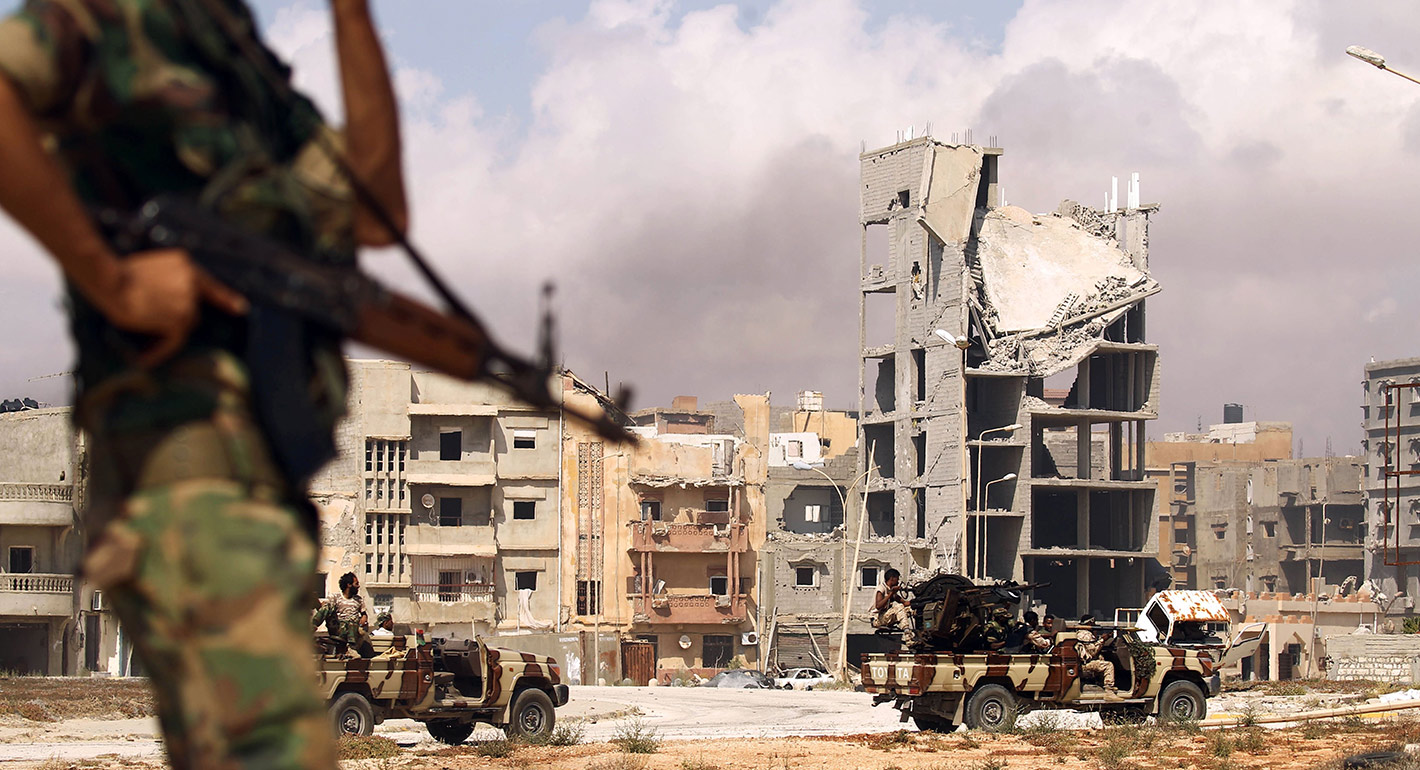
Source: Getty

In The Media

Libya’s New Civil War And What the United States Can Do About It

Washington must get tough on violations of the UN arms embargo and hold Libya’s warring sides accountable for their conduct; it must also pursue a more inclusive governance framework for Libya’s future—one that does not include Haftar.

Link Copied
By Frederic Wehrey and Wolfram Lacher
Published on May 30, 2019

Source: Foreign Affairs

On April 4, Khalifa Haftar, the militia leader who controls eastern Libya, launched a large-scale offensive to capture the capital, Tripoli. The attack marked the collapse of negotiations to form an interim government between Haftar and key leaders in western Libya and triggered Libya’s third civil war since 2011.

Haftar evidently hoped to rapidly gain a foothold in Tripoli, finally establishing himself as the unrivaled ruler of Libya. What happened instead was that armed groups across western Libya mobilized to counter his power grab. For the past month, Haftar’s forces—a coalition of regular military units and militias calling themselves the Libyan National Army—have been stuck on Tripoli’s outskirts, slowly losing terrain to militias nominally allied with Libya’s internationally recognized Government of National Accord (GNA). More than 500 people have been killed in the fighting and more than 80,000 have been displaced.

International actors, paralyzed by disunity, have made halfhearted calls for a cease-fire and a return to the political process. But Haftar’s offensive has fatally damaged that process. Without a credible new framework for negotiations and a more robust international approach to resolving the conflict, a cease-fire will simply give Haftar and his opponents the opportunity to rearm and regroup. Western powers—especially the United States—should use diplomatic and economic tools to prevent regional powers from fueling the conflict and hasten the emergence of a harmful stalemate between the rival factions in Libya. Doing so will compel Libyans to return to a political process under new terms....

Read Full Text

This piece was originally published in Foreign Affairs.

About the Authors

Frederic Wehrey

Senior Fellow, Middle East Program

Frederic Wehrey is a senior fellow in the Middle East Program at the Carnegie Endowment for International Peace, where his research focuses on governance, conflict, and security in Libya, North Africa, and the Persian Gulf.

Wolfram Lacher

Authors

Frederic Wehrey
Senior Fellow, Middle East Program
Frederic Wehrey
Wolfram Lacher
DemocracySecurityForeign PolicyNorth AmericaUnited StatesNorth AfricaLibya

Carnegie India does not take institutional positions on public policy issues; the views represented herein are those of the author(s) and do not necessarily reflect the views of Carnegie, its staff, or its trustees.

More Work from Carnegie India

  • Commentary
    India Signs the Pax Silica—A Counter to Pax Sinica?

    On the last day of the India AI Impact Summit, India signed Pax Silica, a U.S.-led declaration seemingly focused on semiconductors. While India’s accession to the same was not entirely unforeseen, becoming a signatory nation this quickly was not on the cards either.

      Konark Bhandari

  • Commentary
    The Impact of U.S. Sanctions and Tariffs on India’s Russian Oil Imports

    This piece examines India’s response to U.S. sanctions and tariffs, specifically assessing the immediate market consequences, such as alterations in import costs, and the broader strategic implications for India’s energy security and foreign policy orientation.

      Vrinda Sahai

  • Article
    Military Lessons from Operation Sindoor

    The India-Pakistan conflict that played out between May 6 and May 10, 2025, offers several military lessons. This article presents key takeaways from Operation Sindoor and breaks down how India’s preparations shaped the outcome and what more is needed to strengthen future readiness.

      Dinakar Peri

  • Book
    India and the Sovereignty Principle: The Disaggregation Imperative

    This book offers a comprehensive analysis of India's evolving relationship with sovereignty in a complex global order. Moving beyond conventional narratives, it examines how the sovereignty principle shapes India's behavior across four critical domains—from traditional military power to contemporary data governance.

      Rudra Chaudhuri, Nabarun Roy

  • Commentary
    NISAR Soars While India-U.S. Tariff Tensions Simmer

    On July 30, 2025, the United States announced 25 percent tariffs on Indian goods. While diplomatic tensions simmered on the trade front, a cosmic calm prevailed at the Sriharikota launch range. Officials from NASA and ISRO were preparing to launch an engineering marvel into space—the NASA-ISRO Synthetic Aperture Radar (NISAR), marking a significant milestone in the India-U.S. bilateral partnership.

      Tejas Bharadwaj

Get more news and analysis from
Carnegie India
Carnegie India logo, white
Unit C-4, 5, 6, EdenparkShaheed Jeet Singh MargNew Delhi – 110016, IndiaPhone: 011-40078687
  • Research
  • About
  • Experts
  • Projects
  • Events
  • Contact
  • Careers
  • Privacy
  • For Media
Get more news and analysis from
Carnegie India
© 2026 Carnegie Endowment for International Peace. All rights reserved.






