

Commentary
- +1
Paul Haenle, Xue Gong, Ngeow Chow Bing, …
{
  "authors": [
    "Paul Haenle"
  ],
  "type": "commentary",
  "centerAffiliationAll": "dc",
  "centers": [
    "Carnegie Endowment for International Peace",
    "Carnegie China"
  ],
  "collections": [
    "U.S.-China Relations",
    "China’s Foreign Relations",
    "Carnegie China Commentaries"
  ],
  "englishNewsletterAll": "asia",
  "nonEnglishNewsletterAll": "",
  "primaryCenter": "Carnegie China",
  "programAffiliation": "AP",
  "programs": [
    "Asia"
  ],
  "projects": [],
  "regions": [
    "North America",
    "United States",
    "East Asia",
    "China"
  ],
  "topics": [
    "Economy",
    "Foreign Policy"
  ]
}
Source: Getty
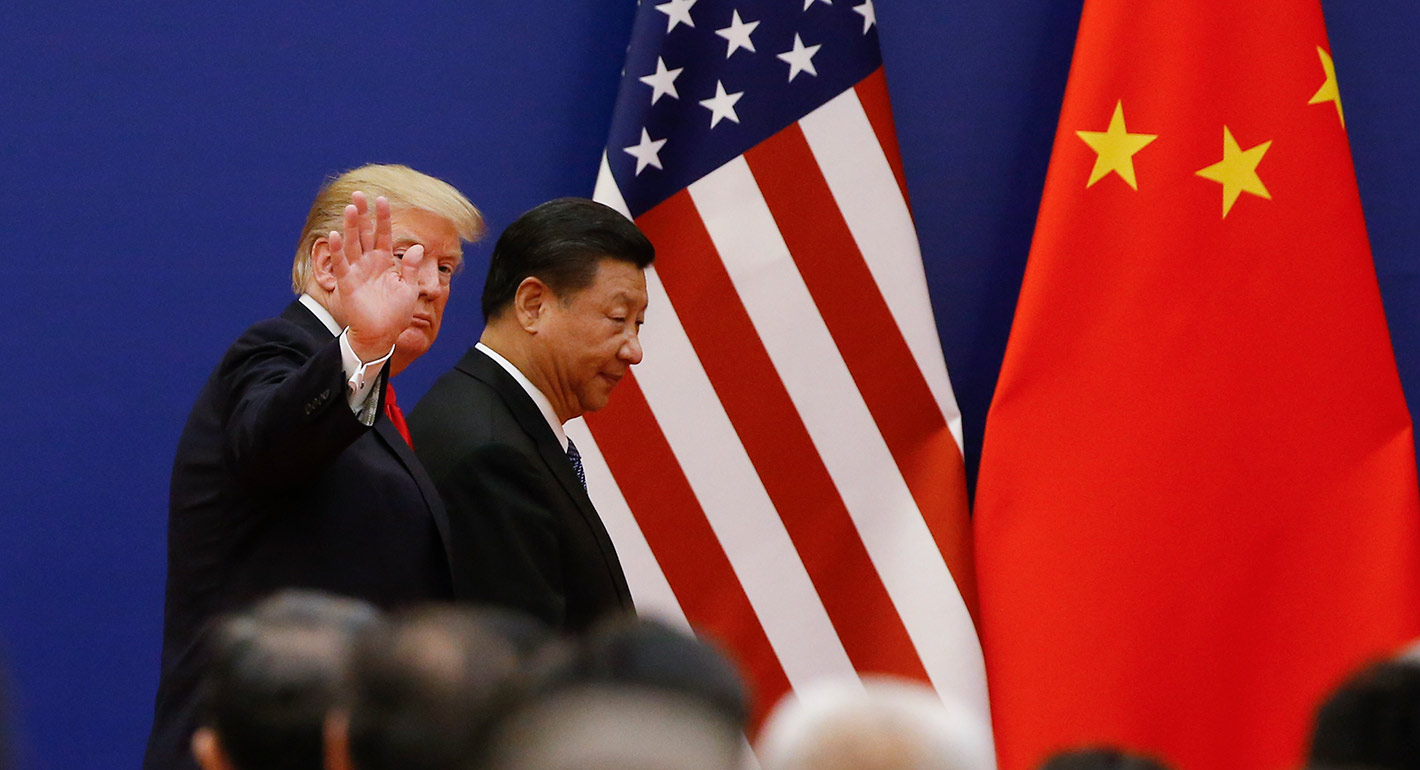
The world’s two largest economies are locked in competition. What drives their different narratives, and how should they avoid a larger confrontation?
Two distinct, yet similarly antagonistic, narratives dominate Washington and Beijing.
U.S. President Donald Trump entered office after campaigning on the promise to stand up to China, especially with regard to Beijing’s “huge” trade deficit. National security documents published early in the Trump administration outlined the more competitive approach it would take toward Beijing. This shift to a harder line has strong bipartisan support in Washington. In recent speeches, Vice President Mike Pence and Secretary of State Mike Pompeo doubled down on the administration’s tougher approach. China is now commonly characterized as a strategic competitor, economic predator, and ideological rival.
In Beijing, early hopes that Trump’s business background and transactional approach might lead to a quick resolution of the trade dispute were proven wrong. Chinese officials view his presidency as a strategic opportunity but have concluded that he is unpredictable and unreliable. However, no matter who the president of the United States is, Chinese officials believe that America is deliberately trying to contain China, constrain its economic growth, limit its global influence, and undermine its political system.
Unfortunately, little is being done in either capital to reconcile these different narratives. Instead, Washington and Beijing continue taking steps that only reinforce the other side’s views. The U.S.-China relationship is increasingly defined by mutual mistrust and suspicion.
Many Chinese analysts argue that China’s rise has led the United States to embrace strategic competition. This brings the danger of what foreign policy experts refer to as the Thucydides Trap, in which a rising power ends up going to war with an established power. The same observers point to the growing political and economic problems in the United States—everything from rising inequality and populism to racial tensions and the opioid epidemic—and argue that rather than facing up to these difficulties, Washington is taking the easy way out by blaming China for all its problems.
There are elements of truth in this thinking. Some in the United States do see a political benefit in playing up the “China threat.” But this is by no means a complete picture of the dynamics driving the downturn in relations. These Chinese narratives absolve China of responsibility for contributing to weaker ties and offer no solutions to put the relationship in a better place.
The signing of a deal is a positive step forward. It builds goodwill and relieves domestic political pressure on Presidents Trump and Xi Jinping. In his most recent speech on China, Pence even suggested a deal could serve as a foundation for addressing other outstanding disagreements in the bilateral relationship.
However, the recently signed deal is not a panacea. Decoupling (in which the United States and China disengage from each other) in the economic and technological realm is no longer theoretical. It is a reality. If the world’s two biggest economies cannot find a way to resolve this, it could over time result in their two systems splitting into entirely separate branches. This would stifle innovation and harm economic growth.
Furthermore, other issues including tensions over Taiwan, Hong Kong, and the South China Sea will become increasingly prickly and harder to manage. Just hours after the announcement of the deal, China’s Foreign Minister Wang Yi said that Washington’s criticism of Beijing’s actions on Hong Kong and Xinjiang had eroded the “hard-won foundation of mutual trust” between the two countries.
A trade deal is a step in the right direction, but far from the cure-all many believe it to be.
As the race for the 2020 U.S. presidential election heats up, House Speaker Nancy Pelosi recently said that a Democratic administration would be more effective at extracting concessions from China because it would coordinate with, rather than alienate, U.S. partners and allies.
Many Democratic presidential candidates have said their China policy would focus on countering China’s actions, while also reinvesting in the American economy.
Trump has been relatively quiet on sensitive issues such as Xinjiang, Taiwan, and Hong Kong, instead prioritizing trade. Before eventually signing it, Trump even floated the idea of vetoing the Hong Kong Human Rights and Democracy Act for the sake of securing a deal. Future administrations may be less willing to take such a transactional approach when it comes to balancing economics with human rights.
Competition between the United States and China is unavoidable, and we should accept this as a new feature of the relationship. Yet it is still unclear how both countries will adapt to this more competitive dynamic.
For the United States, there appear to be two paths.
One is premised on the view that our differences are too large, our systems too incompatible, and our values too irreconcilable. This leaves the United States with no choice but to abandon cooperative efforts and take deliberate steps to contain, counter, and deter China.
The other path resists the temptation to frame what is inherently a competitive relationship as entirely zero-sum. This approach calls for bounding competition as a way of limiting the likelihood of conflict and making sure that both countries can still work together when their interests converge.
Where exactly should these boundaries begin and end, and how should both countries respond when they are violated? That is a far more difficult question to answer.
Yet such uncertainty should not prevent the United States from taking this approach. Creating the space for cooperation will be essential for the United States and China to realize their interests.
This Commentary resulted from discussions during the Carnegie–Tsinghua Center's recent Carnegie Global Dialogue.
The author is grateful for research assistance provided by Bernice Xu, Ethan Paul, and Duan Nongyu.

Former Maurice R. Greenberg Director’s Chair, Carnegie China
Paul Haenle held the Maurice R. Greenberg Director’s Chair at the Carnegie Endowment for International Peace and is a visiting senior research fellow at the East Asian Institute, National University of Singapore. He served as the White House China director on the National Security Council staffs of former presidents George W. Bush and Barack Obama.
Recent Work


Paul Haenle, Xue Gong, Ngeow Chow Bing, …

Paul Haenle, Chong Ja Ian
Carnegie India does not take institutional positions on public policy issues; the views represented herein are those of the author(s) and do not necessarily reflect the views of Carnegie, its staff, or its trustees.

How is AI reshaping space security, creating governance challenges, and where does international diplomacy stand today?


Tejas Bharadwaj, Almudena Azcárate Ortega

After the chill in ties between 2020 and 2024 that brought India–China relations to their lowest point in several decades, the two countries have engaged each other afresh. This paper argues that there are predominantly four imperatives guiding India’s approach to China, and they exist in an order of priority.

Saheb Singh Chadha

This piece argues that India’s central challenge is not managing a single flashpoint but resolving the underlying tension between expansion and institutional coherency of the BRICS grouping.

Vrinda Sahai

A partnership between India, a country of subcontinental size, and Africa, a continent of fifty-four countries, may seem asymmetric until one notes that both are home to nearly the same number of people—1.4 billion. This essay spells out the existing challenges to the partnership, its optimal potential, and the possible pathways to realize it over the next quarter-century.

Rajiv Bhatia

The U.S.–India semiconductor cooperation story is well-stocked with top-level strategic intent. What remains unresolved, however, are some underlying challenges that will determine whether the cooperation actually functions. Three such friction points stand out.

Shruti Mittal