

Article
Paul Stronski
{
  "authors": [
    "Paul Stronski"
  ],
  "type": "commentary",
  "centerAffiliationAll": "dc",
  "centers": [
    "Carnegie Endowment for International Peace"
  ],
  "collections": [],
  "englishNewsletterAll": "ctw",
  "nonEnglishNewsletterAll": "",
  "primaryCenter": "Carnegie Endowment for International Peace",
  "programAffiliation": "russia",
  "programs": [
    "Russia and Eurasia"
  ],
  "projects": [
    "Changing Geopolitics of Eurasia"
  ],
  "regions": [
    "Caucasus",
    "Armenia"
  ],
  "topics": [
    "Political Reform"
  ]
}
Source: Getty
What do the recent spate of suicides and political violence in Armenia mean for the country’s political transition?
The violent death of Georgi Kutoyan on January 17 is a troubling development for Armenia. Found by his wife with a gunshot wound to his head, the thirty-eight-year old former security chief was once a rising star. Starting as an aide to former Armenian president Serzh Sargsyan, he rose to head the Armenian national security service until 2018, when the Armenian Velvet Revolution and subsequent swift collapse of Sargsyan’s government derailed his career. His untimely death has thrown back into public view the wide fissures and deep animosities in Armenian politics.
After learning of Kutoyan’s death, some allies of the former government rushed to claim foul play. They have criticized current Prime Minister Nikol Pashinyan for allegedly not showing respect for the deceased or relaying condolences to his family—criticisms the Prime Minister (who unceremoniously fired Kutoyan in 2018) adamantly denies. In the eyes of the old regime, Pashinyan’s government is vindictive and unlikely to conduct a transparent investigation. This rush to judgment highlights the opposition’s lack of trust in the government—a long-standing problem, no matter who is running the country.
Meanwhile, Armenian law enforcement initially claimed that Kutoyan took his own life. In a twist, however, investigators now wonder whether someone drove Kutoyan to kill himself. To make the case more puzzling, the apartment where Kutyoyan’s body was found was riddled with bullets. Law enforcement has a tough job ahead to determine what happened in a way that instills trust in the process.
Kutoyan was not known to be under investigation by the Pashinyan government. He had been accused of taking documents related to the 2008 violent crackdown against the opposition when he left office, but there were no obvious repercussions for him. His death, however, occurred in a political context where former government officials struggle to reinvent themselves in the new Armenia and often find themselves under pressure by investigators, even if they are not formal targets for indictment.
More troubling is the fact that former police chief Hayk Harutyunyan in September 2019 reportedly also killed himself, again with a self-inflicted gunshot to the head. Harutyunyan headed the police during the violent 2008 crackdown against the opposition, believed to have been ordered by then-president Robert Kocharyan. Harutyunyan was not indicted for his involvement in those events, unlike Kocharyan and several others. But before his death, Harutyunyan complained he was being pressured to provide false testimony against Kocharyan.
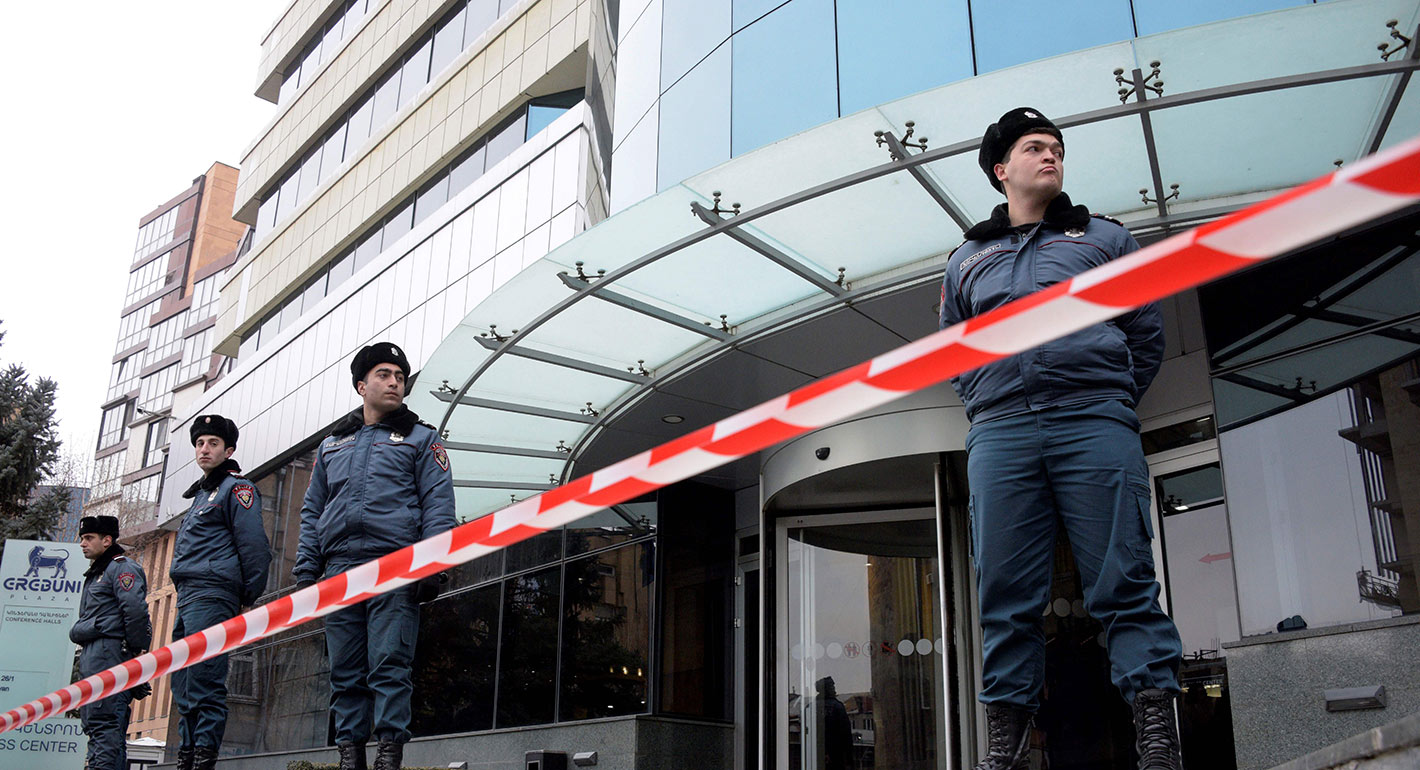
Shots were fired on January 22 at the window of the judge, who was appointed by the previous government and has handed down rulings in several high-profile and politicized cases. On January 23, a gunman fired at the office building that houses Kocharyan’s office and several media outlets that are loyal to him. Beyond timing, it is unclear whether these two shooting incidents are related. Yet both are disturbing.
Over the past year, thugs have roughed up members of the former government, as well as liberal supporters of the new regime. Pressuring and outright beating up one’s political opponents is not new in Armenia; Kocharian allies in September reportedly harassed the judge presiding over his trial. The country has a sad history of political violence. But the continuation of political violence in the Pashinyan era is troubling, as the Prime Minister admits.
Troubling habits of the past linger in other ways too. Law enforcement at times still seems politically motivated. The Pashinyan government has failed to articulate a clear rationale for how it decides whom to target for prosecution from the old system. While prosecutors have gone after Kocharyan with a vengeance, former president Sargsyan remained unscathed for over 18 months until he was indicted for embezzlement in December 2019. Yet, Gagik Tsarukyan, Armenia’s richest oligarch, who leads parliament’s second biggest faction and threw his weight behind Pashinyan during the Velvet Revolution, remains untouched. Prosecutors reportedly charged former defense minister Vigen Sargsyan on vague corruption charges in late September 2019, only to drop the case mysteriously a few weeks later. These inconsistencies raise questions about the Pashinyan’s government’s commitment to conduct transparent non-politicized investigations. So do accusations of government pressure on judges in some of these cases.
Whatever the circumstances of Kutoyan’s death, it could draw necessary attention to the sorry state of mental health services in a country that has experienced war, dislocation, economic turmoil, and political upheaval. Given that history, Armenia needs to do better when it comes to mental health. Armenian officials in November acknowledged that that hazing is a problem in the Armenian military and that it has led to soldier suicides. A parliamentarian even claimed that more soldiers died of suicide or hazing-related deaths than were killed in action. Parliament has rushed to remedy that by passing legislation to prosecute those who drive soldiers to take their own lives. Yet, services to identify and treat mental health conditions remain poor. There is an especially strong stigma in Armenian culture against admitting mental health issues. Seeking treatment often leads to being put into atrocious conditions in unreformed Soviet-style psychiatric centers.
In 2016, a UN Special Rapporteur for Physical and Mental Health called for Armenia to improve its provision of mental health care, including changing attitudes among the general public and medical professions towards mental illness, integrating mental health into primary care, and expanding community-based mental health programs. The Sargsyan government created a few modern mental health centers, but the country has a long way to go to meet the needs of those struggling with depression, anxiety or other mental illnesses.
Kutoyan’s death is not just a tragedy for his family, but for Armenia as a whole. The Pashinyan government has made great efforts in improving governance and instilling faith in the country’s future. But, events of the past week highlight how much work the government has ahead of it to try curb political violence and create an independent judicial and law enforcement system that all citizens can trust. It also needs to improve health care services for unspoken illnesses.

Former Senior Fellow, Russia and Eurasia Program
Paul Stronski was a senior fellow in Carnegie’s Russia and Eurasia Program, where his research focuses on the relationship between Russia and neighboring countries in Central Asia and the South Caucasus.
Recent Work
Paul Stronski
Paul Stronski
Carnegie India does not take institutional positions on public policy issues; the views represented herein are those of the author(s) and do not necessarily reflect the views of Carnegie, its staff, or its trustees.

As India’s economy recovers from the coronavirus pandemic, Indian businesses need efficient financial structures to regain their ground. Key reforms to India’s Insolvency and Bankruptcy Code could fill these gaps.

Anirudh Burman

Access to cross-border data is an integral piece of the law enforcement puzzle. India is well placed to lead the discussions on international data agreements subject to undertaking necessary surveillance reforms.

Smriti Parsheera, Prateek Jha
After the coronavirus pandemic wanes, how will China’s reorientation of the Belt and Road Initiative to address global health concerns influence its relationships with South Asian countries?

Deep Pal, Rahul Bhatia
Early in the outbreak, government researchers forecast several high-risk scenarios that were downplayed or ignored in public messaging.
Gautam I. Menon
Governments around the world are turning to new forms of digital surveillance to monitor the spread of the coronavirus, though they are mostly using existing laws to do so.
Anirudh Burman