

Article
This piece argues that India’s central challenge is not managing a single flashpoint but resolving the underlying tension between expansion and institutional coherency of the BRICS grouping.
Vrinda Sahai
{
  "authors": [
    "Frederic Wehrey",
    "Jalel Harchaoui"
  ],
  "type": "legacyinthemedia",
  "centerAffiliationAll": "dc",
  "centers": [
    "Carnegie Endowment for International Peace"
  ],
  "collections": [],
  "englishNewsletterAll": "menaTransitions",
  "nonEnglishNewsletterAll": "",
  "primaryCenter": "Carnegie Endowment for International Peace",
  "programAffiliation": "MEP",
  "programs": [
    "Middle East"
  ],
  "projects": [],
  "regions": [
    "North Africa",
    "Libya"
  ],
  "topics": [
    "Security",
    "Foreign Policy"
  ]
}
Source: Getty
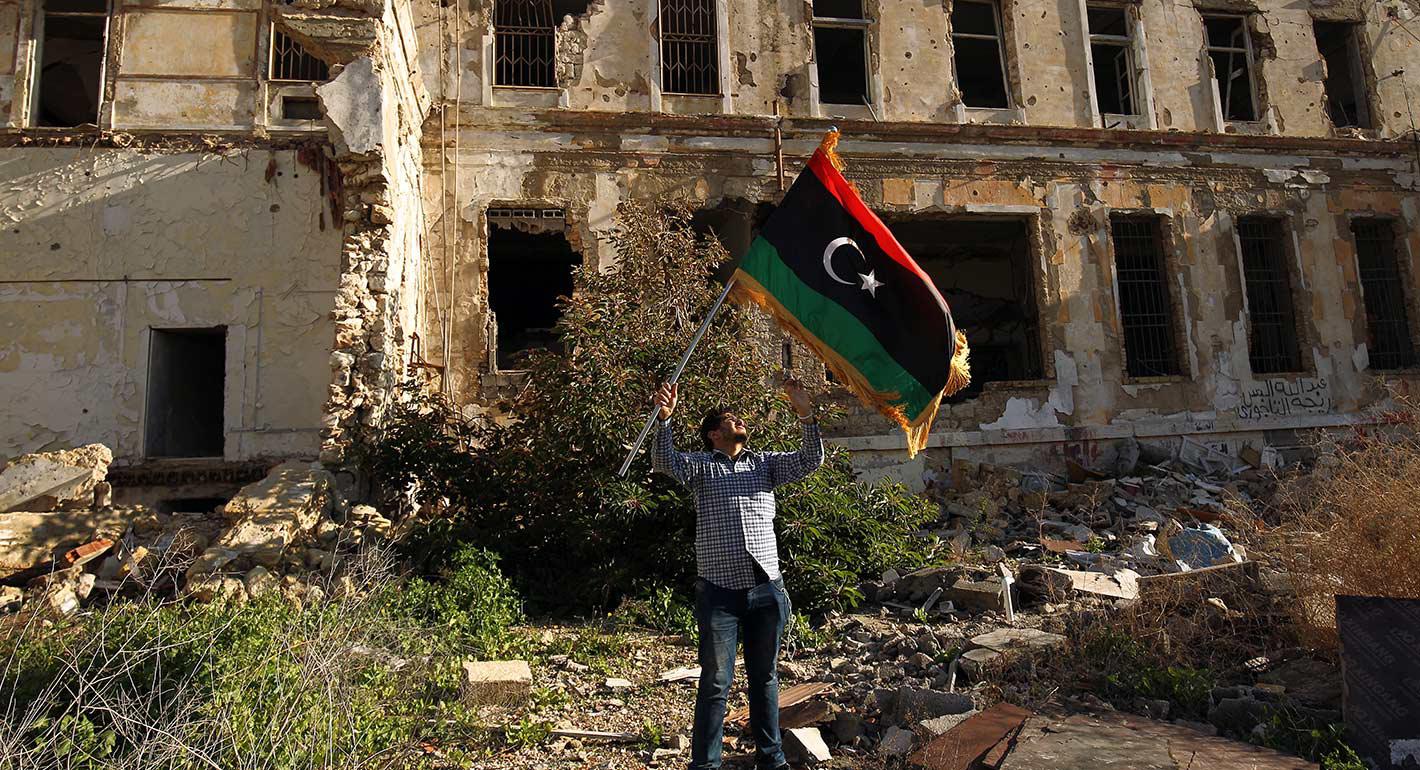
More robust U.S. diplomacy is urgently needed in Libya, not just to halt Haftar’s destructive campaign but to salvage U.S. credibility in a region marked by multipolarity and increasing defiance of the West.
Source: Foreign Affairs
In April 2019, Khalifa Haftar, the militia commander whose forces control much of eastern Libya, began an assault on the capital, Tripoli, in an effort to topple the country’s internationally recognized Government of National Accord (GNA). But instead of a swift, decisive victory establishing Haftar as Libya’s undisputed leader, the offensive resulted in a stalemate. Militias from across western Libya came together to repel Haftar, slowly pushing his forces back into the southern outskirts of the capital. For the next six months, the fighting ground on like this, with drone strikes, artillery barrages, and mortar fire creating a humanitarian crisis but no clear advantage for either side.
Then, in September, hundreds of Russian mercenaries arrived to support Haftar and shifted the battlefield momentum in his direction. Since 2015, Moscow has been gradually ramping up its engagement in Libya, where it sees economic opportunities and a chance to expand its influence at the expense of Western powers. It now supplies Haftar’s forces with antitank missiles and laser-guided artillery and supports them with paramilitary fighters from the Wagner Group, a shadowy military contractor that does the Kremlin’s bidding in a growing list of countries in Africa and the Middle East. Buoyed by the Russians’ tactical expertise, Haftar’s forces are now making slow territorial gains in the capital—and pushing the war into a new and more dangerous phase.

Senior Fellow, Middle East Program
Frederic Wehrey is a senior fellow in the Middle East Program at the Carnegie Endowment for International Peace, where his research focuses on governance, conflict, and security in Libya, North Africa, and the Persian Gulf.

Jalel Harchaoui
Associate Fellow at the Royal United Services Institute (RUSI).
Jalel Harchaoui is a political scientist specialising in North Africa, with a specific focus on Libya. He worked on the same topics previously at The Global Initiative Against Transnational Organised Crime, a Geneva-based NGO, as well as at the Clingendael Institute, based in The Hague. His research has concentrated on Libya’s security landscape and political economy.
Carnegie India does not take institutional positions on public policy issues; the views represented herein are those of the author(s) and do not necessarily reflect the views of Carnegie, its staff, or its trustees.

This piece argues that India’s central challenge is not managing a single flashpoint but resolving the underlying tension between expansion and institutional coherency of the BRICS grouping.

Vrinda Sahai

A partnership between India, a country of subcontinental size, and Africa, a continent of fifty-four countries, may seem asymmetric until one notes that both are home to nearly the same number of people—1.4 billion. This essay spells out the existing challenges to the partnership, its optimal potential, and the possible pathways to realize it over the next quarter-century.

Rajiv Bhatia

The India–EU Free Trade Agreement (FTA) is shaping up to be one of the most consequential trade negotiations, both economically and strategically. But, what’s in the agreement, what’s missing, and what will determine its success in the years ahead
Vrinda Sahai, Nicolas Köhler-Suzuki

This piece argues that the present Indian strategy, based on opportunistic diversification and utilization of limited strategic reserves, remains inadequate when confronting supply disruptions. It evaluates India’s options in the short, medium, and long terms.
Vrinda Sahai

Trump 2.0 has unsettled India’s external environment—but has not overturned its foreign policy strategy, which continues to rely on diversification, hedging, and calibrated partnerships across a fractured order.



Milan Vaishnav, ed., Sameer Lalwani, Tanvi Madan, …