

Commentary
H. A. Hellyer
{
  "authors": [
    "H. A. Hellyer"
  ],
  "type": "legacyinthemedia",
  "centerAffiliationAll": "dc",
  "centers": [
    "Carnegie Endowment for International Peace"
  ],
  "collections": [],
  "englishNewsletterAll": "menaTransitions",
  "nonEnglishNewsletterAll": "",
  "primaryCenter": "Carnegie Endowment for International Peace",
  "programAffiliation": "MEP",
  "programs": [
    "Middle East"
  ],
  "projects": [],
  "regions": [
    "Southeast Asia",
    "Eastern Europe",
    "Western Europe"
  ],
  "topics": [
    "Security",
    "Foreign Policy"
  ]
}
Source: Getty
The ideas of European Identitarians, an extremist far-right movement, affect and impact the politics of so much of the western world, and beyond.
Source: National
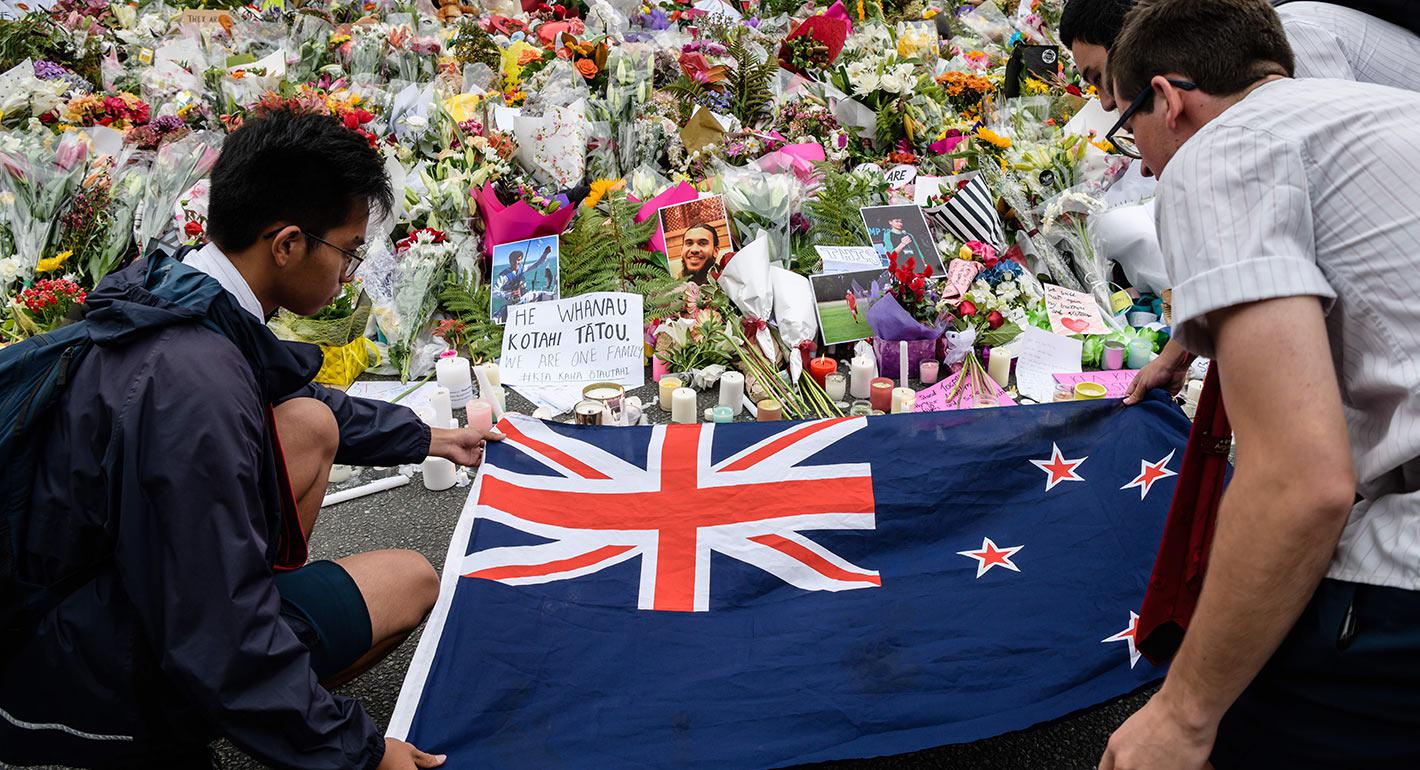
Brenton Tarrant, the terrorist of the New Zealand Christchurch massacre who killed 51 people in different mosques last year, was sentenced to life in prison without parole today. The verdict will no doubt provide some solace and closure to the survivors of the attacks, as well as to families of the victims. However, the phenomenon that produced him continues, and the question remains: how long will it continue before we address not simply the end result of this kind of bigotry, but the causes of it?
It is not as though this was the first time such a massacre took place. Almost a decade ago, a Norwegian Islamophobic white supremacist carried out one of the brutal terrorist attacks on European soil in recent history. Anders Behring Breivik detonated a bomb in Oslo, murdering 8 people; he then went to a youth camp, and killed another 69. His motivations were all clearly laid out in the manifesto he deliberately left for people to find. He was a bigot who hated Muslims, lauded white supremacy, and viewed himself as a soldier in a new crusade to save western civilisation.
Former Nonresident Scholar, Middle East Program
Dr. H.A. Hellyer was a nonresident scholar at the Carnegie Endowment for International Peace. He serves as a senior associate fellow at the Royal United Services Institute for Defence and Security Studies in London, and as a Cambridge University fellow.
Recent Work
H. A. Hellyer
H. A. Hellyer
Carnegie India does not take institutional positions on public policy issues; the views represented herein are those of the author(s) and do not necessarily reflect the views of Carnegie, its staff, or its trustees.

After the chill in ties between 2020 and 2024 that brought India–China relations to their lowest point in several decades, the two countries have engaged each other afresh. This paper argues that there are predominantly four imperatives guiding India’s approach to China, and they exist in an order of priority.

Saheb Singh Chadha

This piece argues that India’s central challenge is not managing a single flashpoint but resolving the underlying tension between expansion and institutional coherency of the BRICS grouping.

Vrinda Sahai

A partnership between India, a country of subcontinental size, and Africa, a continent of fifty-four countries, may seem asymmetric until one notes that both are home to nearly the same number of people—1.4 billion. This essay spells out the existing challenges to the partnership, its optimal potential, and the possible pathways to realize it over the next quarter-century.

Rajiv Bhatia

The India–EU Free Trade Agreement (FTA) is shaping up to be one of the most consequential trade negotiations, both economically and strategically. But, what’s in the agreement, what’s missing, and what will determine its success in the years ahead
Vrinda Sahai, Nicolas Köhler-Suzuki

This piece argues that the present Indian strategy, based on opportunistic diversification and utilization of limited strategic reserves, remains inadequate when confronting supply disruptions. It evaluates India’s options in the short, medium, and long terms.
Vrinda Sahai