

Commentary
H. A. Hellyer
{
  "authors": [
    "H. A. Hellyer"
  ],
  "type": "legacyinthemedia",
  "centerAffiliationAll": "dc",
  "centers": [
    "Carnegie Endowment for International Peace"
  ],
  "collections": [],
  "englishNewsletterAll": "menaTransitions",
  "nonEnglishNewsletterAll": "",
  "primaryCenter": "Carnegie Endowment for International Peace",
  "programAffiliation": "MEP",
  "programs": [
    "Middle East"
  ],
  "projects": [],
  "regions": [
    "Middle East",
    "Israel",
    "Palestine"
  ],
  "topics": [
    "Political Reform",
    "Foreign Policy"
  ]
}
Source: Getty
The push for the normalization of Israel’s position in the Arab world is far stronger than that of de-normalizing the Israeli occupation of Arab territories, which are illegal under international law.
Source: Mada
As an academic and analyst in the D.C. Beltway on issues pertaining to the Arab world, I’ve been closely following discussions about the accelerating Arab normalization with Israel. Absent from those deliberations is the consideration of what has held back such normalization for decades: the Israeli military occupation of Gaza, East Jerusalem and the West Bank.
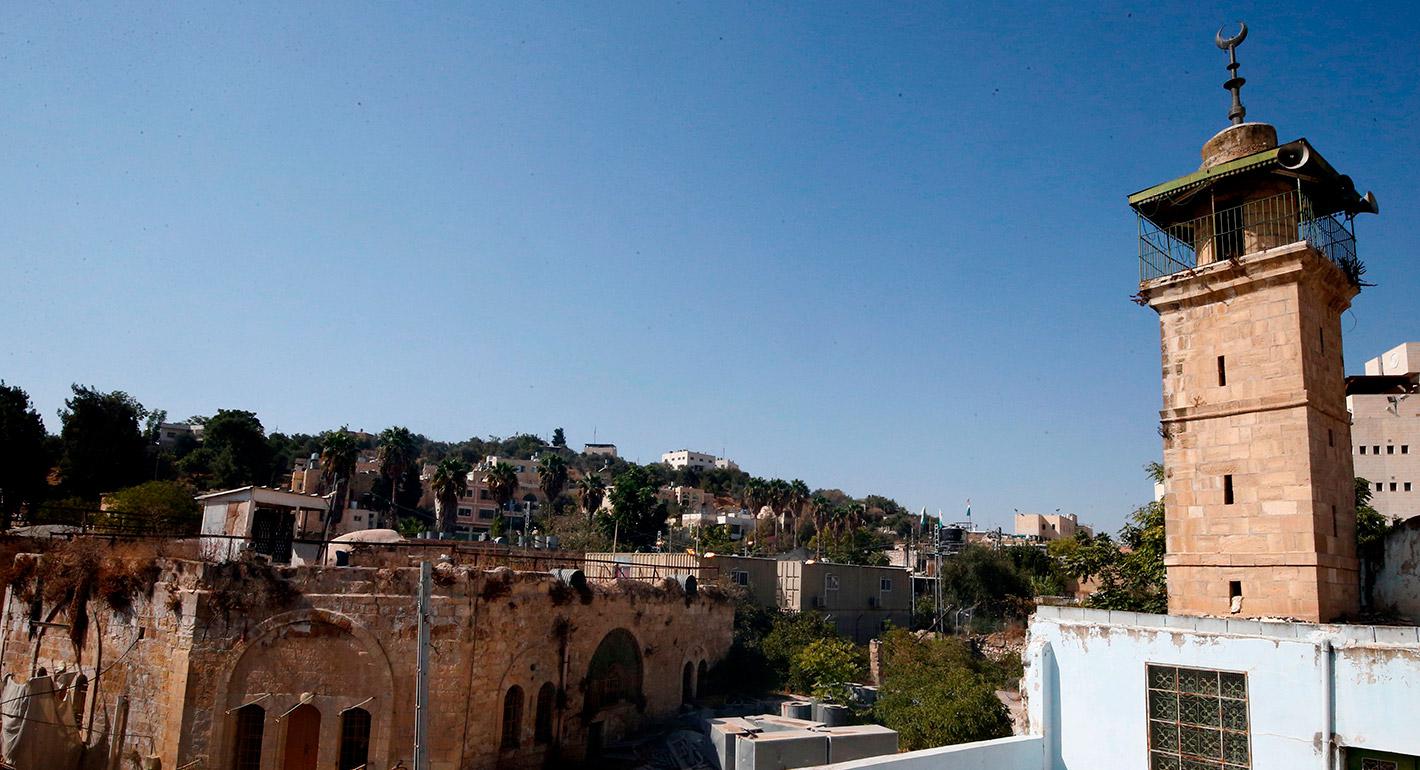
Earlier this year, I visited Hebron in the occupied West Bank – a city which exemplifies a particular sharpness of the occupation more than anywhere else. It is in Hebron that the military occupation actually divides a civilian population, at the very core of the ancient city.
There’s an awesomeness to Hebron that cannot be compared to any other holy site — but there’s a devastating desolation to behold as well.
After Israel moved toward normalization with the UAE and then Bahrain, Washington was awash with widely believed rumors among analysts and politicians that others would follow. Sudan, a country suffering tremendously under deeply debilitating American sanctions, decades of a dictatorship that its people managed to force out last year, and a humanitarian disaster owing to mass floods, was the latest country to signal a process of normalization, although that is still subject to a future Sudanese parliament. To put it bluntly, normalization with Israel is being used as leverage to get Sudan off the sanctions lists, at a time when Sudan desperately needs it to save its population from crisis.
But it is also clear that the push for the normalization of Israel’s position in the Arab world is far stronger than that of de-normalizing the Israeli occupation of Arab territories, which are illegal under international law.
Two causes were prominent in my family upbringing: the South African anti-apartheid struggle, and the Palestinian cause. Both were deeply significant for me, through my adolescence and into adulthood. I tried hard not to have any expectations when I went to Hebron. I’ve read about Hebron for more than two decades, and the very name has a certain resonance for me. But still, I tried hard not to think too much about it. Instead, I thought about how to get to Hebron — which is a mission in and of itself.
I went straight from the Old City of Jerusalem, where I had also visited, and arranged a taxi with a Palestinian Jerusalemite, who had one of those rare passes — for a Palestinian — that allowed him to drive anywhere in the Holy Land. He wasn’t an Israeli citizen — he was from east Jerusalem — but with that particular pass, he was able to go to Haifa, to Jerusalem, to Bethlehem, and to Hebron. As I drove with him from the Old City, I remembered that very clearly — he wasn’t free in his own land. His ability to travel was dependent on this pass, granted by the occupying power, and could be withdrawn at any time by that same occupying power, the Israeli state.
If the patchwork of different roads and Jewish-Israeli only settlements that we passed on our way to Hebron were a reminder of that occupation, there was something far starker ahead of us. Hebron is one of the most symbolic cities in the Palestinian occupied territories. With around 215,000 inhabitants, the old town of Hebron is a UNESCO World Heritage site because of one particular place — a place that is now so completely wrought with subtle beauty, and piercing pain.
Hebron is the English name for the city, derived from the Hebrew Khevron. Its inhabitants call it al-Khalil, which means “the friend,” as does the Hebrew name. There’s a reason for that — the old town of Hebron is where the Patriarch, Abraham, is said to be buried. Abraham is cherished by Jews, Christians and Muslims — indeed, in the West, we describe their religions as the Abrahamic faiths, noting their common claim of Abraham as spiritual progenitor. For Muslims, Abraham is known as the prophet who built the Kaaba in Mecca, and established the Hajj rituals that all Muslims are called upon to perform once in their lifetimes.
Abraham’s privileged position is so highly regarded, he is called Friend of God, as per the Quranic verse:
“Who can be better in religion than one who submits his whole self to God, does good, and follows the way of Abraham, the true in faith? For God did take Abraham for a friend.”
And thus, the name al-Khalil is the name of the city itself, although that notion of friendship is now deeply troubled. Because on the one hand, it is definitely there in the old town of Hebron, and where Abraham is reported to rest, and on the other, its precise opposite — enmity — is tremendously evident.
I think the first time I heard the name Hebron was in reference to murder. In 1994, an American-Israeli religious extremist entered the enclosure of the Tomb of the Patriarchs and proceeded to massacre and injure 29 Palestinian Muslims at prayer. It was one of the most extreme singular examples of the Israeli occupation and the settler movement — and three decades later, it’s still very much remembered in Palestine, and around the world.
That was probably part of the emotion that I felt as I proceeded closer to the old town — remembering that awful event. I’ve never been able to disassociate Hebron from that massacre. And at the same time, Hebron is al-Khalil — the friend. It is where the Sanctuary of Abraham, al-Haram al-Ibrahimi, exists. That sanctuary is where, even before the Arab-Muslim conquest in the mid-7th century, residents believed that the biblical figures of Abraham, Isaac, Jacob, Sarah, Rebecca and Leah were all buried. And such is it to this day — the Mamluks in the 14th century built a cenotaph for each of those figures in the enclosure; the Ottomans ensured that the tombs were covered in splendor; scores of believers have visited the sanctuary throughout history. The Prophet Abraham, perhaps like no other, resonates so tremendously across religious boundaries. I’ve long heard the term “Abrahamic faiths” in my work — but in Hebron, it’s given a new meaning.
Alas, that meaning — in practice — isn’t a gentle or kind one. The sanctuary is in the heart of the old city of Hebron, and it is in the area around the sanctuary where the most brutal and visible evidence of the Israeli occupation is brought to bear. As you get closer and closer to the sanctuary complex, the otherwise bustling city of Hebron becomes quieter, and quieter. Shops that would have been busy in earlier years because of their proximity to the sanctuary appear to be scarcely surviving. And then you reach the entry point to the complex, and you’re subjected to the security checkpoint of the Israelis.

Former Nonresident Scholar, Middle East Program
Dr. H.A. Hellyer was a nonresident scholar at the Carnegie Endowment for International Peace. He serves as a senior associate fellow at the Royal United Services Institute for Defence and Security Studies in London, and as a Cambridge University fellow.
Recent Work
H. A. Hellyer
H. A. Hellyer
Carnegie India does not take institutional positions on public policy issues; the views represented herein are those of the author(s) and do not necessarily reflect the views of Carnegie, its staff, or its trustees.

After the chill in ties between 2020 and 2024 that brought India–China relations to their lowest point in several decades, the two countries have engaged each other afresh. This paper argues that there are predominantly four imperatives guiding India’s approach to China, and they exist in an order of priority.

Saheb Singh Chadha

This piece argues that India’s central challenge is not managing a single flashpoint but resolving the underlying tension between expansion and institutional coherency of the BRICS grouping.

Vrinda Sahai

A partnership between India, a country of subcontinental size, and Africa, a continent of fifty-four countries, may seem asymmetric until one notes that both are home to nearly the same number of people—1.4 billion. This essay spells out the existing challenges to the partnership, its optimal potential, and the possible pathways to realize it over the next quarter-century.

Rajiv Bhatia

The India–EU Free Trade Agreement (FTA) is shaping up to be one of the most consequential trade negotiations, both economically and strategically. But, what’s in the agreement, what’s missing, and what will determine its success in the years ahead
Vrinda Sahai, Nicolas Köhler-Suzuki

Trump 2.0 has unsettled India’s external environment—but has not overturned its foreign policy strategy, which continues to rely on diversification, hedging, and calibrated partnerships across a fractured order.



Milan Vaishnav, ed., Sameer Lalwani, Tanvi Madan, …