

Commentary
Harith Hasan, Alfadhel Ahmad
{
  "authors": [
    "Harith Hasan"
  ],
  "type": "commentary",
  "centerAffiliationAll": "dc",
  "centers": [
    "Carnegie Endowment for International Peace",
    "Malcolm H. Kerr Carnegie Middle East Center"
  ],
  "collections": [],
  "englishNewsletterAll": "menaTransitions",
  "nonEnglishNewsletterAll": "",
  "primaryCenter": "Malcolm H. Kerr Carnegie Middle East Center",
  "programAffiliation": "MEP",
  "programs": [
    "Middle East"
  ],
  "projects": [],
  "regions": [
    "Iraq",
    "North America",
    "United States",
    "Middle East"
  ],
  "topics": [
    "Foreign Policy"
  ]
}
Source: Getty
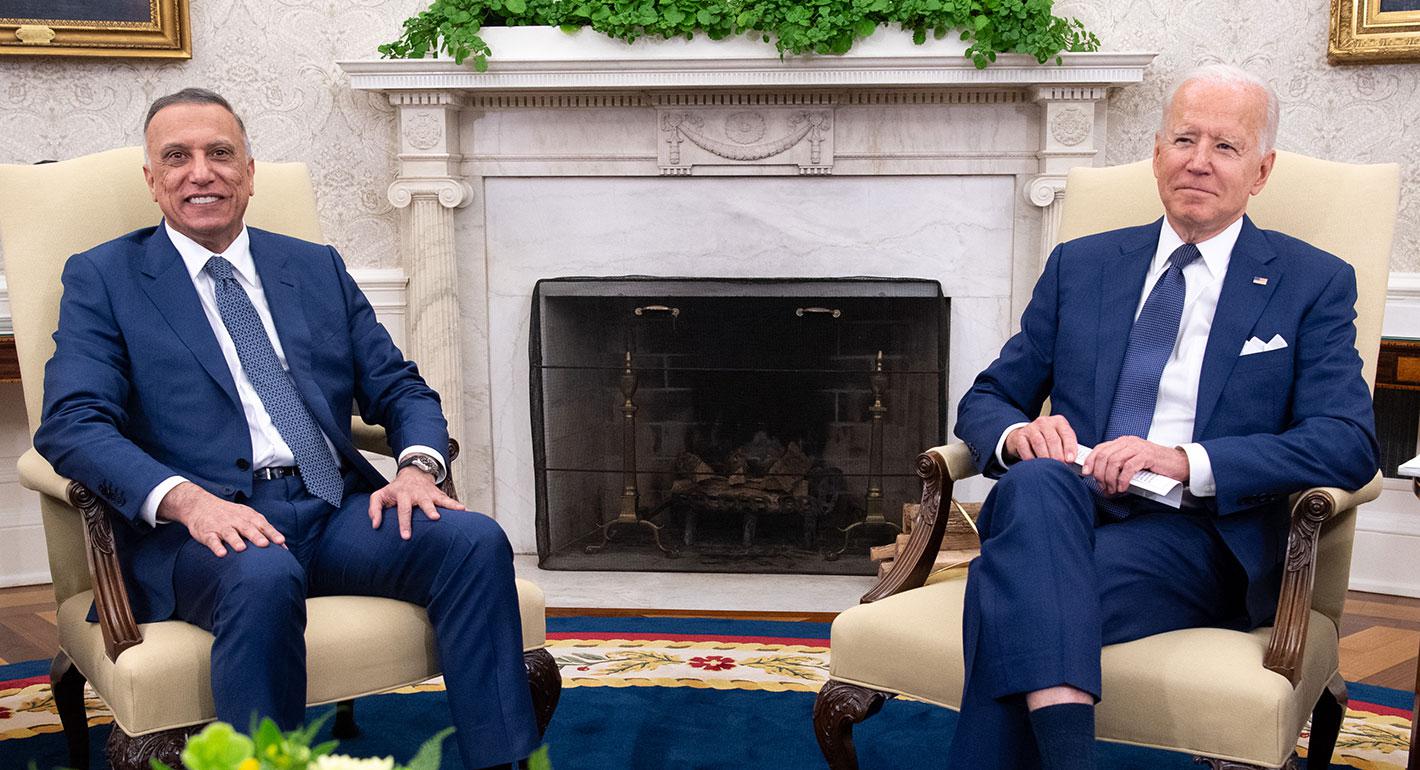
When Iraq’s prime minister met U.S. President Joe Biden, he had a complex balancing act to perform.
Editor’s Note: Since this piece’s publication, U.S. President Joe Biden has committed to end the U.S. combat mission in Iraq by the end of 2021.
The visit of Iraqi Prime Minister Mustafa al-Kadhimi to Washington, DC, comes at a difficult time for the premier and his country.
At the top of Kadhimi’s agenda is the U.S. military presence in Iraq. The prime minister is facing increasing pressure, from both Shia factions in Iraq and militias allied with Iran, to implement the Iraqi parliament’s earlier nonbinding decision to end the foreign military presence in the country.
This decision came after the high-profile assassinations by a January 2020 U.S. strike of Qassem Soleimani, the former head of Iran’s Islamic Revolutionary Guard Corps’ elite Quds Force, and Abu Mahdi al-Muhandis, then deputy head of an Iraqi paramilitary organization known as the Popular Mobilization Forces. Since then, Iran and its allies in Iraq have prioritized ending the U.S. military presence in the country—despite the objections and a lack of support for this goal from Kurdish and Sunni groups, as well as a handful of Shia moderates. The United States says that it is willing to end its troops’ presence if the Iraqi government officially requests it.
Recently, the pressure increased on Kadhimi to clearly demand the withdrawal of U.S. troops or set a timeline for it. Iran-allied militias escalated their attacks on military bases hosting U.S. troops, using new technologies such as unmanned aerial vehicles and targeting areas in the governorates of Baghdad, Anbar, and Erbil (the capital of the autonomous region of Kurdistan). The Iraqi Resistance Coordination Committee, a clandestine group that is supposed to represent these militias, threatened recently to continue their attacks until the last U.S. soldier leaves Iraq. They accused Kadhimi’s government of lacking the desire or the will to demand a full and real withdrawal of U.S. troops.
Any further escalation could provoke another U.S. retaliation, which would threaten the fragile stability in Iraq—as happened at the end of June when the United States bombed militia sites located near the Iraqi-Syrian border. Such an escalation would diminish Kadhimi’s government’s power to influence events, especially as it prepares to hold parliamentary elections in October 2021.
At the same time, Kadhimi is facing huge socioeconomic challenges, as Iraq experiences high rates of coronavirus infections and casualties, rising poverty and unemployment, poor provision of basic services such as electricity and healthcare, and scaled-up attacks by the self-proclaimed Islamic State (ISIS) and militias against Iraqi civilians.
Kadhimi came to Washington with hopes of reaching a formula that would satisfy Iran-allied groups without losing the U.S. support that remains necessary to secure international economic support and to give him leverage vis-à-vis other internal opponents.
Likely, the outcome will be an announcement of the redeployment of U.S. combat troops away from Iraq (perhaps with a timeline) and an emphasis on shifting the mission of the U.S.-led anti-ISIS coalition toward providing technical advice and training for Iraqi troops.
Although the militias announced that they would object to any type of U.S. military presence (even in an advisory capacity), Kadhimi can claim that he implemented the parliamentary decision to end the foreign military presence if he manages to obtain a clear timeline and commitment from the U.S. to complete the withdrawal of combat forces. This would let him transfer pressure off himself and onto Shia political groups, including those connected to the militias. His plan will be either to convince these militias to stop their attacks on military bases that host U.S. troops or to create a Shia political consensus against those attacks.
This is Kadhimi’s second visit to Washington as prime minister. He came last July and met a very different interlocuter: former U.S. president Donald Trump. At the time, Trump’s team was focused on encouraging Kadhimi to take stronger action against militias and to reduce Iranian influence in the country. Trump himself was interested in knowing how the Iraqi government could prove it was still useful to the United States and whether it could provide the economic gains that justified the continuation of U.S. involvement in the country. Indeed, the Kadhimi government supported several projects, especially in the energy sector, that favored U.S. companies. It also sought to accelerate efforts to increase Iraqi gas production, which would help Iraq reduce its reliance on importing Iranian gas for its power stations—a key U.S. demand.
Now Kadhimi has met with U.S. President Joe Biden, whose administration is likely to be more realistic in its expectations about his ability to face the country’s Iranian influence and rein in the militias. Several of the Biden administration’s senior officials worked in or on Iraq over the past few years and understand its complexities. The Biden administration remains interested in keeping some leverage in Iraq and preventing it from collapsing again or fully succumbing to Iranian influence. However, these efforts will be conditioned by other factors—such as the United States’ expressed desire to reduce involvement in the Middle East, the limited mandate Kadhimi has as a transitional premier with no political party backing him, and the gravity of the challenges Iraq is facing.

Associate researcher at the Arab Center for Research and Policy Studies.
Harith Hasan is an associate researcher at the Arab Center for Research and Policy Studies.
Recent Work
Harith Hasan, Alfadhel Ahmad
Harith Hasan
Carnegie India does not take institutional positions on public policy issues; the views represented herein are those of the author(s) and do not necessarily reflect the views of Carnegie, its staff, or its trustees.

How is AI reshaping space security, creating governance challenges, and where does international diplomacy stand today?


Tejas Bharadwaj, Almudena Azcárate Ortega

After the chill in ties between 2020 and 2024 that brought India–China relations to their lowest point in several decades, the two countries have engaged each other afresh. This paper argues that there are predominantly four imperatives guiding India’s approach to China, and they exist in an order of priority.

Saheb Singh Chadha

This piece argues that India’s central challenge is not managing a single flashpoint but resolving the underlying tension between expansion and institutional coherency of the BRICS grouping.

Vrinda Sahai

A partnership between India, a country of subcontinental size, and Africa, a continent of fifty-four countries, may seem asymmetric until one notes that both are home to nearly the same number of people—1.4 billion. This essay spells out the existing challenges to the partnership, its optimal potential, and the possible pathways to realize it over the next quarter-century.

Rajiv Bhatia

The U.S.–India semiconductor cooperation story is well-stocked with top-level strategic intent. What remains unresolved, however, are some underlying challenges that will determine whether the cooperation actually functions. Three such friction points stand out.

Shruti Mittal