

Commentary
Alexander Baunov
{
  "authors": [
    "Alexander Baunov"
  ],
  "type": "commentary",
  "centerAffiliationAll": "",
  "centers": [
    "Carnegie Endowment for International Peace",
    "Carnegie Russia Eurasia Center"
  ],
  "collections": [],
  "englishNewsletterAll": "",
  "nonEnglishNewsletterAll": "",
  "primaryCenter": "Carnegie Endowment for International Peace",
  "programAffiliation": "",
  "programs": [],
  "projects": [],
  "regions": [
    "North America",
    "United States",
    "Russia",
    "Western Europe",
    "Germany"
  ],
  "topics": [
    "Economy"
  ]
}
Source: Getty
The agreement between Germany and the United States, which at first glance appears to be to Russia’s advantage, is in fact beneficial to all parties—even Ukraine.
The U.S.-German agreement to allow completion of Russia’s controversial Nord Stream 2 gas pipeline, which will run from Russia to Germany via the Baltic Sea—bypassing Ukraine—has been largely described as a victory for Russia, a defeat for the West, and the trampling of Ukrainian sovereignty. Yet for Germany, the completion of Nord Stream 2 had become a matter of its own sovereignty. While there are, of course, those in Germany opposed to the project, most of the country’s political class, business community and general public are in favor of it.
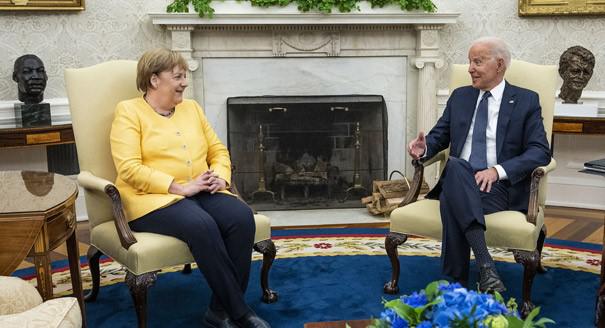
So while the agreement between U.S. President Joe Biden and German Chancellor Angela Merkel may—to Kyiv and Warsaw—look like a victory for the Kremlin, it is in fact a victory for Germany: without Berlin voicing its support for finishing the project, the Kremlin would have been helpless.
Getting the go-ahead for the pipeline’s completion is, of course, good news for Russian President Vladimir Putin, and will increase Europe’s dependence on Moscow, but it will also make Germany and other Western European countries economically stronger, which will in turn boost their ability to promote democratic values. And an irate Germany whose wishes had been overruled would have been just as detrimental to Western unity as the umbrage taken by Warsaw and Kyiv over the deal.
Even more damaging to the West is the spectacle of U.S. impotence. On the eve of the agreement’s signing, U.S. Secretary of State Antony Blinken said the pipeline’s completion was a fait accompli. Nothing would have harmed America’s image as a leader more than fighting against something that could not realistically be stopped.
Washington only reached the agreement with Germany after first deploying a broad range of sanctions: financial, political, and technological. But it became apparent that Russia could finance the pipeline’s completion itself if need be. In the end, however, it didn’t come to that: European companies had invested most of the money before U.S. sanctions were introduced in December 2019. Meanwhile, two modernized Russian vessels proved capable of finishing construction (albeit at a slower pace) following the departure of the Swiss-owned crane ship Pioneering Spirit after the sanctions were imposed.
Both Germany and the United States acted to minimize the damage to their relations with Ukraine and Poland from the agreement. An article in Politico full of leaks about how the White House had asked Ukrainian President Volodymyr Zelensky to refrain from criticizing the deal ahead of its finalization has the ring of truth to it.
In fact, the agreement, which at first glance appears to be to Russia’s advantage, is—in its own way—beneficial to all parties. Given Germany’s determination to get the pipeline completed, and Russia’s ability to do so, the agreement has given Russia the chance to do just that without coming under additional pressure, while allowing Germany to do it with the U.S. blessing rather than going against it. The Biden administration, faced with a done deal, managed at the last minute not to be left standing on the sidelines, but to step up as a friend to some of its allies and a guarantor of the interests of others. The gas pipeline would have been built and Germany would have tried to ease the situation for Ukraine in any case, but now the United States is the co-author of that effort. Finally, Ukraine, which could easily have been left with nothing but vague promises, has a written agreement between its allies, half of which is devoted to Ukraine, and which includes specific figures.
The agreement enshrines the obligation to preserve Ukraine’s status as a gas transit country; to protect Ukraine; and to take action against Russia if it attempts to use energy supplies to exert political pressure on its neighbor, as it has done repeatedly in the past. The United States and Germany commit to using “all available leverage to facilitate an extension of up to ten years to Ukraine’s gas transit agreement with Russia” when it expires in 2024.
There’s no denying that Nord Stream 2 will strengthen Gazprom’s negotiating position, and all the promises in the world cannot change that. In 2020, 55 billion cubic meters of gas was shipped to Europe via Ukraine: precisely the volume that Nord Stream 2 will add to Russia’s current transit capacity. Of that 55 billion cubic meters, 10 billion stayed in Ukraine, officially as reverse supplies of Russian gas from Europe, though in reality, that gas never left Ukraine. If transit via Ukraine is halted, Ukraine will have to pay more for the real—rather than virtual—transfer of Russian gas from Europe. But if, on the other hand, Gazprom is going to increase its gas supplies to Europe to 200 billion cubic meters or more, as it hopes, it may be in need of the Ukrainian route as well.
In a worst-case scenario, the EU’s task will be to help Ukraine recoup the lost revenues and 10 billion cubic meters of gas that it currently gets from transporting Russian gas. The promises made in the agreement by the United States and Germany to establish a Green Fund for Ukraine to support its energy transition with investments and technical assistance are partly aimed at fulfilling that task.
Indeed, the U.S.-German agreement on Nord Stream 2 can only really be understood amid the context of the transition over to green energy that the EU and United States plan to implement during the next fifteen to twenty years. That transition, if successful, should balance out the advantage that Russia has gained just now, and provide the West with new ways to stay competitive. European economies will need less Russian gas as they move over to new, green energy sources, and the EU, as a buyer coming from the green future, will deal with its supplier from its hydrocarbon past from a position of technological superiority—or so the thinking goes.
The transition to green energy was likely one of the deciding factors in persuading Biden to accept the fait accompli and reach an agreement with Merkel. Biden is determined to restore the United States’ image as a country that can coordinate global efforts and lead the way in solving global problems, and in no area did that image suffer more than in the fight against global warming. Whoever manages to lead the war on climate change will be at the forefront of world progress and will set the international rules going forward.
As for Ukraine, the West is trying to compensate it for its weakened position by including it in the Europe-wide energy transition. New energy is an area in which Ukraine is already quite competent, and if it seizes the opportunity, it could become an exporter of green energy to the EU. Gas pipelines can be used to transport hydrogen as well as natural gas (though in their current condition, as no more than 10 percent of a hydrogen-methane mix). That 10 percent in the gas transport system going through Ukrainian territory to the EU could be sold as a Ukrainian product.
Russia, for its part, could fight to export its own hydrogen: not only via both Nord Stream pipelines, but also via the old Soviet pipeline through Ukraine: gaining this competitive advantage could become an incentive for Russia to continue transporting gas through Ukraine. The energy transition should, according to those who initiated it, create a new toolbox of carrots and sticks for use in relations with Russia. For now, Russia and its hydrocarbons are still needed, but depending on its political behavior and its technological achievements, it will either be brought along into the low-carbon future, or left impoverished in the polluted past with its increasingly irrelevant hydrocarbons. Russia can either prepare for this new format of relations or, as it has done so far, bank on the green plans of its rivals ending in failure.

Senior Fellow, Editor-in-Chief, Carnegie Russia Eurasia Center
Baunov is a senior fellow and editor-in-chief at the Carnegie Russia Eurasia Center.
Recent Work
Alexander Baunov
Alexander Baunov
Carnegie India does not take institutional positions on public policy issues; the views represented herein are those of the author(s) and do not necessarily reflect the views of Carnegie, its staff, or its trustees.

How is AI reshaping space security, creating governance challenges, and where does international diplomacy stand today?


Tejas Bharadwaj, Almudena Azcárate Ortega

This piece argues that India’s central challenge is not managing a single flashpoint but resolving the underlying tension between expansion and institutional coherency of the BRICS grouping.

Vrinda Sahai

The U.S.–India semiconductor cooperation story is well-stocked with top-level strategic intent. What remains unresolved, however, are some underlying challenges that will determine whether the cooperation actually functions. Three such friction points stand out.

Shruti Mittal

On March 10, 2026, India’s Union Cabinet approved amendments to Press Note 3, a regulation that mandated government approval on all foreign direct investment (FDI) from countries sharing a land border with India. This amendment raises questions primarily about whether its stated benefits will materialize and if the risks have been adequately weighed. This piece will address the same.

Konark Bhandari

India and the United States are close to concluding a Reciprocal Defense Procurement Agreement (RDPA) that will allow firms from the two countries to sell to each other’s defense establishments more easily. While this may not remedy the specific grievances both sides may have regarding larger bilateral issues, an RDPA could restore some momentum, following the trade deal announcement.
Konark Bhandari