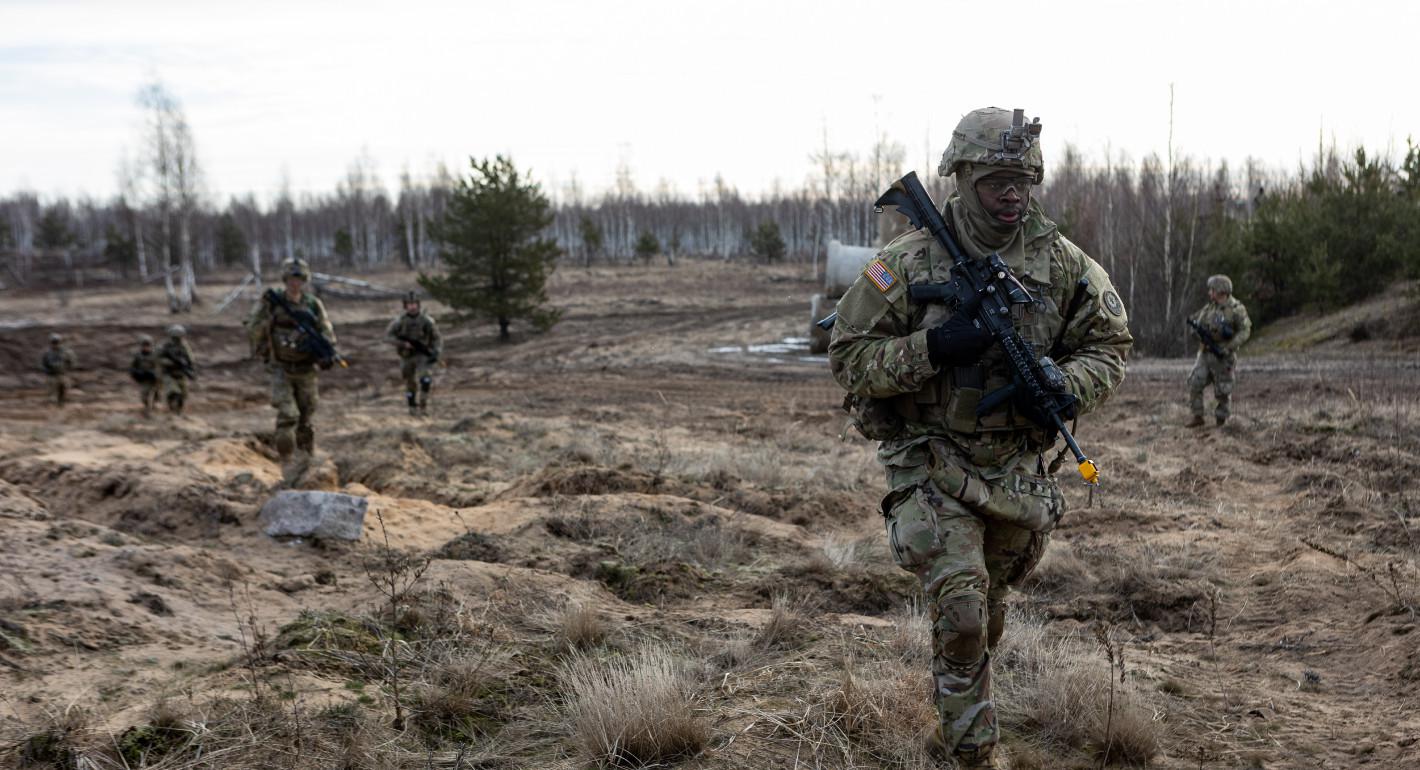
The annual debate over the nearly $900 billion National Defense Authorization Act (NDAA), alongside the seventy-fifth anniversary of former president Harry Truman’s watershed decision to integrate the armed forces, offers a chance to reflect on African American views on defense and security issues. We polled a representative sample of African Americans to try to grasp how they view national security and defense issues of the mid-twenty-first century. What emerged was a complex picture that has echoes in the history of the twentieth century. In general, support for the U.S. military is strong among African Americans, but many want greater caution in how the United States uses military force overseas.
Our previous research found that 80 percent of African Americans view the U.S. military favorably. The high regard the community has for the institution could be a function of the military being one of the first federal institutions to formally rid itself of segregationist policies, a move that pushed the nation to act on its promise of equality for all.
African Americans are 14 percent of the U.S. population but make up 17 percent of the armed forces. They have an especially high representation among enlisted service members, at 19 percent—down from 30 percent several decades prior. Support for the military also reflects this tradition of national service, as well as the social, economic, and other benefits military service has provided many African Americans and their families.
However, our survey found that national security is far less salient, relative to economic and racial issues, when African American voters choose a presidential candidate. Sixty-seven percent of respondents listed domestic issues such as jobs, racial discrimination, or healthcare as the top priority when voting, while only 5 percent reported national security as their top concern. Similar to non-Black voters, African Americans are paying attention to major global developments yet primarily vote on kitchen-table issues.
Our most recent survey also showed substantial African American support for military spending. Only 28 percent of African Americans felt defense spending should be cut back, while 37 percent say that defense spending should increase. These are views that are broadly similar to those of the general American public.
Notably, however, support for military spending is in line with African Americans’ support for higher levels of government spending across the board, and there is actually less African American support for increasing military spending than for increases in spending in several other areas.
Our survey also revealed that respondents show stronger support for increasing federal spending for domestic programs such as improving public infrastructure (67 percent), education (78 percent), healthcare (80 percent), and social security (75 percent).
African Americans, especially those on the lower rungs of the income bracket, are far less likely than the general population to favor overseas military interventions, according to our research. To illustrate this point, only 21 percent of African Americans expressed support for sending troops to assist Ukraine against Russia, compared to 38 percent of the general American public. When asked about trade-offs between domestic spending and financial assistance to Ukraine, Black Americans have proven less likely to support sustained aid to Ukraine if it results in increased material costs to American households, according to a separate study conducted by the Chicago Council on Global Affairs.
Views like these are long-standing in African American communities, and the logic is encapsulated in Martin Luther King Jr.’s famous critique of the Vietnam War at Manhattan’s Riverside Church. King was initially supportive of the Vietnam War effort, perhaps because of his broader support for then president Lyndon B. Johnson’s civil rights and economic justice efforts. Eventually, however, King began to believe that the war would distract from America’s domestic problems. At Riverside Church in 1967, he declared that a nation that spent “more money on military defense than on programs of social uplift” would approach a “spiritual death.”
Although King delivered the Vietnam speech during a tumultuous period in U.S. race relations, his words serve as a harbinger of potential future sentiments. Although African American support for defense spending sits relatively high, in a budget-constrained environment and as civil rights legislation meant to remedy past harm comes undone, support for defense or the continued financial support of Ukraine might plummet.
The unique relationship between African Americans and the national security apparatus presents a complex picture. The socioeconomic benefits of military service and belief in a strong military may explain the support for increasing the defense budget. However, concern about the human and material costs associated with overseas military engagements could explain the relatively low importance certain national security issues hold for the community.