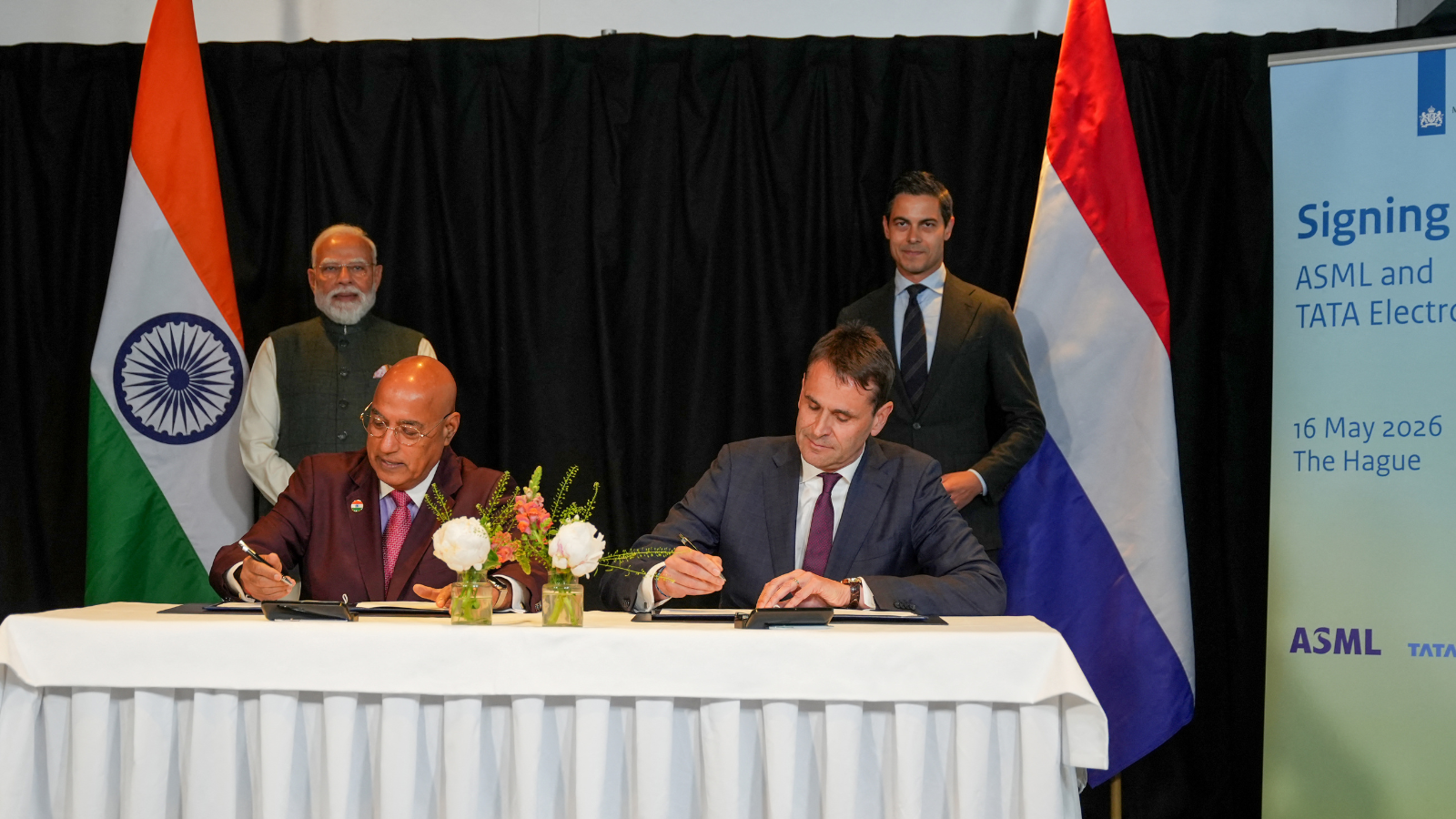

The ASML MoU with Tata Electronics is an indicator of how far the Indian semiconductor ecosystem has come. This ecosystem has been years in the making and represents real commercial logic.
Konark Bhandari
{
"authors": [
"Richard Youngs",
"Ricardo Farinha"
],
"type": "legacyinthemedia",
"centerAffiliationAll": "dc",
"centers": [
"Carnegie Endowment for International Peace",
"Carnegie Europe"
],
"collections": [],
"englishNewsletterAll": "ctw",
"nonEnglishNewsletterAll": "",
"primaryCenter": "Carnegie Europe",
"programAffiliation": "EP",
"programs": [
"Europe",
"Democracy, Conflict, and Governance"
],
"projects": [
"European Democracy Hub"
],
"regions": [
"Europe",
"Southern, Eastern, and Western Africa",
"North Africa",
"Mali",
"Iran"
],
"topics": [
"Foreign Policy",
"EU",
"Security",
"Democracy",
"Political Reform"
]
}REQUIRED IMAGE
As the frequency of political instability and coups d’Etat has increased, the EU has struggled to adopt a coherent, systematic response. The union must craft a robust strategy against the threat posed by military takeovers.
Senior Fellow, Democracy, Conflict, and Governance Program
Richard Youngs is a senior fellow in the Democracy, Conflict, and Governance Program, based at Carnegie Europe. He works on EU foreign policy and on issues of international democracy.
Program Manager, Carnegie Europe
Ricardo Farinha is a program manager in the Democracy, Conflict, and Governance Program at Carnegie Europe.
Carnegie India does not take institutional positions on public policy issues; the views represented herein are those of the author(s) and do not necessarily reflect the views of Carnegie, its staff, or its trustees.
The ASML MoU with Tata Electronics is an indicator of how far the Indian semiconductor ecosystem has come. This ecosystem has been years in the making and represents real commercial logic.
Konark Bhandari
A partnership between India, a country of subcontinental size, and Africa, a continent of fifty-four countries, may seem asymmetric until one notes that both are home to nearly the same number of people—1.4 billion. This essay spells out the existing challenges to the partnership, its optimal potential, and the possible pathways to realize it over the next quarter-century.
Rajiv Bhatia
The India–EU Free Trade Agreement (FTA) is shaping up to be one of the most consequential trade negotiations, both economically and strategically. But, what’s in the agreement, what’s missing, and what will determine its success in the years ahead
Vrinda Sahai, Nicolas Köhler-Suzuki
This piece argues that the present Indian strategy, based on opportunistic diversification and utilization of limited strategic reserves, remains inadequate when confronting supply disruptions. It evaluates India’s options in the short, medium, and long terms.
Vrinda Sahai
Trump 2.0 has unsettled India’s external environment—but has not overturned its foreign policy strategy, which continues to rely on diversification, hedging, and calibrated partnerships across a fractured order.
Milan Vaishnav, ed., Sameer Lalwani, Tanvi Madan, …