

Commentary
How is AI reshaping space security, creating governance challenges, and where does international diplomacy stand today?
Tejas Bharadwaj, Almudena Azcárate Ortega
{
  "authors": [
    "Political Violence Researchers",
    "Rachel Kleinfeld",
    "Dalya Berkowitz"
  ],
  "type": "other",
  "centerAffiliationAll": "dc",
  "centers": [
    "Carnegie Endowment for International Peace"
  ],
  "collections": [
    "U.S. Democracy in Comparative Perspective"
  ],
  "englishNewsletterAll": "democracy",
  "nonEnglishNewsletterAll": "",
  "primaryCenter": "Carnegie Endowment for International Peace",
  "programAffiliation": "DCG",
  "programs": [
    "Democracy, Conflict, and Governance"
  ],
  "regions": [
    "United States"
  ],
  "topics": [
    "Democracy",
    "Domestic Politics"
  ]
}
Source: Getty
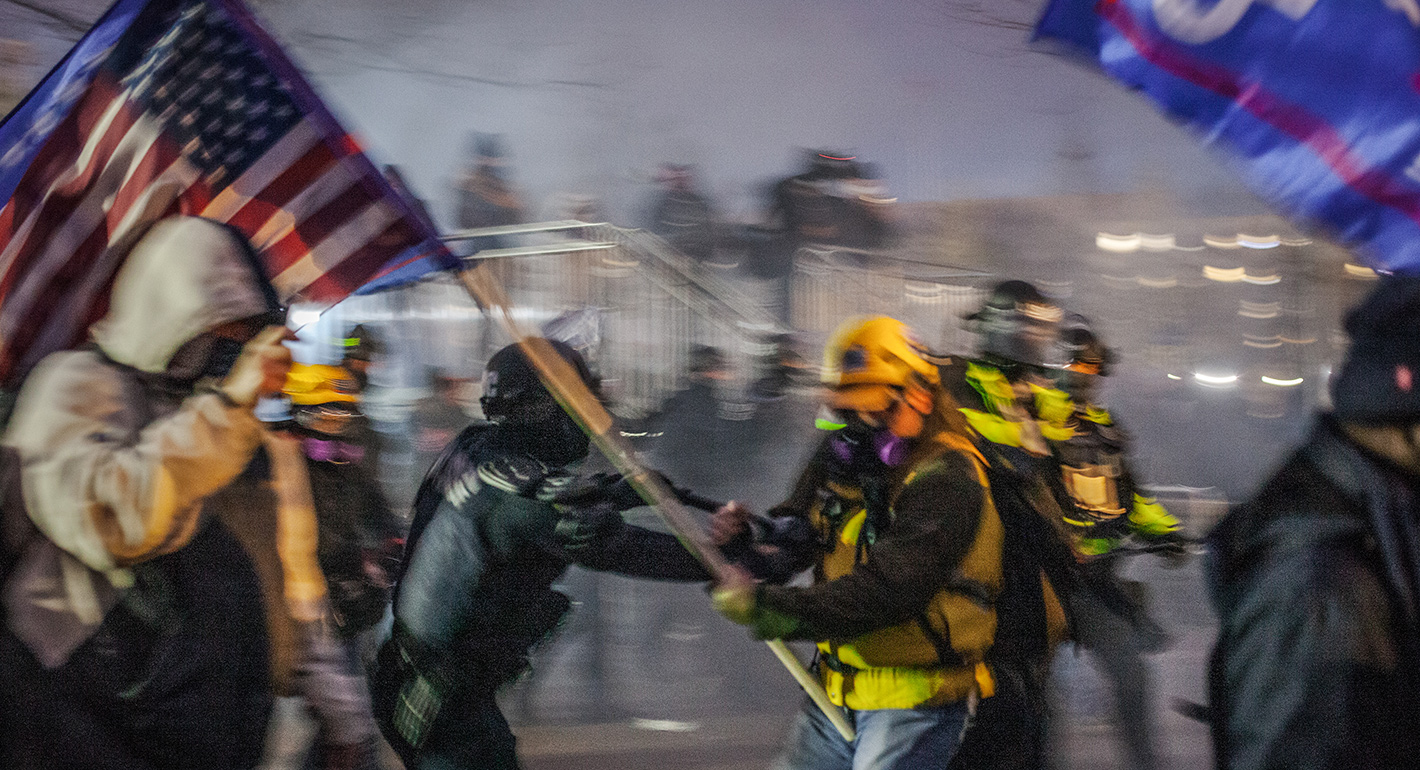
What is political violence and what works to reduce it.
Nonpolitical homicides have been dropping for several years.
But threats and acts of political violence remain high.2
Threats and violent acts are having major consequences. Hate is inundating targeted communities. Public servants are leaving roles after decades of helping our communities run smoothly.3
The National Association of Attorneys General found doxxing and swatting rose from 2024 to 2025.4
While threats remain high across all groups (including white men), women, minorities, and younger officials report receiving higher rates of threats and less willingness to take part in civil service or continue in elected office as a result.5
“I get two or three really severe rashes of death threats every single year where we end up having to have police stationed outside. And it was one thing when I was single, and you know, the threat was just [to] myself, but it seems untenable that my family could also be harmed now, especially after what happened in Minnesota . . . so that’s kind of been playing into my decision about whether or not I’m going to run again next year.”17
—Laurie Pohutsky, Michigan State Representative
The left and right have both been responsible for periods of political violence. In the 1950s, U.S. political violence largely targeted civil rights workers and mostly came from the right. By the 1960s-1970s, the left was responsible for most political violence. Political violence lessened, but moved more to the right in the 1980s, then the left in the late ‘90s and then jihadists in the early 2000s. After 2015, political violence from the right skyrocketed. Following the 2024 election, political violence from the right fell, but started to rise from the left, from a very low point.6
First, a disproportionate number of the people who commit political violence face mental health distress (although the overwhelming majority of individuals with mental health issues are victims, not perpetrators, of violence).7
Second, many of today’s perpetrators draw from a mix of ideological beliefs.8 Violence is growing for policy reasons, such as fear of AI, that are not clearly left or right. Nihilistic violence, from people who reject the political process altogether, is a growing concern.9 Both left and right are nearly equally targeted—at times by their own side.
Third, young people are more likely than older people to support violence.10 Frustration at a government that isn’t answering problems has combined with social “scripts” that offer aggrieved young people a violent template for response.
Finally, political violence from the government grew in 2025, especially from ICE. This may be replacing previous right-leaning vigilantism.11 In 2025, 32 people died in ICE custody.12 In 2026, as of March 19, ICE has killed two protesting Americans and at least 13 people died in ICE custody.13 Since January 2025, immigration agents have shot at people in at least 24 incidents.14 In 2025, law enforcement used less-lethal munitions in 22% of protests with police engagement, almost four times the rate in 2024.15
Threats and harassment are causing crucial talent to leave government and are affecting the quality of our representation, according to Bridging Divides Initiative/Civic Pulse data. In 2025, local public servants reported that as a result, they were:
“I was on the hit list. . . . There’s always been a level of risk in my job, but I had never considered that somebody could come to my home and shoot me and my wife, and . . . would my daughter be screaming in her crib? People can carry guns in the Capitol. And the chamber is a circle and the viewing galleries above it. We take votes in a fishbowl where people can stand over us with not signs, but guns. And I find that terrifying.”18
—Erin Maye Quade, Minnesota State Senator following the assassinations of Minnesota lawmakers
“You got family in [redacted]. I’m taking a trip there because I’m gonna get next to one of your family members and have you feel some [explicit] pain the way you make us feel pain.”19
—excerpt from a voicemail left for a congressional office
Almost 90% of state legislators experienced threats or attacks from 2021 to 2024, and more than half of locally elected officials (such as school board members) experienced threats or attacks from mid-2023 to 2024.26 Public servants have stressful jobs keeping everyday life running smoothly. Serious threats against them, including, often, death threats against their young children, are not okay. Everyone should be safe to do their jobs. We all have the power to choose to do better, to speak out against threats, and see others as human beings even if we disagree.27
Created by Rachel Kleinfeld and Dalya Berkowitz based on data from the previously cited organizations, Carnegie Endowment for International Peace, June 2026.
Political Violence Researchers
Created by Rachel Kleinfeld and Dalya Berkowitz based on data from the cited organizations, Carnegie Endowment for International Peace, June 2026.

Senior Fellow, Democracy, Conflict, and Governance Program
Rachel Kleinfeld is a senior fellow in Carnegie’s Democracy, Conflict, and Governance Program, where she focuses on issues of rule of law, security, and governance in democracies experiencing polarization, violence, and other governance problems.
Former Senior Research Analyst, Democracy, Conflict and Governance Program
Carnegie India does not take institutional positions on public policy issues; the views represented herein are those of the author(s) and do not necessarily reflect the views of Carnegie, its staff, or its trustees.

How is AI reshaping space security, creating governance challenges, and where does international diplomacy stand today?


Tejas Bharadwaj, Almudena Azcárate Ortega

The U.S.–India semiconductor cooperation story is well-stocked with top-level strategic intent. What remains unresolved, however, are some underlying challenges that will determine whether the cooperation actually functions. Three such friction points stand out.

Shruti Mittal

India and the United States are close to concluding a Reciprocal Defense Procurement Agreement (RDPA) that will allow firms from the two countries to sell to each other’s defense establishments more easily. While this may not remedy the specific grievances both sides may have regarding larger bilateral issues, an RDPA could restore some momentum, following the trade deal announcement.

Konark Bhandari

On the last day of the India AI Impact Summit, India signed Pax Silica, a U.S.-led declaration seemingly focused on semiconductors. While India’s accession to the same was not entirely unforeseen, becoming a signatory nation this quickly was not on the cards either.
Konark Bhandari

This piece examines India’s response to U.S. sanctions and tariffs, specifically assessing the immediate market consequences, such as alterations in import costs, and the broader strategic implications for India’s energy security and foreign policy orientation.

Vrinda Sahai