• Research
  • About
  • Experts
Carnegie India logoCarnegie lettermark logo
Technology
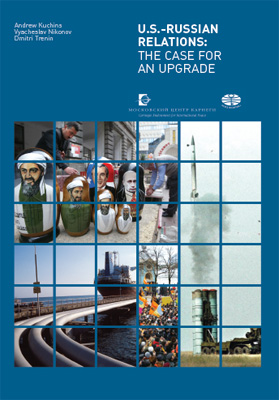
U.S.-Russian Relations: The Case for an Upgrade
Report

U.S.-Russian Relations: The Case for an Upgrade

Highly touted in both Washington and Moscow as a "strategic partnership" in 2001, the relationship has drifted and the gap between glowing rhetoric and thin substance has grown. When major policy differences emerge, as over war in Iraq in 2002-2003 and recently over Ukraine, all too easily the U.S.-Russian relationship spirals into "crisis," and the threat of a "new Cold War" looms.

Link Copied
By Andrew Kuchins, Vyacheslav A. Nikonov, Dmitri Trenin
Published on Jan 26, 2005

Additional Links

Full Text (PDF)

"The recent sharp dispute over the Ukrainian presidential elections vividly illustrated the fragile and shallow nature of the U.S.-Russian relationship. Highly touted in both Washington and Moscow as a "strategic partnership" in 2001, the relationship has drifted and the gap between glowing rhetoric and thin substance has grown. When major policy differences emerge, as over war in Iraq in 2002-2003 and recently over Ukraine, all too easily the U.S.-Russian relationship spirals into "crisis," and the threat of a "new Cold War" looms."

Click on the link above for full text of this Carnegie report in English and Russian.

About the Authors
Andrew C. Kuchins is Director of the Carnegie Moscow Center. He conducts research and writes widely on Russian foreign and security policy. He is a member of the governing council of the Program on Basic Research and Higher Education in Russia, the advisory committee of Washington Profile, and the editorial board of the journal, Demokratizatsiya.

Vyacheslav Nikonov is the President of the Polity Foundation in Moscow. He is the author of  "Contemporary Russian Politics" (2003), "The Age of Change: Russia of the 1990s through Conservative's Eyes" (1999), "Conservative Manifesto" (1994), "The Republicans: From Nixon to Reagan" (1988), "Iran-Contra Affair" (1987), "The Republicans : From Eisenhower to Nixon" (1984).

Dmitri Trenin is Deputy Director of the Carnegie Moscow Center, where he also co-chairs the Program on Foreign and Security Policy. He is the author of numerous articles and books on Russian security issues, including, most recently, Russia’s Restless Frontier: The Chechnya Factor in Post-Soviet Russia (Carnegie, 2004)

About the Authors

Andrew Kuchins

Former Senior Associate and Director, Russian & Eurasian Program

Vyacheslav A. Nikonov

Polity Foundation

Dmitri Trenin

Former Director, Carnegie Moscow Center

Trenin was director of the Carnegie Moscow Center from 2008 to early 2022.

Authors

Andrew Kuchins
Former Senior Associate and Director, Russian & Eurasian Program
Andrew Kuchins
Vyacheslav A. Nikonov
Polity Foundation
Dmitri Trenin
Former Director, Carnegie Moscow Center
CaucasusRussiaPolitical ReformDemocracyEconomyMilitaryForeign PolicyNuclear PolicyNuclear Energy

Carnegie India does not take institutional positions on public policy issues; the views represented herein are those of the author(s) and do not necessarily reflect the views of Carnegie, its staff, or its trustees.

More Work from Carnegie India

  • Commentary
    The Impact of U.S. Sanctions and Tariffs on India’s Russian Oil Imports

    This piece examines India’s response to U.S. sanctions and tariffs, specifically assessing the immediate market consequences, such as alterations in import costs, and the broader strategic implications for India’s energy security and foreign policy orientation.

      Vrinda Sahai

  • Article
    Military Lessons from Operation Sindoor

    The India-Pakistan conflict that played out between May 6 and May 10, 2025, offers several military lessons. This article presents key takeaways from Operation Sindoor and breaks down how India’s preparations shaped the outcome and what more is needed to strengthen future readiness.

      Dinakar Peri

  • Paper
    India-China Economic Ties: Determinants and Possibilities

    This paper examines the evolution of India-China economic ties from 2005 to 2025. It explores the impact of global events, bilateral political ties, and domestic policies on distinct spheres of the economic relationship.

      Santosh Pai

  • Commentary
    NISAR Soars While India-U.S. Tariff Tensions Simmer

    On July 30, 2025, the United States announced 25 percent tariffs on Indian goods. While diplomatic tensions simmered on the trade front, a cosmic calm prevailed at the Sriharikota launch range. Officials from NASA and ISRO were preparing to launch an engineering marvel into space—the NASA-ISRO Synthetic Aperture Radar (NISAR), marking a significant milestone in the India-U.S. bilateral partnership.

      Tejas Bharadwaj

  • Commentary
    TRUST and Tariffs

    The India-U.S. relationship currently appears buffeted between three “Ts”—TRUST, Tariffs, and Trump.

      Arun K. Singh

Get more news and analysis from
Carnegie India
Carnegie India logo, white
Unit C-4, 5, 6, EdenparkShaheed Jeet Singh MargNew Delhi – 110016, IndiaPhone: 011-40078687
  • Research
  • About
  • Experts
  • Projects
  • Events
  • Contact
  • Careers
  • Privacy
  • For Media
Get more news and analysis from
Carnegie India
© 2026 Carnegie Endowment for International Peace. All rights reserved.