

Report
- +4
Ms. Sandra Polaski, Joaquim Bento de Souza Ferreir, Janine Berg, …
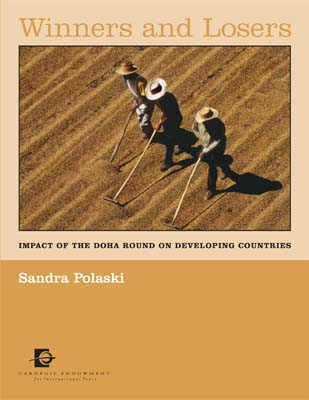
This report presents a new, path breaking model of global trade as a tool to analyze the potential impacts of the negotiations and underlying economic interests of the WTO’s diverse members.
Source: Carnegie Endowment

Meeting in Hong Kong in December 2005, trade ministers from World Trade Organization member countries were unable to bridge major disagreements in virtually every area of the Doha Round negotiations. As the global trade regime has expanded to include most developing countries, the range of divergent priorities within the negotiations has widened. What would it take to produce a global trade agreement that addresses the interests of developing countries and holds the potential to lift their incomes, while at the same time offering advantages for developed countries?
Winners and Losers: Impact of the Doha Round on Developing Countries presents a new, path breaking model of global trade as a tool to analyze the potential impacts of the negotiations and underlying economic interests of the WTO’s diverse members. This new Carnegie model makes several critical innovations—notably, modeling unemployment in developing countries and separating agricultural labor markets from urban unskilled labor markets. The result is a thorough, detailed, and more accurate analysis of the impact of trade policies on both developing and developed countries.
The report’s major findings are striking: any of the plausible trade scenarios will produce only modest gains for the world; agricultural trade is not a panacea for most poor countries; the poorest countries may actually lose from any agreement; and additional special measures will be needed to ensure that the least developed countries succeed. The full document includes technical specifications of the Carnegie model, simulation results, a wealth of regional and national data, over 50 full color charts and graphs, policy implications and recommendations.
What people are saying about Winners and Losers: Policymakers and journalists have commented on the results of the Carnegie model. Click on the links below to read their responses:
Click on one of the links above for the full text of this Carnegie report.
Sandra Polaski is senior associate and director of the Trade, Equity, and Development Project at the Carnegie Endowment. She served as the U.S. secretary of state's special representative for international labor affairs from 1999 to 2002, playing a leading role in the development of U.S. government policy on international labor and trade issues.

Former Senior Associate, Director, Trade, Equity and Development Program
Until April 2002, Polaski served as the U.S. Secretary of State’s Special Representative for International Labor Affairs, the senior State Department official dealing with such matters.
Recent Work
Ms. Sandra Polaski, Joaquim Bento de Souza Ferreir, Janine Berg, …
Ms. Sandra Polaski
Carnegie India does not take institutional positions on public policy issues; the views represented herein are those of the author(s) and do not necessarily reflect the views of Carnegie, its staff, or its trustees.

How is AI reshaping space security, creating governance challenges, and where does international diplomacy stand today?


Tejas Bharadwaj, Almudena Azcárate Ortega

After the chill in ties between 2020 and 2024 that brought India–China relations to their lowest point in several decades, the two countries have engaged each other afresh. This paper argues that there are predominantly four imperatives guiding India’s approach to China, and they exist in an order of priority.

Saheb Singh Chadha

This piece argues that India’s central challenge is not managing a single flashpoint but resolving the underlying tension between expansion and institutional coherency of the BRICS grouping.

Vrinda Sahai

The U.S.–India semiconductor cooperation story is well-stocked with top-level strategic intent. What remains unresolved, however, are some underlying challenges that will determine whether the cooperation actually functions. Three such friction points stand out.

Shruti Mittal

On March 10, 2026, India’s Union Cabinet approved amendments to Press Note 3, a regulation that mandated government approval on all foreign direct investment (FDI) from countries sharing a land border with India. This amendment raises questions primarily about whether its stated benefits will materialize and if the risks have been adequately weighed. This piece will address the same.

Konark Bhandari