• Research
  • About
  • Experts
Carnegie India logoCarnegie lettermark logo
AI
Issues in U.S.-India Nuclear Cooperation

Source: Getty

Article

Issues in U.S.-India Nuclear Cooperation

Link Copied
By Sharon Squassoni
Published on Nov 7, 2007

Additional Links

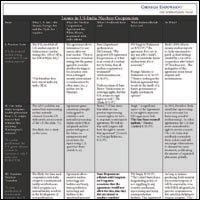
123 Agreement Table (PDF)
Chart
In October, the U.S.-India nuclear cooperation agreement -- a foreign policy priority for the Bush Administration -- hit a snag in Indian domestic politics. In response to heavy criticism by Indian leftist parties, which threatened to call for early elections, Prime Minister Singh put negotiations on safeguards with the International Atomic Energy Agency (IAEA) on hold. Since the safeguards agreement is a likely prerequisite for a Nuclear Suppliers Group (NSG) decision to make an exception for India -- both of which must be completed before the deal comes back to the U.S. Congress -- this delay provides some much-needed room for reflection. In particular, Congress and the NSG should use the time to resolve significant ambiguities.
 
One ambiguity is whether the nuclear cooperation agreement is consistent with the Hyde Act, passed last December to provide certain waiver authorities to the President. On October 4, 2007, Representatives Berman and Ros-Lehtinen introduced a resolution (H. Res. 711) in the House, which noted that it remained to be seen whether the nuclear cooperation agreement was fully consistent with the Hyde Act, and urged the Administration to resolve all outstanding questions raised by Congress. H. Res. 711 also urged the Administration to propose a NSG exemption that clearly calls for the termination of all exports should India test a nuclear explosive device.
 
Although it might seem like common sense to halt nuclear exports to a state that violates the international norm of not testing, the U.S.-Indian agreement is rather ambiguous on the matter, as the table above illustrates. It's not clear what would happen if India tests another nuclear device -- do U.S. exports terminate? Will the U.S. encourage or discourage other states from supplying India in that event? Would U.S. consideration of mitigating factors surrounding an Indian test lead to continuation of exports? 
 
At this stage, it is remarkable that there continue to be so many uncertainties. It will be important to take every opportunity -- for example, when the NSG consultative group meets in November and in congressional hearings -- to clarify and resolve issues before the NSG opens up nuclear commerce to India.

Sharon Squassoni is senior associate in the Nonproliferation Program at the Carnegie Endowment for International Peace.

About the Author

Sharon Squassoni

Former Senior Associate, Nuclear Policy Program

Squassoni came to Carnegie from the Congressional Research Service. She also served for nine years in the executive branch. Her last position at the State Department was director of Policy Coordination in the Nonproliferation Bureau.

    Recent Work

  • Other
    Grading Progress on 13 Steps Toward Nuclear Disarmament

      Sharon Squassoni

  • Report
    Nuclear Energy: Rebirth or Resuscitation?

      Sharon Squassoni

Sharon Squassoni
Former Senior Associate, Nuclear Policy Program
Sharon Squassoni
North AmericaUnited StatesSouth AsiaIndiaNuclear Policy

Carnegie India does not take institutional positions on public policy issues; the views represented herein are those of the author(s) and do not necessarily reflect the views of Carnegie, its staff, or its trustees.
More Work from Carnegie India

  • Commentary
    India Signs the Pax Silica—A Counter to Pax Sinica?

    On the last day of the India AI Impact Summit, India signed Pax Silica, a U.S.-led declaration seemingly focused on semiconductors. While India’s accession to the same was not entirely unforeseen, becoming a signatory nation this quickly was not on the cards either.

      Konark Bhandari

  • Commentary
    The PSLV Setback: Restoring India’s Workhorse

    On January 12, 2026, India's "workhorse," the Polar Satellite Launch Vehicle, experienced a consecutive mission failure for the first time in its history. This commentary explores the implications of this incident on India’s space sector and how India can effectively address issues stemming from the incident.

      Tejas Bharadwaj

  • Commentary
    AI Adoption Journey for Population Scale

    Connecting real-world AI use cases across sectors such as health, education, agriculture, and livelihoods can help policymakers, innovators, and institutions align around a shared goal. This article looks at a framework ensuring that AI works for everyone.

      Shalini Kapoor, Tanvi Lall

  • Commentary
    The Impact of U.S. Sanctions and Tariffs on India’s Russian Oil Imports

    This piece examines India’s response to U.S. sanctions and tariffs, specifically assessing the immediate market consequences, such as alterations in import costs, and the broader strategic implications for India’s energy security and foreign policy orientation.

      Vrinda Sahai

  • Article
    Revisiting the Usage of Refurbished Equipment in India’s Semiconductor Ecosystem

    This article looks at the progress of the Semiconductor Laboratory fab modernization plan based on publicly available documents, and potential learnings for future upgrades to government-owned fabs and India’s larger semiconductor ecosystem, especially regarding the use of refurbished equipment.

      Shruti Mittal, Konark Bhandari

Get more news and analysis from
Carnegie India
Carnegie India logo, white
Unit C-4, 5, 6, EdenparkShaheed Jeet Singh MargNew Delhi – 110016, IndiaPhone: 011-40078687
  • Research
  • About
  • Experts
  • Projects
  • Events
  • Contact
  • Careers
  • Privacy
  • For Media
Get more news and analysis from
Carnegie India
© 2026 Carnegie Endowment for International Peace. All rights reserved.