

Paper
Ashley J. Tellis
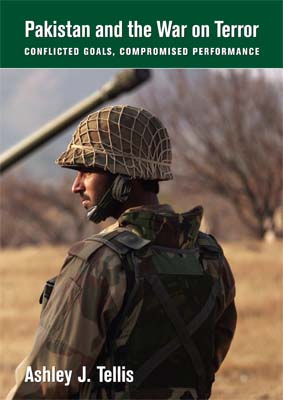
The United States must shift its counterterrorism policy towards Pakistan away from a reciprocal approach—requiring Islamabad to perform desirable actions to receive support—towards one encouraging Pakistan to enact effective counterterrorism policies, not for an immediate payoff, but to strengthen institutionalized trust with the U.S. over time,
The United States must shift its counterterrorism policy towards Pakistan away from a reciprocal approach—requiring Islamabad to perform desirable actions to receive support—towards one encouraging Pakistan to enact effective counterterrorism policies, not for an immediate payoff, but to strengthen institutionalized trust with the U.S. over time, according to a new report from the Carnegie Endowment.
In Pakistan and the War on Terror: Conflicted Goals, Compromised Performance, Carnegie Senior Associate Ashley J. Tellis points to growing dissatisfaction in the United States with the Musharraf regime’s commitment to counterterrorism operations, given the influx of U.S. aid. But while Pakistan’s performance in the “war on terror” has fallen short of expectations, Islamabad’s inability to defeat terrorist groups cannot simply be explained by neglect or lack of motivation. U.S. policy makers must take into account the specific and complex counterterrorism challenges facing Pakistan and move away from their current unsustainable policies.
“The Bush administration ought to persist with its current emphasis on the noncoercive engagement of Pakistan at least so long as there is a reasonable hope that the transformation of Pakistan into a moderate Muslim state is not a lost cause, that the Musharraf regime can be persuaded to expand its counterterrorism operations to those groups that have thus far remained beyond reach, and that the United States will have sufficient opportunity to switch to an alternative strategy before the present attempt at engagement is judged to have failed irremediably.”
A limited number of print copies are available.
Request a copy
Former Senior Fellow
Ashley J. Tellis was a senior fellow at the Carnegie Endowment for International Peace.
Recent Work
Ashley J. Tellis
Ashley J. Tellis
Carnegie India does not take institutional positions on public policy issues; the views represented herein are those of the author(s) and do not necessarily reflect the views of Carnegie, its staff, or its trustees.

In any defense establishment, change is an ongoing process. However, despite the best of intentions, existing bureaucracies, bound by habit and years of socialization, have their limits in implementing transformative change.

Anit Mukherjee

After the chill in ties between 2020 and 2024 that brought India–China relations to their lowest point in several decades, the two countries have engaged each other afresh. This paper argues that there are predominantly four imperatives guiding India’s approach to China, and they exist in an order of priority.

Saheb Singh Chadha

This piece argues that India’s central challenge is not managing a single flashpoint but resolving the underlying tension between expansion and institutional coherency of the BRICS grouping.

Vrinda Sahai

A partnership between India, a country of subcontinental size, and Africa, a continent of fifty-four countries, may seem asymmetric until one notes that both are home to nearly the same number of people—1.4 billion. This essay spells out the existing challenges to the partnership, its optimal potential, and the possible pathways to realize it over the next quarter-century.

Rajiv Bhatia

The India–EU Free Trade Agreement (FTA) is shaping up to be one of the most consequential trade negotiations, both economically and strategically. But, what’s in the agreement, what’s missing, and what will determine its success in the years ahead
Vrinda Sahai, Nicolas Köhler-Suzuki