

• Research
  • About
  • Experts
Carnegie India logoCarnegie lettermark logo
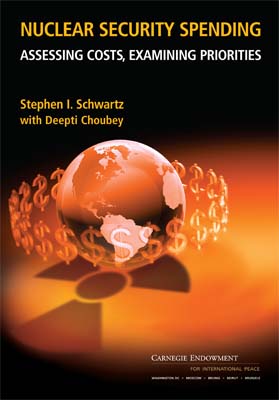
Nuclear Security Spending: Assessing Costs, Examining Priorities
Report

Nuclear Security Spending: Assessing Costs, Examining Priorities

The United States spent over $52 billion on nuclear weapons and related programs in fiscal year 2008, but only 10 percent of that went toward preventing a nuclear attack through slowing and reversing the proliferation of nuclear weapons and technology.

Link Copied
By Stephen I. Schwartz and Deepti Choubey
Published on Jan 12, 2009

Additional Links

Executive Summary, Low Res (2.8 MB)Executive Summary, High Res (33 MB)Full Text, Low Res (2.7 MB)Full Text, High Res (33 MB)PPT Presentation2008 Nuclear Spending Data

The United States spent over $52 billion on nuclear weapons and related programs in fiscal year 2008, but only 10 percent of that went toward preventing a nuclear attack through slowing and reversing the proliferation of nuclear weapons and technology. That is the main finding of Nuclear Security Spending: Assessing Costs, Examining Priorities, a new study that uses publicly available documents and extensive interviews with government officials and experts to calculate the U.S. nuclear security "budget." The United States has never tracked nuclear weapons-related spending comprehensively, hindering effective oversight and weighing of priorities in nuclear security policy.

The lack of comprehensive accounting impairs balancing of priorities and fosters the impression that the United States is more interested in preserving and upgrading its nuclear arsenal than in reducing and eliminating the growing threats of nuclear proliferation and limited nuclear or radiological attack. Because classified expenditures and some other relevant costs are omitted from the analysis, total actual spending is significantly higher.

Key Conclusions

  • Only 1.3 percent ($700 million) of the nuclear security budget was devoted to preparing for the consequences of a nuclear or radiological attack.
     
  • Another 56 percent of the total went toward operating, sustaining, and upgrading the U.S. nuclear arsenal. 
     
  • Nuclear security consumes $13 billion more than international diplomacy and foreign assistance; nearly double what the United States allots for general science, space, and technology; and 14 times what the Department of Energy (DOE) budgets for all energy-related research and development.
     
  • Nuclear weapons and weapons-related programs account for at least 67 percent of DOE’s budget, 8.5 percent of the FBI’s budget, 7.1 percent of the Department of Defense budget, and 1.7 percent of the Department of Homeland Security’s budget.

Policy Recommendations

  • Require the executive branch to submit both an unclassified and a classified annual accounting of all nuclear weapons-related spending. Without an accurate understanding of the costs of nuclear spending, Congress and the executive branch cannot conduct essential oversight or devise the most effective policy.
     
  • Place greater emphasis on programs that secure and prevent the proliferation of nuclear weapons, weapons material, technology, and expertise.
     
  • Develop better measures to explain and quantify nuclear weapons-related intelligence expenditures. Greater transparency and insight could lead to a more effective allocation of intelligence assets.
     
  • Release an accurate accounting of the number of veterans who have received or been denied compensation and care for radiation exposure during atmospheric nuclear tests between 1946 and 1962, along with the total cost of such compensation and care.

The authors conclude:

“Implementing these recommendations will increase understanding and accountability, which in turn will lead to greater public support for critical nuclear security programs and a more effective allocation of public resources. When combined with a new focus on nuclear issues, including the Obama administration’s forthcoming Nuclear Posture Review, these efforts will help ensure that political and financial priorities are properly aligned.”

About the Authors

Stephen I. Schwartz is the editor of The Nonproliferation Review, published by the James Martin Center for Nonproliferation Studies at the Monterey Institute of International Studies, the largest nongovernmental organization in the United States devoted exclusively to research and training on nonproliferation issues. He is also the editor and coauthor of Atomic Audit: The Costs and Consequences of U.S. Nuclear Weapons since 1940 (Brookings Institution Press, 1998), the authoritative chronicle of historical expenditures associated with the U.S. nuclear weapons program. Schwartz has previously served as publisher and executive director of the Bulletin of the Atomic Scientists, and as a guest scholar with the Foreign Policy Studies Program at the Brookings Institution.

Deepti Choubey is deputy director of the Nonproliferation Program at the Carnegie Endowment. Her research interests include the calculations of non–nuclear-weapon states, how much the U.S. spends on nuclear security, and the role of nonproliferation for long-term U.S. foreign policy. Prior to joining the Carnegie Endowment in 2006, Choubey was director of the Peace and Security Initiative (PSI) for the Ploughshares Fund.

About the Authors

Stephen I. Schwartz

Deepti Choubey

Former Deputy Director, Nuclear Policy Program

Choubey was previously the director of the Peace and Security Initiative for the Ploughshares Fund. She also worked for Ambassador Nancy Soderberg in the New York office of the International Crisis Group.

Authors

Stephen I. Schwartz
Deepti Choubey
Former Deputy Director, Nuclear Policy Program
Deepti Choubey
North AmericaUnited StatesSecurityMilitaryNuclear Policy

Carnegie India does not take institutional positions on public policy issues; the views represented herein are those of the author(s) and do not necessarily reflect the views of Carnegie, its staff, or its trustees.

More Work from Carnegie India

  • Commentary
    India Signs the Pax Silica—A Counter to Pax Sinica?

    On the last day of the India AI Impact Summit, India signed Pax Silica, a U.S.-led declaration seemingly focused on semiconductors. While India’s accession to the same was not entirely unforeseen, becoming a signatory nation this quickly was not on the cards either.

      Konark Bhandari

  • Commentary
    The Impact of U.S. Sanctions and Tariffs on India’s Russian Oil Imports

    This piece examines India’s response to U.S. sanctions and tariffs, specifically assessing the immediate market consequences, such as alterations in import costs, and the broader strategic implications for India’s energy security and foreign policy orientation.

      Vrinda Sahai

  • Article
    Military Lessons from Operation Sindoor

    The India-Pakistan conflict that played out between May 6 and May 10, 2025, offers several military lessons. This article presents key takeaways from Operation Sindoor and breaks down how India’s preparations shaped the outcome and what more is needed to strengthen future readiness.

      Dinakar Peri

  • Book
    India and the Sovereignty Principle: The Disaggregation Imperative

    This book offers a comprehensive analysis of India's evolving relationship with sovereignty in a complex global order. Moving beyond conventional narratives, it examines how the sovereignty principle shapes India's behavior across four critical domains—from traditional military power to contemporary data governance.

      Rudra Chaudhuri, Nabarun Roy

  • Commentary
    NISAR Soars While India-U.S. Tariff Tensions Simmer

    On July 30, 2025, the United States announced 25 percent tariffs on Indian goods. While diplomatic tensions simmered on the trade front, a cosmic calm prevailed at the Sriharikota launch range. Officials from NASA and ISRO were preparing to launch an engineering marvel into space—the NASA-ISRO Synthetic Aperture Radar (NISAR), marking a significant milestone in the India-U.S. bilateral partnership.

      Tejas Bharadwaj

Get more news and analysis from
Carnegie India
Carnegie India logo, white
Unit C-4, 5, 6, EdenparkShaheed Jeet Singh MargNew Delhi – 110016, IndiaPhone: 011-40078687
  • Research
  • About
  • Experts
  • Projects
  • Events
  • Contact
  • Careers
  • Privacy
  • For Media
Get more news and analysis from
Carnegie India
© 2026 Carnegie Endowment for International Peace. All rights reserved.