• Research
  • About
  • Experts
Carnegie India logoCarnegie lettermark logo
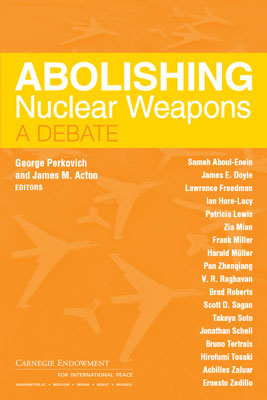
Abolishing Nuclear Weapons: A Debate
Book

Abolishing Nuclear Weapons: A Debate

A distinguished group of experts from thirteen countries explore how to overcome obstacles to nuclear disarmament and pose questions that require further official and nongovernmental deliberation.

Link Copied
By George Perkovich, James M. Acton, Lawrence Freedman, Frank Miller, Jonathan Schell, Brad Roberts, Harald Müller, Bruno Tertrais, Achilles Zaluar, Scott Sagan, Takaya Suto, Hirofumi Tosaki, James E. Doyle, Patricia Lewis, Ian Hore-Lacy, Pan Zhenqiang, V.R. Raghavan, Sameh Aboul-Enein, Ernesto Zedillo, Zia Mian
Published on Feb 13, 2009

Additional Links

Full TextL. FreedmanF. MillerJ. SchellB. RobertsH. Müller B. TertraisA. ZaluarS. D. SaganP. LewisI. Hore-LacyP. Zhenqiang V. R. RaghavanS. Aboul-EneinE. ZedilloZ. MianConclusionT. Suko and H. TosakiJ. E. Doyle

Source: Carnegie Endowment for International Peace

IMGXYZ1894IMGZYXIn the past few years, horizontal and vertical proliferation have collided. That is, the need for significant strengthening of the nonproliferation regime in the wake of nuclear developments in North Korea, Iran, Iraq, and Pakistan is now absolutely clear. So too, however, is growing unwillingness among non–nuclear-weapon states to even consider additional measures in what they see as the absence of serious progress by the nuclear-armed states toward disarmament.

The pathbreaking paper Abolishing Nuclear Weapons by George Perkovich and James Acton was first published by the International Institute for Strategic Studies as an Adelphi Paper in September 2008. One of the paper’s major aims was to prompt serious international analysis, discussion, and debate, recognizing divergent views within and between nuclear-armed states and those that do not possess these weapons. The absence of such engagement in official forums such as Non-Proliferation Treaty Review Conferences and the Conference on Disarmament makes it vital for nongovernmental actors to take the lead in hopes that governments will see the value of such dialogue and follow.

The present volume takes the next step. To advance the sort of analysis and dialogue Perkovich and Acton call for, they have invited a distinguished group of experts—current and former officials, respected defense analysts—from thirteen countries, nuclear and non-nuclear, to critique the Adelphi Paper. Their diverse views explore pathways around obstacles to nuclear disarmament and sharpen questions requiring further official and nongovernmental deliberation. Perkovich and Acton are grateful to the contributors for the thoroughly constructive character of their critiques.

Included in this Volume:

  • George Perkovich and James M. Acton – Abolishing Nuclear Weapons (reprint)
  • Lawrence Freedman – Nuclear Disarmament: From a Popular Movement to an Elite Project, and Back Again?
  • Frank Miller – Disarmament and Deterrence: A Practitioner’s View
  • Jonathan Schell – The Power of Abolition
  • Brad Roberts – On Order, Stability, and Nuclear Abolition
  • Harald Müller – The Importance of Framework Conditions
  • Bruno Tertrais – Advancing the Disarmament Debate: Common Ground and Open Questions
  • Achilles Zaluar – A Realistic Approach to Nuclear Disarmament
  • Scott D. Sagan – Good Faith and Nuclear Disarmament Negotiations
  • Takaya Suto and Hirofumi Tosaki – Abolishing Nuclear Weapons: A Japanese Perspective
  • James E. Doyle – Eyes on the Prize: A Strategy for Enhancing Global Security
  • Patricia Lewis – Verification, Compliance, and Enforcement
  • Ian Hore-Lacy – Nuclear Power and Proliferation: A Nuclear Industry Perspective
  • Pan Zhenqiang – Abolishing Nuclear Weapons: Why Not Outlaw Them First?
  • V.R. Raghavan – Nuclear Abolition: Need for a Phased Plan
  • Sameh Aboul-Enein – The Roadmap to Total Nuclear Disarmament
  • Ernesto Zedillo – The Role of International Institutions in the Disarmament Process
  • Zia Mian – Beyond the Security Debate: The Moral and Legal Dimensions of Abolition

The volume concludes with an essay by Perkovich and Acton that works through some of the key questions or paradoxes raised by the critiques. Their focus is on major issues and crucial differences. They do not defend their original text, rebut points, or cite passages to show where they may have been misunderstood. Rather, in the spirit of the commentators, they use the points raised from diverse international viewpoints to clarify and sharpen the big picture.

Few, if any, top-tier issues attract as much simplistic analysis, as many verbal red herrings, and as little serious work by governments as does the feasibility of nuclear disarmament. As was pointed out in Abolishing Nuclear Weapons, none of the nuclear-weapon states "has an employee, let alone an inter-agency group, tasked full time with figuring out what would be required to verifiably decommission all its nuclear weapons."

Perkovich and Acton's endeavor launched with Abolishing Nuclear Weapons, advanced in this volume, and continuing into the future, is to jump-start a broad and deep international debate, based on serious analysis, of what it would take to achieve the immensely important and equally difficult goal of nuclear disarmament. Like this volume, that debate will have to include active participation by all states—non-nuclear as well as nuclear-armed.

About the Authors

George Perkovich

Japan Chair for a World Without Nuclear Weapons, Senior Fellow

George Perkovich is the Japan Chair for a World Without Nuclear Weapons and a senior fellow in the Carnegie Endowment for International Peace’s Nuclear Policy Program. He works primarily on nuclear deterrence, nonproliferation, and disarmament issues, and is leading a study on nuclear signaling in the 21st century.

James M. Acton

Jessica T. Mathews Chair, Co-director, Nuclear Policy Program

Acton holds the Jessica T. Mathews Chair and is co-director of the Nuclear Policy Program at the Carnegie Endowment for International Peace.

Lawrence Freedman

Sir Lawrence Freedman is emeritus professor of War Studies, King's College London. He was professor of War Studies from 1982 to 2014 and vice-principal from 2003 to 2013. Before joining King's he held research appointments at Nuffield College Oxford, the International Institute for Strategic Studies and the Royal Institute of International Affairs. Elected a fellow of the British Academy in 1995, he was appointed official historian of the Falklands Campaign in 1997. In June 2009 he was appointed to serve as a member of the official inquiry into Britain and the 2003 Iraq War. He has written on international history, strategic theory and nuclear weapons issues, as well as commenting on current security issues. Among his recent books are Strategy: A History (2013), The Future of War: A History (2017), and Ukraine and the Art of Strategy (2019). In September he will publish Command: The Politics of Military Operations from Korea to Afghanistan.

Frank Miller

Jonathan Schell

Brad Roberts

Brad Roberts is director of the Center for Global Security Research at Lawrence Livermore National Laboratory. Among his recent publications is an edited CGSR Occasional Paper entitled “Taking Stock: US-China Track 1.5 Nuclear Dialogue."

Harald Müller

Bruno Tertrais

Foundation for Strategic Research

Deputy Director of the Fondation pour la recherche stratégique (FRS)

Achilles Zaluar

Scott Sagan

Takaya Suto

Hirofumi Tosaki

James E. Doyle

Patricia Lewis

Ian Hore-Lacy

Pan Zhenqiang

V.R. Raghavan

Sameh Aboul-Enein

Ernesto Zedillo

Zia Mian

Zia Mian is a physicist and co-director of Princeton University's Program on Science and Global Security, part of the Princeton School of Public and International Affairs.

Authors

George Perkovich
Japan Chair for a World Without Nuclear Weapons, Senior Fellow
George Perkovich
James M. Acton
Jessica T. Mathews Chair, Co-director, Nuclear Policy Program
James M. Acton
Lawrence Freedman

Sir Lawrence Freedman is emeritus professor of War Studies, King's College London. He was professor of War Studies from 1982 to 2014 and vice-principal from 2003 to 2013. Before joining King's he held research appointments at Nuffield College Oxford, the International Institute for Strategic Studies and the Royal Institute of International Affairs. Elected a fellow of the British Academy in 1995, he was appointed official historian of the Falklands Campaign in 1997. In June 2009 he was appointed to serve as a member of the official inquiry into Britain and the 2003 Iraq War. He has written on international history, strategic theory and nuclear weapons issues, as well as commenting on current security issues. Among his recent books are Strategy: A History (2013), The Future of War: A History (2017), and Ukraine and the Art of Strategy (2019). In September he will publish Command: The Politics of Military Operations from Korea to Afghanistan.

Lawrence Freedman
Frank Miller
Jonathan Schell
Brad Roberts

Brad Roberts is director of the Center for Global Security Research at Lawrence Livermore National Laboratory. Among his recent publications is an edited CGSR Occasional Paper entitled “Taking Stock: US-China Track 1.5 Nuclear Dialogue."

Harald Müller
Bruno Tertrais
Foundation for Strategic Research
Achilles Zaluar
Scott Sagan
Takaya Suto
Hirofumi Tosaki
James E. Doyle
Patricia Lewis
Ian Hore-Lacy
Pan Zhenqiang
V.R. Raghavan
Sameh Aboul-Enein
Ernesto Zedillo
Zia Mian

Zia Mian is a physicist and co-director of Princeton University's Program on Science and Global Security, part of the Princeton School of Public and International Affairs.

Zia Mian
North AmericaUnited StatesSecurityForeign PolicyNuclear PolicyNuclear Energy

Carnegie India does not take institutional positions on public policy issues; the views represented herein are those of the author(s) and do not necessarily reflect the views of Carnegie, its staff, or its trustees.

More Work from Carnegie India

  • Commentary
    India Signs the Pax Silica—A Counter to Pax Sinica?

    On the last day of the India AI Impact Summit, India signed Pax Silica, a U.S.-led declaration seemingly focused on semiconductors. While India’s accession to the same was not entirely unforeseen, becoming a signatory nation this quickly was not on the cards either.

      Konark Bhandari

  • Commentary
    The Impact of U.S. Sanctions and Tariffs on India’s Russian Oil Imports

    This piece examines India’s response to U.S. sanctions and tariffs, specifically assessing the immediate market consequences, such as alterations in import costs, and the broader strategic implications for India’s energy security and foreign policy orientation.

      Vrinda Sahai

  • Article
    Military Lessons from Operation Sindoor

    The India-Pakistan conflict that played out between May 6 and May 10, 2025, offers several military lessons. This article presents key takeaways from Operation Sindoor and breaks down how India’s preparations shaped the outcome and what more is needed to strengthen future readiness.

      Dinakar Peri

  • Book
    India and the Sovereignty Principle: The Disaggregation Imperative

    This book offers a comprehensive analysis of India's evolving relationship with sovereignty in a complex global order. Moving beyond conventional narratives, it examines how the sovereignty principle shapes India's behavior across four critical domains—from traditional military power to contemporary data governance.

      Rudra Chaudhuri, Nabarun Roy

  • Commentary
    NISAR Soars While India-U.S. Tariff Tensions Simmer

    On July 30, 2025, the United States announced 25 percent tariffs on Indian goods. While diplomatic tensions simmered on the trade front, a cosmic calm prevailed at the Sriharikota launch range. Officials from NASA and ISRO were preparing to launch an engineering marvel into space—the NASA-ISRO Synthetic Aperture Radar (NISAR), marking a significant milestone in the India-U.S. bilateral partnership.

      Tejas Bharadwaj

Get more news and analysis from
Carnegie India
Carnegie India logo, white
Unit C-4, 5, 6, EdenparkShaheed Jeet Singh MargNew Delhi – 110016, IndiaPhone: 011-40078687
  • Research
  • About
  • Experts
  • Projects
  • Events
  • Contact
  • Careers
  • Privacy
  • For Media
Get more news and analysis from
Carnegie India
© 2026 Carnegie Endowment for International Peace. All rights reserved.