• Research
  • About
  • Experts
Carnegie India logoCarnegie lettermark logo
AI
Obama and the Moscow Summit: A Job Well Done

Source: Getty

Article

Obama and the Moscow Summit: A Job Well Done

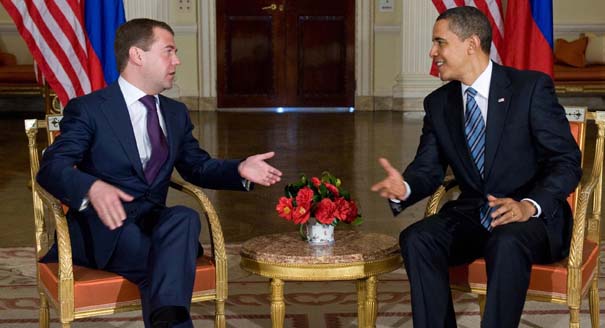
U.S. President Barack Obama made a good start at resetting the relationship with Russia in his first visit to Moscow. He now has to ensure that the American side follows-up on his openings and insist that his colleague in Moscow does the same.

Link Copied
By James F. Collins
Published on Jul 9, 2009

U.S. President Barack Obama made a good start at resetting the relationship with Russia in his first visit to Moscow.  

He made concrete progress on important agenda items. The agreement on strategic arms, measures to prevent proliferation of weapons of mass destruction, broadening cooperation on Afghanistan, and reestablishing a substantive exchange between the U.S. and Russian military take the agenda he and Russian President Dmitri Medvedev agreed upon in London a significant step forward. No less important is that the presidents agreed to a structure to oversee the future relations and took personal responsibility for the work of that institution.
 
Obama also carried his "vision of the possible" to the Russian people more broadly. The speech at the New Economic School was addressed to the coming generation and spoke to exactly the right points. We shall have to see whether the Russian people, particularly a quite cynical younger generation, listened. But Obama’s points about the young taking responsibility for a 21st century agenda and making the decisions that will shape it was on target. He effectively combined the sense of America committed to certain principles in a new era with a challenge to new Russia's emerging leaders to join us in tackling an agenda of the future. 
Obama was not drawn into the games and shenanigans that occupy observers trying to figure out who really has power in Russia.
Finally, Obama also managed the complex Russian leadership effectively and appropriately. He avoided any hint of playing to one of the leaders in Moscow and spoke effectively to the totality of the Russian leadership. He was, in short, not drawn into the games and shenanigans that occupy observers trying to figure out who really has power in Russia. 
 
The outcome of the visit will now turn on how well it is followed-up. The two presidents set down a number of principles to guide key negotiations between Russia and the United States. They opened significant opportunities to be exploited to advance their ambitious agenda and strengthen the cooperation between the two countries. If these opportunities are successfully and effectively followed-up, even those areas where there clearly was no meeting of the minds and where significant differences remain will be easier to manage over time.  
The structure created to manage relations offers an institutional venue to address problems.

In this regard, negotiations over the follow-on to START have a solid foundation but will continue to face difficult issues. The development of greater cooperation on Afghanistan appears promising. Differences over Iran, missile defense, European security systems, etc. remain, but it is constructive that these issues were discussed, some agreement to joint exploration of options appears to have emerged, and the channels of communication on these issues are open.  No less significantly, the structure created to manage relations offers an institutional venue to address problems as they arise in these areas.  
 
In sum, President Obama should be satisfied that he made significant progress. He now has to ensure that the American side follows-up on his openings and insist that his colleague in Moscow does the same. 

About the Author

James F. Collins

Nonresident Senior Fellow, Russia and Eurasia Program; Diplomat in Residence

Ambassador Collins was the U.S. ambassador to the Russian Federation from 1997 to 2001 and is an expert on the former Soviet Union, its successor states, and the Middle East.

    Recent Work

  • Article
    Daunting Challenges and Glimmers of Hope in Ukraine

      James F. Collins

  • Commentary
    The Game Changer: Cooperative Missile Defense

      Dmitri Trenin, James F. Collins

James F. Collins
Nonresident Senior Fellow, Russia and Eurasia Program; Diplomat in Residence
James F. Collins
North AmericaUnited StatesCaucasusRussiaSecurityForeign Policy

Carnegie India does not take institutional positions on public policy issues; the views represented herein are those of the author(s) and do not necessarily reflect the views of Carnegie, its staff, or its trustees.

More Work from Carnegie India

  • Commentary
    The Impact of U.S. Sanctions and Tariffs on India’s Russian Oil Imports

    This piece examines India’s response to U.S. sanctions and tariffs, specifically assessing the immediate market consequences, such as alterations in import costs, and the broader strategic implications for India’s energy security and foreign policy orientation.

      Vrinda Sahai

  • Article
    Military Lessons from Operation Sindoor

    The India-Pakistan conflict that played out between May 6 and May 10, 2025, offers several military lessons. This article presents key takeaways from Operation Sindoor and breaks down how India’s preparations shaped the outcome and what more is needed to strengthen future readiness.

      Dinakar Peri

  • Book
    India and the Sovereignty Principle: The Disaggregation Imperative

    This book offers a comprehensive analysis of India's evolving relationship with sovereignty in a complex global order. Moving beyond conventional narratives, it examines how the sovereignty principle shapes India's behavior across four critical domains—from traditional military power to contemporary data governance.

      Rudra Chaudhuri, Nabarun Roy

  • Commentary
    NISAR Soars While India-U.S. Tariff Tensions Simmer

    On July 30, 2025, the United States announced 25 percent tariffs on Indian goods. While diplomatic tensions simmered on the trade front, a cosmic calm prevailed at the Sriharikota launch range. Officials from NASA and ISRO were preparing to launch an engineering marvel into space—the NASA-ISRO Synthetic Aperture Radar (NISAR), marking a significant milestone in the India-U.S. bilateral partnership.

      Tejas Bharadwaj

  • Article
    Hidden Tides: IUU Fishing and Regional Security Dynamics for India

    This article examines the scale and impact of Chinese IUU fishing operations globally and identifies the nature of the challenge posed by IUU fishing in the Indian Ocean Region (IOR). It also investigates why existing maritime law and international frameworks have struggled to address this growing threat.

      Ajay Kumar, Charukeshi Bhatt

Get more news and analysis from
Carnegie India
Carnegie India logo, white
Unit C-4, 5, 6, EdenparkShaheed Jeet Singh MargNew Delhi – 110016, IndiaPhone: 011-40078687
  • Research
  • About
  • Experts
  • Projects
  • Events
  • Contact
  • Careers
  • Privacy
  • For Media
Get more news and analysis from
Carnegie India
© 2026 Carnegie Endowment for International Peace. All rights reserved.