

Commentary
Amr Hamzawy
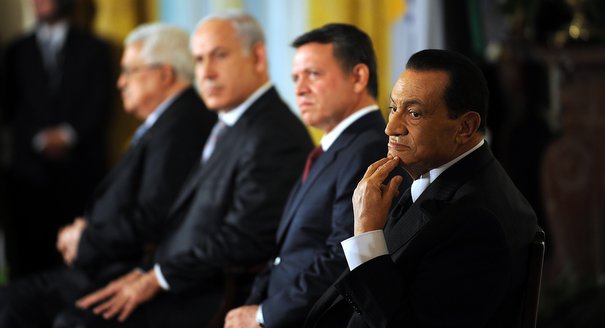
Source: Getty
President Mubarak's recent trip to Washington focused primarily on rekindling the Washington-Cairo relationship and reaffirming Egypt's strategic role in the region. Regional issues remained the priority, with the Obama administration pursuing a measured approach toward the controversial topic of democracy promotion.
Stepping away from Egypt’s state-run media hyperbole and its excessive use of the term “historic visit” to describe President Mubarak’s recent trip to Washington, one can assert that the visit was successful and deserves to be assessed as such by both the American and Egyptian sides.
The Obama administration is primarily concerned with Egypt’s regional role on various fronts: the Arab-Israeli conflict, the future of Iraq after the US military withdrawal, and containing Iranian ambition in the Middle East. In this regard, the US needs the help of its strategic ally, Cairo, and Arab capitals, like Riyadh, to materialize its intense diplomatic activities during the last few months. First, it aspires to achieve a final Palestinian-Israeli settlement; second, to achieve a Syrian-Israeli resolution; third, to create a favorable international environment for political and security stability in Iraq; and fourth, to alter Iran’s foreign policies by putting an end to its intervention in Arab countries and its exploitation of the Arab-Israeli conflict zones in Palestine and Lebanon to gain more regional influence. In this regard, the Obama administration clearly realizes that the key to activating its strategic alliance with Egypt dictates redefining the bilateral relationship between the two to overcome the tension of recent years. A step in that direction is to focus on economic, social and environmental development with keeping a slight concern regarding democratization and human rights practices in a manner acceptable to the Egyptian side; especially with the upcoming parliamentary and presidential elections in 2010 and 2011.
President Obama’s comments in the joint media conference clearly exemplify the order of his administration’s priorities. Regional issues topped the list. Obama has continuously emphasized peace between the Arabs and Israel and Egypt’s important role in achieving a final peace settlement. He then addressed the importance of a regional opening towards Iraq, then ended by discussing the importance of bilateral relationship between the US and Egypt in economic development, education, and public health. Obama also briefly commented on positive changes of Israeli Settlement policies and his desire to achieve a final peace settlement in the Middle East. At the same time, Washington has been keen to affirm that democracy promotion and human rights practices are of concern to the administration. The State Department declared that the US Secretary of State, Hillary Clinton, did indeed address democracy promotion, human rights practices, and political reform with Mubarak. Media debates held in the US contain increasing calls against the comeback, of what a Washington Post editorial described as, “embracing Arab autocrats’ policy”, to secure and protect US interests in the Middle East. The fact that Obama did not even come close to mentioning either democratization or human rights in Egypt clearly signifies the limited interest of the US administration in these issues. And on the other hand, it also signals the adoption of a variant approach than the Bush administration’s when addressing these issues, by relying strictly on closed-room talks and refusing to interlink issues of democratization and Washington’s strategic alliance with Egypt.
The Mubarak agenda in Washington also sought to place regional issues on top; driven by its fear of the sluggish peace process between the Arabs and Israel and its conviction that this will pave the way for an increased Iranian influence – which Cairo perceives as the greatest threat to its security and Middle East stability. Egypt, like other Arab countries, warmly welcomed the Obama administration policy shift in the region with its speedy military retreat from Iraq and increasing emphasis on resolving the Arab-Israeli conflict in a manner unlike Bush’s complete bias to Israel. The fact that Mubarak has placed regional issues on the forefront is of no surprise. This step is in harmony with the Egyptian role, which even though it has taken a backseat in the last years, remains a central role capable of playing with various cards to create a new moment of negotiation opportunity. Egypt is not a small country with a president that visits Washington to discuss bilateral relations or to receive instructions on its internal affairs, it is the duty and status of its president to refuse to be limited to bilateral relations; and here, Mubarak has rightly positioned regional issues on the fore.
On the other hand, Mubarak and the Egyptian government realize that past years’ tension between Washington and Cairo have left many unresolved scars that must be dealt with. The Egyptian side should also be aware that even though the Obama administration has limited its democracy and human rights discussion, it will still implicitly push for an unpublicized and subtle discussion on it. Efforts to achieve a positive impact on the relationship between the countries would require an Egyptian opening in that direction. Remarkably, while Obama has opted for silence, Mubarak stated during the joint conference that they have discussed reform in Egypt. Mubarak said that he has affirmed to the American president his determination to pursue his 2005 reform program upon which he was elected. Despite my many doubts of Mubarak’s intentions for reform and political opening and the fact that the Egyptian government has not, during the past years, come forward with any step towards real democracy but continued its oppressive practices against political competition and diversity; what is important to record is the varying shift of the two countries’ approach to democracy promotion. By abstaining from assuming his predecessor’s role - who used to publicly criticize antidemocratic and human rights practices - Obama spared his visitor a defensive position of downgrading the importance of the raised criticisms. Mubarak’s optimistic view indicates – even though we as Egyptians highly doubt its credibility - that there is a possibility for launching a calm and uninterrupted dialogue between the US and Egypt that is nothing like what the Bush Administration and the Egyptian government had, which has led to the increasing tensions between the two countries and a personal dislike between its presidents.
It is the right of Egyptian-Americans and those who are interested in democracy and human rights - whether writers or US institutions - to criticize the Obama administration on its limited interest in democracy promotion and human rights and to protest against its public silence. However, I have faith in the ability of Obama’s quiet diplomacy and closed-room talks to bring the Egyptian side to openly deal with the US vision and lead to a gradual accumulation that will allow Washington to have a somewhat positive impact on Egypt. In the meantime, and with utmost realism, the current conditions in the Middle East do not allow Obama to do more than what he is doing, and his administration on its own does not have the capabilities to push Egypt towards achieving substantial democratic changes or preventing presidential succession. Maybe it simply regards presidential succession in Egypt as a guarantee of stability for a strategic ally in a disrupted region. What is clear is that Egypt’s internal matters and the paths drawing the future of the country’s political life are in the hands of the Egyptians alone – and no one else.

Director, Middle East Program
Amr Hamzawy is a senior fellow and the director of the Carnegie Middle East Program. His research and writings focus on Egypt’s and other middle powers’ involvement in regional security in the Middle East, particularly through collective diplomacy and multilateral conflict resolution
Recent Work
Amr Hamzawy
Amr Hamzawy
Carnegie India does not take institutional positions on public policy issues; the views represented herein are those of the author(s) and do not necessarily reflect the views of Carnegie, its staff, or its trustees.

How is AI reshaping space security, creating governance challenges, and where does international diplomacy stand today?


Tejas Bharadwaj, Almudena Azcárate Ortega

After the chill in ties between 2020 and 2024 that brought India–China relations to their lowest point in several decades, the two countries have engaged each other afresh. This paper argues that there are predominantly four imperatives guiding India’s approach to China, and they exist in an order of priority.

Saheb Singh Chadha

This piece argues that India’s central challenge is not managing a single flashpoint but resolving the underlying tension between expansion and institutional coherency of the BRICS grouping.

Vrinda Sahai

A partnership between India, a country of subcontinental size, and Africa, a continent of fifty-four countries, may seem asymmetric until one notes that both are home to nearly the same number of people—1.4 billion. This essay spells out the existing challenges to the partnership, its optimal potential, and the possible pathways to realize it over the next quarter-century.

Rajiv Bhatia

The U.S.–India semiconductor cooperation story is well-stocked with top-level strategic intent. What remains unresolved, however, are some underlying challenges that will determine whether the cooperation actually functions. Three such friction points stand out.

Shruti Mittal