
• Research
  • About
  • Experts
Carnegie India logoCarnegie lettermark logo
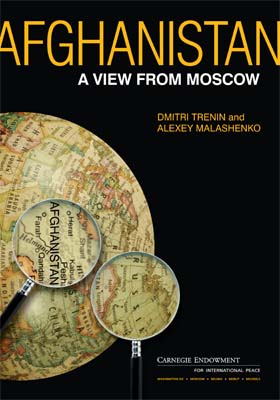
Afghanistan: A View from Moscow
Report
Carnegie Russia Eurasia Center

Afghanistan: A View from Moscow

Despite its importance, Russia’s perspective on the war in Afghanistan has typically been missing from previous analyses of coalition policy. Moscow views Afghanistan largely through the prism of security threats to itself and its Central Asian neighborhood.

Link Copied
By Dmitri Trenin and Alexey Malashenko
Published on Apr 27, 2010

Additional Links

Full Text
Project hero Image

Project

Eurasia in Transition

Learn More

Despite its importance, Russia’s perspective has been missing from many previous analyses of coalition policy in Afghanistan. Dmitri Trenin and Alexey Malashenko fill that gap with a report that takes a fresh look at the coalition’s involvement in Afghanistan. They conclude that Moscow is an essential part of the Afghan equation that is often overlooked.

Russia remains cautious about becoming too involved in the conflict, but Moscow fears the prospect of instability in Central Asia and drug trafficking from Afghanistan. Russia wants to:

  • Prevent an outright Taliban victory fearing that if the Taliban regain control they could export radicalism and support rebel activity in Russia’s near abroad. Even though there is a rivalry with the United States for influence in Central Asia, Russia essentially supports the U.S.–led coalition.
     
  • Stem the flow of drugs out of Afghanistan to Russia’s consumers. Its leaders worry about the exponential growth in narcotics production of narcotics in Afghanistan since the fall of the Taliban.
     
  • Restore a neutral, pacified Afghanistan to serve as a buffer state between Central Asia and the Greater Middle East.

“Russia views Afghanistan today largely through the prism of security threats to itself and its Central Asian neighborhood, where Moscow aspires to soft dominance,” write Trenin and Malashenko.
 

About the Authors

Dmitri Trenin

Former Director, Carnegie Moscow Center

Trenin was director of the Carnegie Moscow Center from 2008 to early 2022.

Alexey Malashenko

Former Scholar in Residence, Religion, Society, and Security Program

Malashenko is a former chair of the Carnegie Moscow Center’s Religion, Society, and Security Program.

Authors

Dmitri Trenin
Former Director, Carnegie Moscow Center
Alexey Malashenko
Former Scholar in Residence, Religion, Society, and Security Program
Alexey Malashenko
South AsiaAfghanistanCaucasusRussiaAsiaForeign Policy

Carnegie India does not take institutional positions on public policy issues; the views represented herein are those of the author(s) and do not necessarily reflect the views of Carnegie, its staff, or its trustees.

More Work from Carnegie India

  • Commentary
    The Impact of U.S. Sanctions and Tariffs on India’s Russian Oil Imports

    This piece examines India’s response to U.S. sanctions and tariffs, specifically assessing the immediate market consequences, such as alterations in import costs, and the broader strategic implications for India’s energy security and foreign policy orientation.

      Vrinda Sahai

  • Commentary
    NISAR Soars While India-U.S. Tariff Tensions Simmer

    On July 30, 2025, the United States announced 25 percent tariffs on Indian goods. While diplomatic tensions simmered on the trade front, a cosmic calm prevailed at the Sriharikota launch range. Officials from NASA and ISRO were preparing to launch an engineering marvel into space—the NASA-ISRO Synthetic Aperture Radar (NISAR), marking a significant milestone in the India-U.S. bilateral partnership.

      Tejas Bharadwaj

  • Commentary
    Indian Airstrikes in Pakistan: May 7, 2025

    On May 7, 2025, between 1:05 and 1:30 a.m. (IST), airstrikes carried out by the Indian Air Force hit nine locations inside Pakistan and Pakistan occupied Kashmir (PoK). It was codenamed Operation Sindoor.

      Rudra Chaudhuri

  • Research
    Views From Taipei: Essays by Young Indian Scholars on China

    This compendium brings together three essays by scholars who participated in Carnegie India's Security Studies Dialogue in 2024, each examining a different aspect of China’s policies. Drawing on their expertise and research, the authors offer fresh perspectives on key geopolitical challenges.

      • +1

      Vijay Gokhale, Suyash Desai, Amit Kumar, …

  • Commentary
    The India-U.S. TRUST Initiative: Advancing Semiconductor Supply Chain Cooperation

    As part of the TRUST initiative, leaders of the two countries committed to building trusted and resilient supply chains, including for semiconductors and critical minerals. India and the United States have made steady progress in this area over the years. This essay explores the takeaways from discussions on semiconductor supply chains that took place at Carnegie India’s 9th Global Technology Summit.

      Konark Bhandari

Get more news and analysis from
Carnegie India
Carnegie India logo, white
Unit C-4, 5, 6, EdenparkShaheed Jeet Singh MargNew Delhi – 110016, IndiaPhone: 011-40078687
  • Research
  • About
  • Experts
  • Projects
  • Events
  • Contact
  • Careers
  • Privacy
  • For Media
Get more news and analysis from
Carnegie India
© 2026 Carnegie Endowment for International Peace. All rights reserved.







