• Research
  • About
  • Experts
Carnegie India logoCarnegie lettermark logo
AI
War in Saada: From Local Insurrection to National Challenge

Source: Getty

Paper

War in Saada: From Local Insurrection to National Challenge

The Yemeni government is mired in an unwinnable and sporadic civil conflict in the northern governorate of Saada that has weakened the central government, accelerated the economic crisis, and threatens global stability by emboldening al-Qaeda.

Link Copied
By Christopher Boucek
Published on May 5, 2010

Additional Links

Full Text

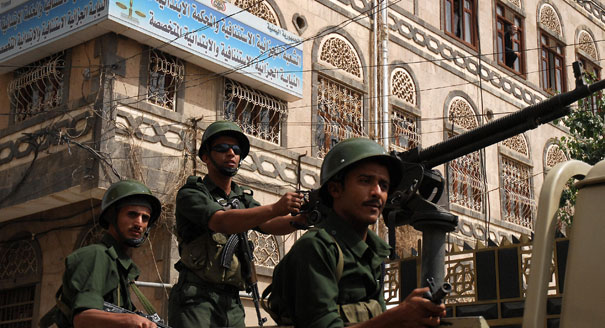
The Yemeni government has been mired in an unwinnable and sporadic civil conflict in the northern governorate of Saada since 2004. This war has weakened the central government, accelerated the economic crisis, and threatened global stability by emboldening al-Qaeda, concludes a paper by Christopher Boucek.

Key conclusions about the conflict in Saada:

  • Fighting likely to continue. The current cease-fire agreed to in February 2010 is likely to fail as the central government shows little interest in addressing the core grievances of the rebelling Houthis.
     
  • Priorities are misguided. The Southern secessionist movement is Yemen’s more serious security threat, but the regime is more involved in Saada for two key reasons: the government believes the war is winnable, and uses the military operations in the North to send a message to agitators in the South.
     
  • Costs are escalating. In the six years the war evolved from a local insurrection into a national challenge, devastating the economy and consuming crucial resources.
     
  • Burdens disproportionately felt by noncombatants. The six rounds of fighting came with high humanitarian costs. Hostilities displaced over 250,000 people, killed hundreds or thousands (the exact number of casualties is unknown), and destroyed significant civilian infrastructure.
     
  • Conflict expands beyond borders. When Saudi Arabia’s military entered the conflict in November 2009 following Houthi incursions, conditions went from bad to worse. But there is no evidence that the conflict in Saada is a proxy war between Saudi Arabia and Iran as commonly asserted.

“The government’s uncompromising position in Saada has exacerbated local grievances and rapidly accelerated Yemen’s economic crisis,” writes Boucek. “Without a serious international effort at mediation, further fighting is inevitable—and poses a serious threat to Yemeni stability.”

 

About the Author

Christopher Boucek

Former Associate, Middle East Program

Boucek was an associate in the Carnegie Middle East Program where his research focused on security challenges in the Arabian Peninsula and Northern Africa.

    Recent Work

  • Q&A
    Yemen After Saleh’s Return and Awlaki’s Exit

      Christopher Boucek

  • Q&A
    Rivals—Iran vs. Saudi Arabia

      Christopher Boucek, Karim Sadjadpour

Christopher Boucek
Former Associate, Middle East Program
Christopher Boucek
Middle EastYemenGulfPolitical ReformSecurityForeign Policy

Carnegie India does not take institutional positions on public policy issues; the views represented herein are those of the author(s) and do not necessarily reflect the views of Carnegie, its staff, or its trustees.

More Work from Carnegie India

  • Commentary
    The Impact of U.S. Sanctions and Tariffs on India’s Russian Oil Imports

    This piece examines India’s response to U.S. sanctions and tariffs, specifically assessing the immediate market consequences, such as alterations in import costs, and the broader strategic implications for India’s energy security and foreign policy orientation.

      Vrinda Sahai

  • Article
    Military Lessons from Operation Sindoor

    The India-Pakistan conflict that played out between May 6 and May 10, 2025, offers several military lessons. This article presents key takeaways from Operation Sindoor and breaks down how India’s preparations shaped the outcome and what more is needed to strengthen future readiness.

      Dinakar Peri

  • Book
    India and the Sovereignty Principle: The Disaggregation Imperative

    This book offers a comprehensive analysis of India's evolving relationship with sovereignty in a complex global order. Moving beyond conventional narratives, it examines how the sovereignty principle shapes India's behavior across four critical domains—from traditional military power to contemporary data governance.

      Rudra Chaudhuri, Nabarun Roy

  • Commentary
    NISAR Soars While India-U.S. Tariff Tensions Simmer

    On July 30, 2025, the United States announced 25 percent tariffs on Indian goods. While diplomatic tensions simmered on the trade front, a cosmic calm prevailed at the Sriharikota launch range. Officials from NASA and ISRO were preparing to launch an engineering marvel into space—the NASA-ISRO Synthetic Aperture Radar (NISAR), marking a significant milestone in the India-U.S. bilateral partnership.

      Tejas Bharadwaj

  • Article
    Hidden Tides: IUU Fishing and Regional Security Dynamics for India

    This article examines the scale and impact of Chinese IUU fishing operations globally and identifies the nature of the challenge posed by IUU fishing in the Indian Ocean Region (IOR). It also investigates why existing maritime law and international frameworks have struggled to address this growing threat.

      Ajay Kumar, Charukeshi Bhatt

Get more news and analysis from
Carnegie India
Carnegie India logo, white
Unit C-4, 5, 6, EdenparkShaheed Jeet Singh MargNew Delhi – 110016, IndiaPhone: 011-40078687
  • Research
  • About
  • Experts
  • Projects
  • Events
  • Contact
  • Careers
  • Privacy
  • For Media
Get more news and analysis from
Carnegie India
© 2026 Carnegie Endowment for International Peace. All rights reserved.