

In The Media
Lilia Shevtsova

While the "reset" in U.S.–Russian relations has come with closer cooperation on arms control, Afghanistan, and Iran, as long as Russia's system of personalized power rests on anti-Western principles, a true reset is unattainable.
Source: Washington

Is it possible to reform the Russian system from the top? Could technological innovation help Russia’s political liberalization? What are the domestic roots of Russia’s foreign policy and how sustainable is the current reset with the United States?
In Lonely Power, adapted from the Russian version, Lilia Shevtsova questions the veracity of clichés about Russia—by both insiders and outsiders—and analyzes Russia’s trajectory and how the West influences the country’s modernization.
Rejection of real reform in Russia risks gradual decay of the political system or even state collapse. Russia can break this vicious circle only if it rejects personalized power and if the West helps Russia transform economically and politically.
“Lilia Shevtsova is one of Russia's best-known political analysts, equally at home in the academic world and in the more robust exchanges of journalism and the media.”
—The Economist on the Russian version of Lonely Power

Former Senior Associate, Russian Domestic Politics and Political Institutions Program, Moscow Center
Shevtsova chaired the Russian Domestic Politics and Political Institutions Program at the Carnegie Moscow Center, dividing her time between Carnegie’s offices in Washington, DC, and Moscow. She had been with Carnegie since 1995.
Recent Work
Lilia Shevtsova
Lilia Shevtsova
Carnegie India does not take institutional positions on public policy issues; the views represented herein are those of the author(s) and do not necessarily reflect the views of Carnegie, its staff, or its trustees.

After the chill in ties between 2020 and 2024 that brought India–China relations to their lowest point in several decades, the two countries have engaged each other afresh. This paper argues that there are predominantly four imperatives guiding India’s approach to China, and they exist in an order of priority.

Saheb Singh Chadha

This piece argues that India’s central challenge is not managing a single flashpoint but resolving the underlying tension between expansion and institutional coherency of the BRICS grouping.

Vrinda Sahai

A partnership between India, a country of subcontinental size, and Africa, a continent of fifty-four countries, may seem asymmetric until one notes that both are home to nearly the same number of people—1.4 billion. This essay spells out the existing challenges to the partnership, its optimal potential, and the possible pathways to realize it over the next quarter-century.

Rajiv Bhatia

The India–EU Free Trade Agreement (FTA) is shaping up to be one of the most consequential trade negotiations, both economically and strategically. But, what’s in the agreement, what’s missing, and what will determine its success in the years ahead
Vrinda Sahai, Nicolas Köhler-Suzuki
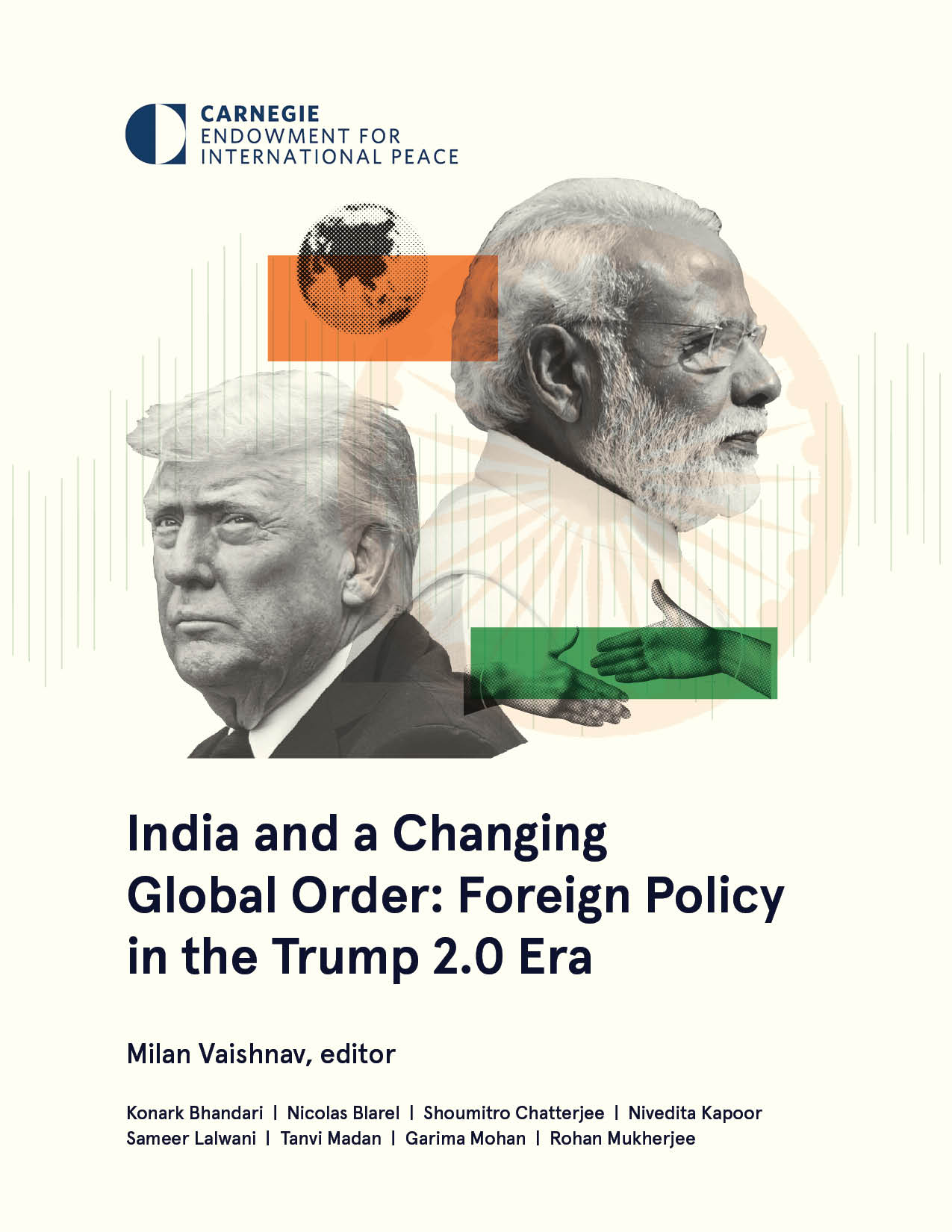
Trump 2.0 has unsettled India’s external environment—but has not overturned its foreign policy strategy, which continues to rely on diversification, hedging, and calibrated partnerships across a fractured order.



Milan Vaishnav, ed., Sameer Lalwani, Tanvi Madan, …