
• Research
  • About
  • Experts
Carnegie India logoCarnegie lettermark logo
AI
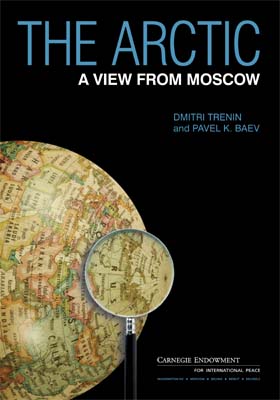
The Arctic: A View From Moscow
Report
Carnegie Russia Eurasia Center

The Arctic: A View From Moscow

As the melting Arctic ice cap opens new shipping lanes and makes it easier to access strategic energy reserves, countries are racing to gain control over the Arctic’s abundant natural resources.

Link Copied
By Dmitri Trenin and Павел Баев
Published on Sep 20, 2010

Additional Links

Full Text

The Arctic is emerging as the world’s next hot spot for oil and gas development. As the melting ice cap opens new shipping lanes and makes it easier to access strategic energy reserves, countries are racing to gain control over the Arctic’s abundant natural resources.

 In a report, Dmitri Trenin and Pavel Baev offer a view from Moscow on what the opening of the Arctic means. While there is a strong desire to compete over the resources in order to meet increasing energy demands, Trenin and Baev argue that all countries—with Russia in a leading role—can benefit more through cooperation.

 Key Conclusions:

  • Sizable energy reserves. The Arctic potentially contains 20 percent of the world’s oil and gas reserves. The Arctic territory claimed by Russia could be home to twice the volume of Saudi Arabia’s oil resources.
     
  • Warmer climate. The Arctic’s ice is melting and over time Russia’s Northern Sea Route—linking the Atlantic and Pacific Oceans—could become commercially profitable.
     
  • Chance for cooperation. Russia should help bring other Arctic countries together—notably Canada, Denmark, Norway, and the United States—to manage the area peacefully and focus on its economic benefits.

 “As countries around the globe continue to rely on a dwindling number of oil and gas reserves to serve their energy needs, the Arctic territory—parts of which remain unclaimed—will continue to be an area of intense geopolitical interest,” Trenin and Baev write. “Russia’s role in fostering either goodwill or rivalry will have implications for countries far from the Arctic’s icy waters.”

About the Authors

Dmitri Trenin

Former Director, Carnegie Moscow Center

Trenin was director of the Carnegie Moscow Center from 2008 to early 2022.

Павел Баев

Authors

Dmitri Trenin
Former Director, Carnegie Moscow Center
Павел Баев

Additional Links

Full Text
CaucasusRussiaNorth AmericaEconomyClimate ChangeForeign Policy

Carnegie India does not take institutional positions on public policy issues; the views represented herein are those of the author(s) and do not necessarily reflect the views of Carnegie, its staff, or its trustees.

More Work from Carnegie India

  • Paper
    Threading the Needle: India’s Path Forward with China

    After the chill in ties between 2020 and 2024 that brought India–China relations to their lowest point in several decades, the two countries have engaged each other afresh. This paper argues that there are predominantly four imperatives guiding India’s approach to China, and they exist in an order of priority.

      Saheb Singh Chadha

  • Article
    Managing Divergence: India’s BRICS Presidency in 2026

    This piece argues that India’s central challenge is not managing a single flashpoint but resolving the underlying tension between expansion and institutional coherency of the BRICS grouping.

      Vrinda Sahai

  • Article
    India–Africa Strategic Partnership: Challenges, Potential, and Possible Pathways

    A partnership between India, a country of subcontinental size, and Africa, a continent of fifty-four countries, may seem asymmetric until one notes that both are home to nearly the same number of people—1.4 billion. This essay spells out the existing challenges to the partnership, its optimal potential, and the possible pathways to realize it over the next quarter-century.

      Rajiv Bhatia

  • Commentary
    Emerging From the “Zombie State” of Trade Agreements: The India-EU FTA

    The India–EU Free Trade Agreement (FTA) is shaping up to be one of the most consequential trade negotiations, both economically and strategically. But, what’s in the agreement, what’s missing, and what will determine its success in the years ahead

      Vrinda Sahai, Nicolas Köhler-Suzuki

  • Article
    India’s Press Note 3 Gamble: Opening the FDI Door to China

    On March 10, 2026, India’s Union Cabinet approved amendments to Press Note 3, a regulation that mandated government approval on all foreign direct investment (FDI) from countries sharing a land border with India. This amendment raises questions primarily about whether its stated benefits will materialize and if the risks have been adequately weighed. This piece will address the same.

      Konark Bhandari

Get more news and analysis from
Carnegie India
Carnegie India logo, white
Unit C-4, 5, 6, EdenparkShaheed Jeet Singh MargNew Delhi – 110016, IndiaPhone: 011-40078687
  • Research
  • About
  • Experts
  • Projects
  • Events
  • Contact
  • Careers
  • Privacy
  • For Media
Get more news and analysis from
Carnegie India
© 2026 Carnegie Endowment for International Peace. All rights reserved.




