

Commentary
How is AI reshaping space security, creating governance challenges, and where does international diplomacy stand today?
Tejas Bharadwaj, Almudena Azcárate Ortega
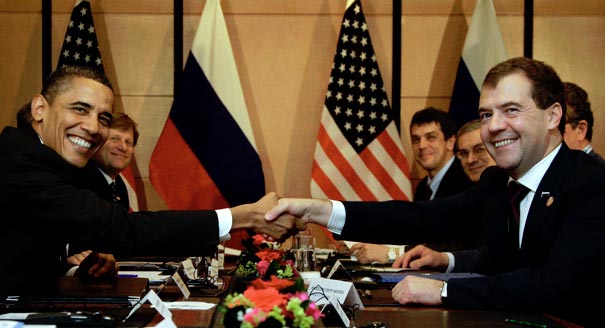
Source: Getty
The U.S.-Russia reset is off to a solid beginning, but it is incomplete in many respects; while the countries have made good progress in their relationship, much remains to be done.
When we, former ambassadors to Washington and Moscow from Russia and the United States last came together in September 2008, the U.S.-Russia relationship had reached a post–Cold War low point. We urged immediate attention to setting a new course that would restore effective cooperation.
Our recent discussions concluded that the two-year reset of policy undertaken by the American and Russian governments has gone a great way toward a comprehensive revival of cooperation on security and economic issues and toward establishing a framework to manage working level cooperation between the sides.
Our presidents have signed the New START treaty and the “123 agreement” on civilian nuclear cooperation has been resubmitted to the U.S. Congress; our governments have implemented a firm multilateral response to Iran’s continuing defiance of the global nuclear nonproliferation regime; they are cooperating on preventing further deterioration of the situation in Afghanistan and responding to potential crises elsewhere in Central Asia; they have advanced the process of Russia’s accession to the WTO, and worked cooperatively to address the global financial crisis.
We are similarly encouraged that the two presidents and their administrations have institutionalized the conduct of the U.S.-Russia relationship by establishing the Bilateral Presidential Commission (BPC). And we noted that the BPC has made substantial progress on key elements of its comprehensive agenda through concerted efforts by many of its working groups to engage with nongovernmental actors on both sides of the relationship. In sum, we have made a good beginning.
At the same time, the reset is in many respects incomplete and the relationship remains fragile. To consolidate our gains and move beyond the lingering uncertainty and suspicion that remains in U.S.-Russia relations will require sustained effort. It is vital to invigorate the work of the BPC across the full breadth of its agenda, and our discussion concluded that the next phase of work should focus in three principal areas:
We agreed that ratification of the New START Treaty and completing the steps to bring the 123 agreement into force remain essential to preserving our agenda on strategic arms control and our position of global leadership in efforts to prevent the proliferation of nuclear weapons. Completion of Russia’s WTO accession is required to build a framework to resolve perennial trade disputes, develop future Russian-American cooperation in support of Russia’s modernization program, and expand our bilateral economic relations to the level of their potential. Continuation of constructive post-reset cooperation on Afghanistan and issues associated with Iran’s nuclear program will, meanwhile, strengthen a qualitatively new capacity to work jointly on those two issues, which are of vital importance to the security of both nations.
Beyond these immediate steps we also considered how the BPC might shape its agenda and work in the next phase.
To maintain strategic arms control as a source of strength for U.S.-Russia relations will require our two countries to address new and controversial subjects, including negotiation of further significant reductions of operational strategic arms, the role of ballistic missile defense, and the possibility of inviting other nuclear weapon states to join the ongoing nuclear arms control process.
We believe as well that it is timely to build further on our defense cooperation on Afghanistan, and we urge our governments to begin discussion and planning about post-conflict cooperation in the region. Our mutual interest in Afghanistan’s stable and peaceful development should impel both governments to develop joint approaches toward the issues of narcotics and preventing terrorists from again making Afghanistan a haven.
In order to strengthen our bilateral relations, we agreed that the economic dimension should receive significantly enhanced attention. This will require engagement from both governments and the private sector. In particular, we believe that enhancing scientific and technical cooperation and strengthening the legal and regulatory framework, including possible conclusion of a new Bilateral Investment Treaty, should receive priority attention. We similarly concluded that the field of health is an area of particular promise for cooperation, and we urge that the BPC’s Working Group on Health become more active in supporting and encouraging an expanded agenda of cooperative research and development and joint programming in this field.
Finally, in discussing the BPC itself, we noted that despite half a century’s effort, leaders in Moscow and Washington have yet to create a permanent institutional framework for the conduct of relations between our two nations. A number of different models have been tried but have failed to outlast changes in the leadership each was designed to serve. We believe the interests of both nations now call for a change in that pattern, and we recommend to both our governments that they begin to discuss how to make permanent the essential institutional framework for guiding our relations.
We believe the steps outlined here will carry us some distance toward stable U.S.-Russia bilateral relations and toward making our cooperation more effective in addressing the new century’s global challenges. Nevertheless, we noted that today, two decades after the end of the Cold War and collapse of the USSR, our thinking all too easily reverts to Cold War stereotypes and preserves outdated patterns of conducting business. To change that pattern will require us to move beyond reset, to take steps that will promote a more fundamental change in the political consciousness in both countries.
First and foremost, this will require that our presidents, political leaders, and those who shape the opinions of our people put away once and for all Cold War stereotypes and begin to rethink how U.S.-Russia relations can place security cooperation—not competition—at the center of our shared future. To do so will demand bold and creative policy as well as readiness to resolve and reconcile issues and disputes with deep roots.
As a first step, we believe a full review of the rules, regulations, and systems that govern the interaction between our two societies is overdue. We are convinced that enlarging opportunities and removing impediments to free and normal contacts between our people and strengthening the rule of law is essential to breaking down old barriers and stereotypes and to promoting broader exchange among people and partnerships in the arts, education, science, media, and sports. To promote this objective, we urge both governments to undertake a thorough review of the visa regimes that presently govern the travel of our citizens. We recommend that each government undertake a study of its current system and the implications it has for the full range of our relations with the objective of minimizing the impact the visa systems and travel regulation have on the free movement of people between our societies and on the development of civic partnerships.
Establishing an effective and inclusive security system for the Euro-Atlantic region is an important task that would have a profound impact in removing sources of tension and suspicion in our relations. Concrete actions by both sides and by our allies have begun to put the key elements of a broader, inclusive new vision for a Euro-Atlantic security community on the table. Both sides have likewise demonstrated restraint and a new readiness to cooperate on threats to shared interests in the greater Eurasian region. However, there is a need for an effective process, building on the principles embodied in documents from the Helsinki Agreement to the Paris Charter, including arms reduction, to reconcile the divergent security priorities—politico-military, economic, and human security—of all stakeholders in this diverse space. Likewise, U.S.-Russia cooperation on the range of global issues, from terrorism to climate change and from confronting the economic crisis to shaping more effective means to combat international crime, have made a beginning. Now the challenge is to concentrate our focus on how our two countries can effectively cooperate in international efforts to address these issues and to deepen our cooperation in the United Nations toward that end. That will be our common contribution to global security and development.
In the last two years, our two countries have reversed the earlier dangerous downward spiral in relations. A new basis now exists for moving toward rebuilding a cooperative, productive, stable relationship based on mutual respect, strategic stability, and shared interest. To realize this potential will demand sustained and effective diplomacy, expanded engagement by our two societies, and shared commitment to putting cooperation at the center of U.S.-Russia relations. We urge President Medvedev and President Obama to give priority to supporting and leading this effort.
Alexander Bessmertnykh

Nonresident Senior Fellow, Russia and Eurasia Program; Diplomat in Residence
Ambassador Collins was the U.S. ambassador to the Russian Federation from 1997 to 2001 and is an expert on the former Soviet Union, its successor states, and the Middle East.
Yuri Dubinin
Arthur Hartman
Victor Komplektov
Vladimir Lukin
Jack Matlock
Thomas Pickering
Thomas Pickering is a former U.S. undersecretary of state for political affairs and ambassador to Russia, Israel and the UN.
Carnegie India does not take institutional positions on public policy issues; the views represented herein are those of the author(s) and do not necessarily reflect the views of Carnegie, its staff, or its trustees.

How is AI reshaping space security, creating governance challenges, and where does international diplomacy stand today?


Tejas Bharadwaj, Almudena Azcárate Ortega

After the chill in ties between 2020 and 2024 that brought India–China relations to their lowest point in several decades, the two countries have engaged each other afresh. This paper argues that there are predominantly four imperatives guiding India’s approach to China, and they exist in an order of priority.

Saheb Singh Chadha

This piece argues that India’s central challenge is not managing a single flashpoint but resolving the underlying tension between expansion and institutional coherency of the BRICS grouping.

Vrinda Sahai

A partnership between India, a country of subcontinental size, and Africa, a continent of fifty-four countries, may seem asymmetric until one notes that both are home to nearly the same number of people—1.4 billion. This essay spells out the existing challenges to the partnership, its optimal potential, and the possible pathways to realize it over the next quarter-century.

Rajiv Bhatia

The U.S.–India semiconductor cooperation story is well-stocked with top-level strategic intent. What remains unresolved, however, are some underlying challenges that will determine whether the cooperation actually functions. Three such friction points stand out.

Shruti Mittal