

Commentary
Marc Pierini
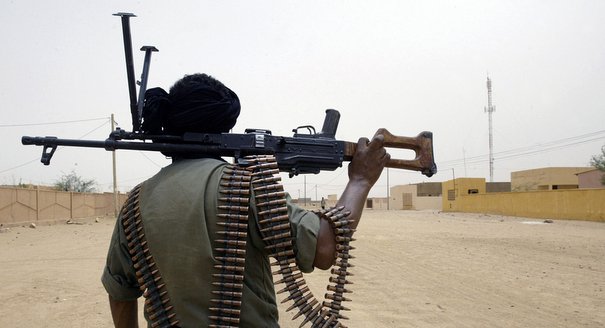
Source: Getty
The French military intervention in Mali illustrates what the fight against radical Islamists might look like in the future.
Seen from a European standpoint, the French military intervention in Mali illustrates what the fight against radical Islamists might look like in the years ahead. While Western democracies are disengaging from their long, costly, and frustrating Afghanistan operation, they are still facing immense threats from groups much smaller than al-Qaeda that have shifted both techniques and targets. As states engage in operations to combat these post-Afghanistan threats within new political and budgetary environments at home, their strengths and limitations tend to show more acutely, while resource pooling and sharing becomes a necessity.
Since early 2012, Islamist insurgents have controlled northern Mali. On January 11, France launched airstrikes to halt the insurgents’ advance further into the country, and West African nations have also approved the deployment of troops to confront the rebels. This French-African operation might provide a blueprint for international counterterrorism policies to come.
Along with the Horn of Africa, where piracy off the Somali coast presents a significant challenge, Mali and the Sahel more broadly have become the focus of radical Islamic groups. Al-Qaeda in the Islamic Maghreb (AQIM) has set up a base of operations in the region and is linked to other extremists, such as the Mali-based Ansar Dine and the Movement for Tawhid and Jihad in West Africa (MUJAO). In northern Mali, an insurgency made up of members of the Tuareg ethnic group (the National Movement for the Liberation of Azawad or MNLA) existed before the radical Islamist groups became involved. Boko Haram, meanwhile, is very active in Nigeria.According to French official statements during the past few days, the Malian Islamist groups are highly mobile, and they have effective weaponry and motivated fighters. In addition, they are funded in part by kidnapping foreign citizens for ransom, a pattern which is likely here to stay. They aim to seize vast expenses of territory, and in Mali they are challenging the very existence of the state, taking advantage of the political impasse in the capital, Bamako, and of the weakness of the armed forces. Their ultimate goal is, no doubt, to extend their grip on other countries, as incidents during the past two years in Mauritania, Niger, and northern Nigeria have illustrated.
In the worst-case scenario, Africa, Europe, and the West could be faced with the dire prospect of a destabilized West African region, with some countries or regions formally headed by radical religious groups while others will be permanently threatened by those groups. Such a destabilization of West Africa would also pose wider dangers, potentially threatening the sustainability of the region’s economy, the continuation of development and humanitarian projects, and the safety of expatriate workers. In that sense, the French intervention in Mali is an almost inevitable consequence of these terrorist groups’ strategy, especially as the insurgents decided to move swiftly toward Bamako.
There are other factors at play that made the intervention possible, which becomes clear when the situation in Mali is compared to other conflict situations, past or present, including those in Afghanistan, Libya, and Syria.
The United Nations Security Council unanimously supports the preservation of Mali’s territorial integrity and an international, mostly African force deployment. The only reason the French intervened on their own ahead of the creation of the multinational force was the Islamist insurgents’ sudden advance.
In this emergency phase, France is the de facto leader, primarily because preexisting positioning of troops and air assets in several African countries—Burkina Faso, Chad, Djibouti, Gabon, the Ivory Coast, and Senegal—gives it a decisive operational advantage over other Western countries. An EU operation in support of training and modernizing the Malian army is still in the organizational phase and will be implemented later.
Over the last few months, diplomatic efforts took place within the West African Economic Community (ECOWAS) and the United Nations framework to create the International Mission of Support in Mali (AFISMA). Benin, Burkina Faso, Niger, Nigeria, Senegal, and Togo are deploying contingents of 300–500 troops each to Mali.
Similarly, the United Kingdom is providing airlift support with two C17 transport planes, and the United States is deploying additional satellite and airborne intelligence assets as well as airborne refueling support. Denmark and Germany will contribute in a limited way. These contributions help to make up for some of the structural shortcomings of the French forces, such as their airlift, drone, and satellite capabilities.
Without entering into futile predictions about the length and depth of the French intervention in Mali, it can be said that Operation Serval represents a multifaceted test for France, the EU, and the West. Several questions arise. How much lasting and decisive support will Mali and France receive from friendly West African countries, and how timely and efficient will the EU training operation of Malian forces prove to be? How much further operational support will French forces receive from the United States and European partners? For example, what if there is a need for air assets that the French forces do not possess, such as AC-130 gunships, A-10 close air support aircraft, or missile-firing drones? Those capabilities are considered more suited than conventional fighter aircraft to the kind of operations currently under way, but only the United States can provide them.
As the NATO-led International Security and Assistance Force mission in Afghanistan is winding up its operations by the end of 2014, the emerging Western politico-military landscape is characterized by a political and popular aversion to massive, long-term operations, as well as dire budgetary constraints. This will entail consequences.
This situation is illustrated by the burden-sharing mechanism now in action in Mali between Western countries with a multiforce deployment capacity—the United States, France, and the United Kingdom. The use of British military transport aircraft to ferry French equipment and soldiers to Mali is also a first operational illustration of the Declaration on Defense and Security Cooperation that France and Britain signed on November 2, 2010.
In a wider context and in the medium term, as France sustains an operation in Mali, the availability of Western forces for other eventual emergencies is under scrutiny. For example, the political guarantee of the integrity of Lebanon recently given by the French president might be called upon if the Syrian conflict were to spill over into Lebanon. Similarly, in a post-Assad Syria, in almost all the foreseeable political scenarios, there will be a need for Western noncombat military expertise in order to secure and neutralize stocks of chemical weapons and participate in massive de-mining operations.
In an EU-wide context, the issue would be not so much one of asset availability but one of funding and political acceptability at the national level. This is where EU-wide cooperation schemes, much discussed but rarely tested, might become a dire necessity in operational and budgetary terms. A paradox of the time, this necessity surfaces when the “EU big three” want less EU in their foreign policy making and when the United Kingdom in particular wants less EU altogether.

Senior Fellow, Carnegie Europe
Marc Pierini is a senior fellow at Carnegie Europe, where his research focuses on developments in the Middle East and Turkey from a European perspective.
Recent Work
Marc Pierini
Marc Pierini
Carnegie India does not take institutional positions on public policy issues; the views represented herein are those of the author(s) and do not necessarily reflect the views of Carnegie, its staff, or its trustees.

After the chill in ties between 2020 and 2024 that brought India–China relations to their lowest point in several decades, the two countries have engaged each other afresh. This paper argues that there are predominantly four imperatives guiding India’s approach to China, and they exist in an order of priority.

Saheb Singh Chadha

This piece argues that India’s central challenge is not managing a single flashpoint but resolving the underlying tension between expansion and institutional coherency of the BRICS grouping.

Vrinda Sahai

The ASML MoU with Tata Electronics is an indicator of how far the Indian semiconductor ecosystem has come. This ecosystem has been years in the making and represents real commercial logic.

Konark Bhandari

A partnership between India, a country of subcontinental size, and Africa, a continent of fifty-four countries, may seem asymmetric until one notes that both are home to nearly the same number of people—1.4 billion. This essay spells out the existing challenges to the partnership, its optimal potential, and the possible pathways to realize it over the next quarter-century.

Rajiv Bhatia

The India–EU Free Trade Agreement (FTA) is shaping up to be one of the most consequential trade negotiations, both economically and strategically. But, what’s in the agreement, what’s missing, and what will determine its success in the years ahead
Vrinda Sahai, Nicolas Köhler-Suzuki