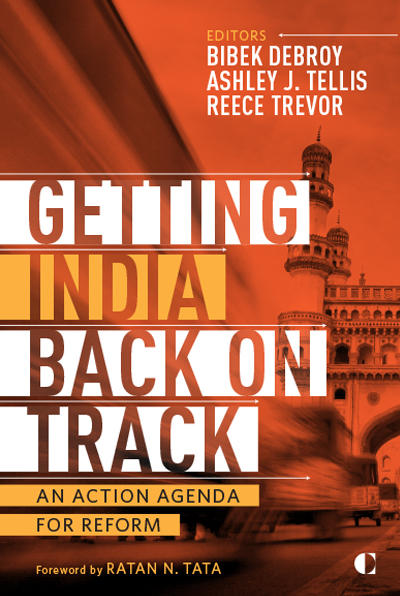
Source: Carnegie Endowment for International Peace
India has fallen far and fast from the runaway growth rates it enjoyed in the first decade of the twenty-first century. In order to reverse this trend, New Delhi must seriously reflect on its policy choices across a wide range of issue areas.
Getting India Back on Track broadly coincides with the 2014 Indian elections to spur a public debate about the program that the next government should pursue in order to return the country to a path of high growth. It convenes some of India’s most accomplished analysts to recommend policies in every major sector of the Indian economy. Taken together, these seventeen focused and concise memoranda offer policymakers and the general public alike a clear blueprint for India’s future.
Advance Praise
“Congratulations to the authors and Carnegie.”
–Narendra Modi, prime minister of India
“I am going to read every part of this book. It will help us to do our job better. The book is well-timed and the title is apt.”
–Arun Jaitley, Indian minister of finance and defense
“Bibek Debroy and Ashley J. Tellis have brought together an impressive group of experts who provide a clear road map to move India forward in 2014. Anyone invested in the country’s success should read this book.”
–Arun Shourie, formerly India’s minister of disinvestment and minister of communications and information technology
“Focusing on a range of key issues, Getting India Back on Track has captured the scale and complexity of as well as the need for resetting India’s policies at the national and state levels. This excellent volume will be a very valuable resource to key policy framers and decisionmakers in India’s new government.”
–Naresh Chandra, former cabinet secretary and former Indian Ambassador to the United States
“It is rare to find a group of experts as accomplished and diverse as those represented in Getting India Back on Track. Their work builds a strong foundation for a real dialogue about India’s future at a time when a generational change in India’s leadership will set the course for decades to come. The Carnegie Endowment for International Peace should be complimented for undertaking such a worthwhile project.”
–Frank Wisner, former U.S. Ambassador to India and former under secretary of defense for Policy
Bibek Debroy is a professor at the Center for Policy Research in New Delhi. He has worked in academia, industry chambers, and government, including in leadership positions in the Legal Adjustments and Reforms for Globalizing the Economy project and the Commission on Legal Empowerment of the Poor. Debroy is the author of several books, papers, and articles. He holds degrees from Presidency College in Calcutta, the Delhi School of Economics, and Trinity College in Cambridge.
Ashley J. Tellis is a senior associate at the Carnegie Endowment for International Peace specializing in international security, defense, and Asian strategic issues. While on assignment to the U.S. Department of State as senior adviser to the undersecretary of state for political affairs, he was intimately involved in negotiating the civil nuclear agreement with India. Previously, he was commissioned into the Foreign Service and served as senior adviser to the ambassador at the U.S. embassy in New Delhi. He also served on the National Security Council staff as special assistant to the president and senior director for strategic planning and Southwest Asia.
Reece Trevor is a research assistant in the South Asia Program at the Carnegie Endowment for International Peace, where he previously served as a junior fellow focusing on South Asian security and U.S. grand strategy. He completed his bachelor’s degree with honors at the University of Chicago.
About the Contributors
Ila Patnaik, National Institute of Public Finance and Policy and Carnegie Endowment for International Peace
Surjit Bhalla, Oxus Investments
Ashok Gulati, Commission for Agriculture Costs and Prices
Rajiv Kumar, Center for Policy Research
Omkar Goswami, Corporate and Economic Research Group
Laveesh Bhandari, Indicus Analytics
A. K. Shiva Kumar, National Advisory Council
Rajiv Lall and Ritu Anand, IDFC Limited
Somik Lall, World Bank
Tara Vishwanath, World Bank
Barun Mitra, Liberty Institute, and Madhumita D. Mitra, Consultant
Tushaar Shah, International Water Management Institute
Shilp Verma, Independent Researcher
Sunjoy Joshi, Observer Research Foundation
Ligia Noronha, Energy and Resources Institute
Devesh Kapur, Center for the Advanced Study of India, University of Pennsylvania
Milan Vaishnav, Carnegie Endowment for International Peace
Ravinder Pal Singh, Stockholm International Peace Research Institute
C. Raja Mohan, Observer Research Foundation and Carnegie Endowment for International Peace
Table of Contents
CONTENTS
Foreword Ratan N. Tata
Acknowledgments
Introduction
Completing Unfinished Business: From the Long View to the Short Ashley J. Tellis
Maintaining Macroeconomic Stability Ila Patnaik
Dismantling the Welfare State Surjit Bhalla
Revamping Agriculture and the Public Distribution System Ashok Gulati
Revisiting Manufacturing Policy Rajiv Kumar
Generating Employment Omkar Goswami
Expanding Education and Skills Laveesh Bhandari
Confronting Health Challenges A. K. Shiva Kumar
Modernizing Transport Infrastructure Rajiv Lall and Ritu Anand
Managing Urbanization Somik Lall and Tara Vishwanath
Renovating Land Management Barun S. Mitra and Madhumita D. Mitra
Addressing Water Management Tushaar Shah and Shilp Verma
Reforming Energy Policy and Pricing Sunjoy Joshi
Managing the Environment Ligia Noronha
Strengthening Rule of Law Devesh Kapur and Milan Vaishnav
Correcting the Administrative Deficit Bibek Debroy
Building Advanced Defense Technology Capacity Ravinder Pal Singh
Rejuvenating Foreign Policy C. Raja Mohan
Index
Contributors
Carnegie Endowment for International Peace
TV 18’s Think India Foundation
India Back on Track: An Agenda for Reform is a series that is produced as a partnership between the Think India Foundation and the Carnegie Endowment for International Peace.
Carnegie India does not take institutional positions on public policy issues; the views represented herein are those of the author(s) and do not necessarily reflect the views of Carnegie, its staff, or its trustees.
As AI grows more sophisticated, as the supply chains that power it become more contested, and as access to frontier models becomes geopolitically charged, India must begin to ask a different set of questions. Not what applications it can build on someone else’s infrastructure but what the world needs.
The Indian Ocean Region hosts one of the densest concentrations of subsea cables in the world. Yet, despite accounting for a significant share of global internet traffic, India’s participation remains limited.
After the chill in ties between 2020 and 2024 that brought India–China relations to their lowest point in several decades, the two countries have engaged each other afresh. This paper argues that there are predominantly four imperatives guiding India’s approach to China, and they exist in an order of priority.
This piece argues that India’s central challenge is not managing a single flashpoint but resolving the underlying tension between expansion and institutional coherency of the BRICS grouping.