

• Research
  • About
  • Experts
Carnegie India logoCarnegie lettermark logo
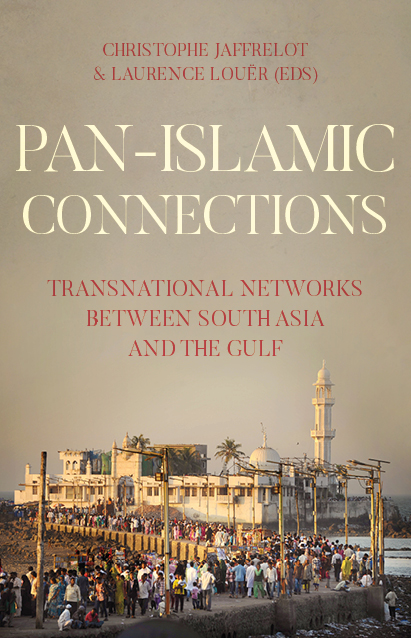
Pan-Islamic Connections: Transnational Networks Between South Asia and the Gulf
Book

Pan-Islamic Connections: Transnational Networks Between South Asia and the Gulf

A comparison of Islam in Arabia and in South Asia and how these versions of the religion interact through the vectors of trade, politics, and migration.

Link Copied
By Christophe Jaffrelot and Laurence Louër
Published on Jan 9, 2018

Additional Links

Paperback - $34.95

Source: Oxford University Press

South Asia is today the region inhabited by the largest number of Muslims—roughly 500 million. In the course of its Islamisation process, which began in the eighth century, it developed a distinct Indo-Islamic civilisation that culminated in the Mughal Empire. While paying lip service to the power centres of Islam in the Gulf, including Mecca and Medina, this civilisation has cultivated its own variety of Islam, based on Sufism.

Over the last fifty years, pan-Islamic ties have intensified between these two regions. Gathering together some of the best specialists on the subject, this volume explores these ideological, educational and spiritual networks, which have gained momentum due to political strategies, migration flows and increased communications.

At stake are both the resilience of the civilisation that imbued South Asia with a specific identity, and the relations between Sunnis and Shias in a region where Saudi Arabia and Iran are fighting a cultural proxy war, as evident in the foreign ramifications of sectarianism in Pakistan.

Advance Praise

“The Indian Ocean, linking Arabia to South Asia, looms as the testcase for Muslim networks, yet the profile of Indo-Islamic civilization remains contested between Saudi Salafis, Pakistani Sufis and also Iranian Shi’ites. This pioneering volume provides a welcome transregional, comparative analysis of multiple case studies, at once historical and contemporary.”
—Bruce Bennett Lawrence, Professor Emeritus of Religion, Duke University

“Connections of trade, family, learning and faith have existed between South Asia and the Gulf for hundreds of years.  This book focuses on their workings in the modern period with especial emphasis on Islam. It demonstrates the significant and complex interactions which take place across the region, some of which are of strategic potential.”
—Francis Robinson, Professor of the History of South Asia, Royal Holloway, University of London

About the Authors

Christophe Jaffrelot

Former Nonresident Scholar, South Asia Program

Jaffrelot’s core research focuses on theories of nationalism and democracy, mobilization of the lower castes and Dalits (ex-untouchables) in India, the Hindu nationalist movement, and ethnic conflicts in Pakistan.

Laurence Louër

Laurence Louër is Associate Professor at the Centre for International Studies (CERI), Sciences.

Authors

Christophe Jaffrelot
Former Nonresident Scholar, South Asia Program
Christophe Jaffrelot
Laurence Louër

Laurence Louër is Associate Professor at the Centre for International Studies (CERI), Sciences.

Middle EastSouth AsiaReligion

Carnegie India does not take institutional positions on public policy issues; the views represented herein are those of the author(s) and do not necessarily reflect the views of Carnegie, its staff, or its trustees.

More Work from Carnegie India

  • Article
    Risk and Retaliation: Israel, Iran, and the Evolving Situation in West Asia

    An Israeli response to Iran’s October 1 attack is imminent. The key question is of its intensity and potential fallout, both within Iran, in terms of nuclear security policy changes, and across the broader region. The coming days are likely to reshape West Asia irreversibly.

      Gaddam Dharmendra
  • Article
    Understanding the Global Debate on Lethal Autonomous Weapons Systems: An Indian Perspective

    This article explores the global debate on lethal autonomous weapons systems (LAWS), highlighting the convergences, complexities, and differences within and beyond the UN Group of Governmental Experts (GGE) on LAWS. It further examines India’s key position at the GGE and the probable reasons behind them.

      Charukeshi Bhatt, Tejas Bharadwaj

  • Commentary
    A Primer on Compute

    This essay is the first of a three-part series that will seek to understand the considerations for building compute capacity and the different pathways to accessing compute in India. This essay delves into the meaning of compute and unpacks the various layers of the compute stack.

      Aadya Gupta, Adarsh Ranjan

  • Commentary
    On Thin Ice: Bhutan’s Diplomatic Challenge Amid the India-China Border Dispute

    This piece examines the strategic implications of Bhutan’s diplomatic efforts amid its border dispute with China, highlighting the thin ice it walks on to achieve a resolution without compromising its vital relationships.

      Shibani Mehta

  • Commentary
    Assessing the “New” Approach to Antitrust Law: An Indian Antitrust Experiment

    This article is part of a series that will discuss some of the themes and proposals that are being considered for an ex-ante framework in India under the Committee on Digital Competition Law (CDCL).

      Konark Bhandari

Get more news and analysis from
Carnegie India
Carnegie India logo, white
Unit C-4, 5, 6, EdenparkShaheed Jeet Singh MargNew Delhi – 110016, IndiaPhone: 011-40078687
  • Research
  • About
  • Experts
  • Projects
  • Events
  • Contact
  • Careers
  • Privacy
  • For Media
Get more news and analysis from
Carnegie India
© 2026 Carnegie Endowment for International Peace. All rights reserved.