

Article
This piece argues that India’s central challenge is not managing a single flashpoint but resolving the underlying tension between expansion and institutional coherency of the BRICS grouping.
Vrinda Sahai
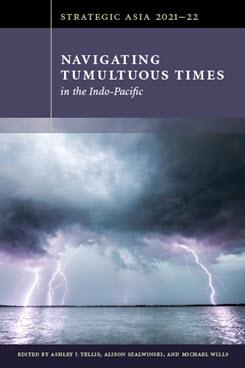
An assessment of the impact of three major trends on the geopolitical environment of the Indo-Pacific region: intensifying strategic competition between China and the United States, growing pushback against globalization, and the Covid-19 pandemic.
Source: National Bureau of Asian Research
Strategic Asia 2021–22: Navigating Tumultuous Times in the Indo-Pacific assesses the impact of three major trends on the geopolitical environment of the Indo-Pacific region: intensifying strategic competition between China and the United States, growing pushback against globalization, and the Covid-19 pandemic. Each chapter examines how these challenges shape the security environment, grand strategy, and national and economic power for a country or in a region and analyzes the implications for U.S. interests.
Read the introduction by Ashley J. Tellis for free or order this book.
Ashley J. Tellis holds the Tata Chair for Strategic Affairs and is a senior fellow at the Carnegie Endowment for International Peace and Research Director of the Strategic Asia Program at the National Bureau of Asian Research (NBR).
Alison Szalwinski is vice president of research at NBR.
Michael Wills is executive vice president at NBR.
Former Senior Fellow
Ashley J. Tellis was a senior fellow at the Carnegie Endowment for International Peace.
Alison Szalwinski
National Bureau of Asian Research
Alison Szalwinski is assistant director for political and security affairs at NBR.
Michael Wills
National Bureau of Asian Research
Michael Wills is senior vice president for strategy and finance at NBR.
Carnegie India does not take institutional positions on public policy issues; the views represented herein are those of the author(s) and do not necessarily reflect the views of Carnegie, its staff, or its trustees.

This piece argues that India’s central challenge is not managing a single flashpoint but resolving the underlying tension between expansion and institutional coherency of the BRICS grouping.

Vrinda Sahai

A partnership between India, a country of subcontinental size, and Africa, a continent of fifty-four countries, may seem asymmetric until one notes that both are home to nearly the same number of people—1.4 billion. This essay spells out the existing challenges to the partnership, its optimal potential, and the possible pathways to realize it over the next quarter-century.

Rajiv Bhatia

The U.S.–India semiconductor cooperation story is well-stocked with top-level strategic intent. What remains unresolved, however, are some underlying challenges that will determine whether the cooperation actually functions. Three such friction points stand out.

Shruti Mittal

The India–EU Free Trade Agreement (FTA) is shaping up to be one of the most consequential trade negotiations, both economically and strategically. But, what’s in the agreement, what’s missing, and what will determine its success in the years ahead
Vrinda Sahai, Nicolas Köhler-Suzuki

Trump 2.0 has unsettled India’s external environment—but has not overturned its foreign policy strategy, which continues to rely on diversification, hedging, and calibrated partnerships across a fractured order.



Milan Vaishnav, ed., Sameer Lalwani, Tanvi Madan, …