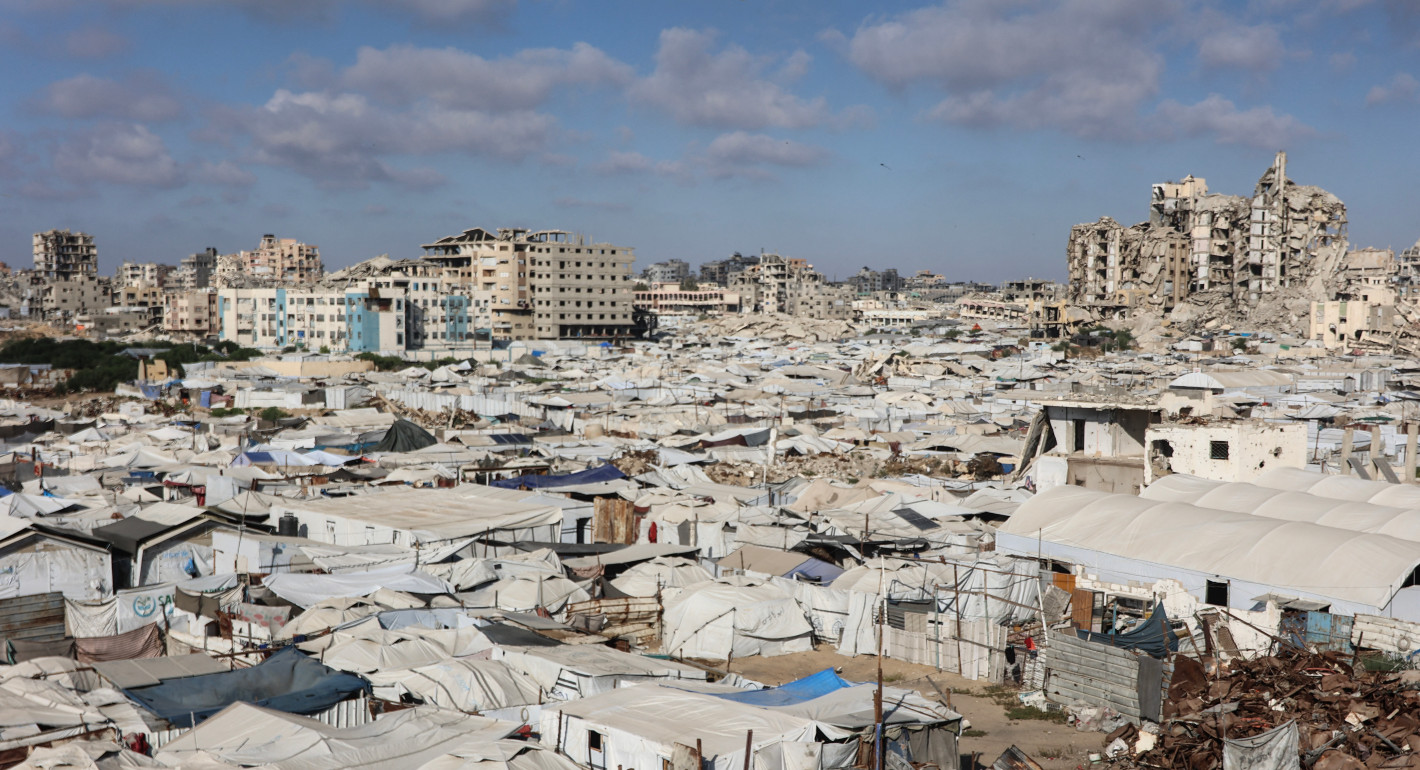
At his first high-level media briefing in May, Board of Peace High Representative for Gaza Nickolay Mladenov stressed that his “north star” was to give Palestinians a better future. According to him, this meant restoring Palestinian life in Gaza—including rebuilding the homes, hospitals, schools, and communities that have been destroyed over the course of more than two and a half years of Israel’s war on the enclave, and creating a pathway for Palestinian self-determination. But is Mladenov’s “north star” actually guiding the Board of Peace?
Discerning the board’s objectives in Gaza is not an easy task. The board’s charter does not mention Gaza at all. However, plans proposed by advisers to the Board of Peace, which appear to be informing the board’s activities on the ground, suggest that the body—led by U.S. President Donald Trump—may be deliberately creating conditions for the forced displacement and resettlement of Palestinians abroad. What Israeli Prime Minister Benjamin Netanyahu has euphemistically referred to as “voluntary emigration” is the preferred outcome of both the Israeli government and the second Trump administration. And since the inception of the Board of Peace, that goal has thrummed in the heads of Palestinians like the ubiquitous drones over Gaza. Even if the Board of Peace and Israel are not completely aligned on how to achieve this objective, the measures they are both taking are leading to the same place. The board’s failure to call out Israeli measures deepening deprivation in Gaza and its plan (laid out in three interlinked documents) to relocate tens of thousands of desperate Palestinians to temporary compounds near destroyed Rafah, where they will live under Israeli military control, will force Palestinians into a position of having to choose between staying in the compounds until permanent housing is built for them (however many years that takes) or accepting resettlement outside of the enclave. Whatever their “choice,” they may be required to give up their property rights to the Board of Peace first.
What Netanyahu has euphemistically referred to as “voluntary emigration” is the preferred outcome of both the Israeli government and the second Trump administration.
Stakeholders who want to prevent implementation of the board plans to forcibly displace and dispossess Palestinians have little time to prevent this outcome. The Board of Peace is unlikely to outlive Trump’s term in office, which ends in January 2029. By then, many Palestinians may have been irreversibly displaced, and Israel may have re-inherited administration and occupation of Gaza, giving it the final say over the fate of those relocated indefinitely to the south in what are effectively internment camps.
Board of Peace Plans for Gaza and “Voluntary Emigration”
Established under the Comprehensive Plan to End the Gaza Conflict with a mandate that includes providing relief and reconstruction in Gaza, the Board of Peace offers little transparency into its operations. Its vision for Gaza must be pieced together from its charter, statements from U.S. officials, leaked board resolutions, news reports, and relief and reconstruction plans that have been informing its activities in Gaza.
U.S. Secretary of State Marco Rubio recently confirmed that the Board of Peace is not a public international organization governed by co-equal states operating under an internationally recognized normative framework. It is a nongovernmental organization that is effectively Trump’s personal enterprise. According to the board’s charter, Trump has virtually absolute authority over its agenda, funding, subsidiary organs, and budget. Until the United States appropriates taxpayer funds to the board, no mechanism exists for congressional oversight over the body’s foreign contributions, financial transactions, relationships, or operations.
Stakeholders must demand major restructuring of the Board of Peace and robust oversight and transparency before engaging with it. Until then, rights-respecting existing platforms and mechanisms for multilateral peacemaking should be supported.
Early in the current administration’s tenure, Trump and Jared Kushner, his son-in-law and close adviser on Gaza, expressed strong support for the permanent resettlement of Palestinians outside of Gaza. Trump later walked back his statements, emphasizing “nobody is expelling any Palestinians.” “I’m not forcing it,” he said, adding, “I’m just going to sit back and recommend it.” In fact, his Board of Peace has more than recommended it. The forced relocation or “voluntary emigration” of Palestinians has been incorporated explicitly or implicitly into three leaked development plans that appear to be informing the board’s activities in Gaza—the Gaza Reconstruction and Economic Acceleration Transformation Trust plan (the GREAT Trust), Project Sunrise, and a pilot plan for temporary compounds in Rafah being implemented by the U.S.-led Civil-Military Coordination Center (CMCC) in Kiryat Gat, Israel. (The CMCC will soon be rebranded the International Gaza Support Center.)
Trump, Kushner, Middle East envoy Steve Witkoff, and a small group of advisers have revised and reformulated these plans for the purposes of pitching the ideas to stakeholders and investors and are taking steps toward their implementation. The most influential of the board’s advisers include former UK prime minister Tony Blair (individually and through his think tank, the Tony Blair Institute for Global Change); former adviser to the U.S. ambassador to Israel (under the first Trump administration) Aryeh Lightstone; Apollo Global Management CEO Marc Rowan; venture capitalist Michael Eisenberg; Israeli military intelligence officer and tech investor Liran Tancman; and members of the CMCC (see figure 1). Blair, Rowan, Eisenberg, Kushner, and Witkoff also sit as Trump’s appointees on the Board of Peace Executive Board, the body’s Gaza Executive Board, or both. Separately, Eisenberg, who is a dual U.S.-Israeli citizen, was appointed by Netanyahu as the Israeli representative to the CMCC where Lightstone is also the White House liaison.
The Board of Peace is effectively Trump’s personal enterprise. Until the United States appropriates taxpayer funds to the board, no mechanism exists for congressional oversight.
Tony Blair Institute staff, Lightstone, Eisenberg, and Tancman are also responsible for designing plans for the Gaza Humanitarian Foundation (GHF), which operated between May and October 2025 and offered a model for how humanitarian relief delivery might be wrested from long-standing and recognized humanitarian aid providers in favor of private contractors operating with little regard for humanitarian principles and answerable to the Israeli military. That experiment, for which the United States provided funding, has since been highly criticized by human rights experts and labeled a “death trap” and “slaughter masquerading as aid” because of the large number of aid seekers who were killed by mercenary forces while queueing or attempting to reach distribution sites. The work of the GHF has since been taken over by the CMCC, which is also responsible for the future deployment of stabilization forces and policing in Gaza. Blair and his institute also developed the plan for establishing a U.S.-led transitional government for Gaza, known as the Gaza International Transitional Authority, which led to the creation of the Board of Peace.
The Plans for Gaza
The Board of Peace’s vision for redeveloping Gaza has been informed by the GREAT Trust, Project Sunrise, and the CMCC pilot for building temporary compounds in Rafah. While the GREAT Trust provides the most details and the plans do differ in some respects, they are not mutually exclusive and each would require the relocation or resettlement of Palestinians and a process for acquiring their land rights.
The GREAT Trust.The GREAT Trust was developed by executives from Boston Consulting Group (BCG), the planners of the GHF, and staff from the Tony Blair Institute, and was leaked in September 2025 to the Washington Post, just as plans for Gaza were being discussed at the White House with Kushner and Blair. The GREAT Trust recommends that a U.S.-led temporary authority govern Gaza (an idea that developed into the Board of Peace), confiscate all Gaza’s public land (estimated by the World Bank at 35 percent of the enclave) and potentially all Palestinian private property, and place these assets in a trust. The plan envisions that most Palestinians exchange their property rights for either alternative permanent housing elsewhere in Gaza (once such becomes available, estimated at between two to eight years) or a resettlement package to emigrate abroad. A financial incentive scheme created by BCG executives, codenamed “Aurora,” calculated that resettling Palestinians, rather than rebuilding permanent housing and maintaining them in Gaza, would save $23,000 per person. (Criticized for appearing to encourage ethnic cleansing of Gaza, BCG disavowed the work of its executives, who have since “exited” the firm.)
At the inaugural convening of the Board of Peace in Washington, Rowan elaborated on the notion of “gathering Gaza’s productive assets in one unified structure,” such as a trust. He identified as strategic assets all Gaza’s rebuilt housing stock, the coastline, and the marine gas fields in Palestine’s territorial waters, among other items. Legal ownership of new homes would be established upon delivery of housing to residents of Gaza. Until such time, the board would act as steward over the assets. However, only the housing stock would be classified as for the benefit of “all Gazans.” Presumably, the rest of Gaza’s assets would be used to attract investors. Rowan identified Rafah, where 400,000 housing units would be built, as the launch site for Gaza’s redevelopment.
The slide deck for the GREAT Trust provides that title to properties would be registered on a blockchain, and trust assets digitized and turned into tradeable tokens that could be used as initial capital or collateral to draw in investors. The use of blockchain technology to register title is controversial in a context of ongoing conflict and mass displacement such as Gaza because of the difficulty of determining land rights. Gaza’s landscape has become unrecognizable to its residents with the near complete destruction of its buildings and infrastructure and with 68 million metric tons of rubble piled throughout the enclave. Israel has also destroyed Gaza’s land administration offices and the boundary beacons that establish the outer limits of plots, and severely damaged land records and archives. Because many Palestinians are killed, missing, or still buried under the rubble, and 90 percent of the population is living in tents or other shelters away from their property—the majority without land deeds in their possession—adjudicating property ownership and inheritance rights will require painstaking work. According to the World Bank, “without reliable records or physical markers, reconstruction planning and fair allocation of land will depend on extensive re-surveying, community validation, and time-sensitive and locally led dispute-resolution mechanisms.”
What blockchain technology ensures is that any inaccurate or fraudulent recording of land rights will be irreversible.
Recording property rights on a blockchain under such circumstances presents a high risk of fraudulent or erroneous digital recording, or what is called “GIGO”—garbage in, garbage out. In any case, with the Board of Peace vested with “all transitional and executive authority, emergency powers, and the administration of justice,” according to the leaked and unsigned Board of Peace Resolution No. 2026/1 dated January 22, 2026, independent Palestinian court decisions on land matters may not be determinative. What blockchain technology ensures is that any inaccurate or fraudulent recording of land rights will be irreversible.
Project Sunrise.Another 2025 leaked plan—Project Sunrise, which Kushner pitched through slides to foreign governments and at Davos and Washington—focuses on the monetization of around 70 percent of Gaza’s coastline for foreign public investment, and creating a new community and seat of government in “New Rafah” atop the former city of 171,000 residents to accommodate hundreds of thousands more, similar to what was proposed in the GREAT Trust. In what may be an attempt to avoid the same criticism lobbed at the authors of the GREAT Trust, however, Project Sunrise omits details concerning the acquisition of land rights and the relocation of Palestinians to effectuate reconstruction and development plans.
With much of the land abutting Gaza’s coastline privately owned—according to members of the Housing, Land and Property Technical Working Group in Gaza whom I spoke to—the Board of Peace would have to obtain legal rights over the land it intends to convert into business hubs or resort properties. Private property owners would have to be permanently relocated and their land expropriated to encourage financial institutions and investors to engage. Though the plan is premised on the complete disarmament of Palestinian resistance groups in Gaza, Kushner stated in January that “we’ve already started removing the rubble and doing some of the demolition,” apparently referencing Israeli activities in western Gaza. The U.S. administration now intends to move forward with development in the areas that are under Israeli control despite armed groups in the western coastal area of Gaza. This is likely to mean the resumption of high-intensity violence for some time before reconstruction can take place. Thus, construction of permanent homes for Palestinians there may be delayed.
The U.S.-led CMCC Humanitarian Compound in Rafah. In November 2025, after the development of the GREAT Trust and Project Sunrise, and as the Israeli-Hamas ceasefire began, an unclassified plan approved by the Israeli military for building temporary compounds in Rafah was leaked. Presented as a pilot, the plan—developed by the CMCC and shared with diplomats and others—calls for relocating Palestinians to an area in Rafah, which would enable Israel to resume its military campaign against Palestinian militia groups and permit reconstruction to advance in parts of Gaza under Israeli control. According to Forensic Architecture, satellite imagery confirms that since fall 2025, Israel has been razing homes, removing rubble, and compacting the ground in Rafah, likely in preparation for these compounds (as Kushner hinted during his presentation earlier in the year). The Board of Peace now intends to relocate tens of thousands of Palestinians currently living in makeshift encampments in the western part of Gaza to the temporary compound. Prospective residents would first be vetted and have to agree to biometric scanning before receiving temporary shelter, per the CMCC plan and Board of Peace Resolution No. 2026/1. Vetted Palestinians would then have their land ownership rights taken into consideration. What this means is not yet clear. Allocating temporary shelters based on the private property interests of an aid seeker, however, would certainly run afoul of international humanitarian law.
Palestinian families will face an impossible choice: Wait for what might be many years in the temporary compound, or accept resettlement abroad.
Those briefed on the CMCC plan described as a top priority the launching of a land deed review. Clarifying ownership of land is important to potential donors, investors, and financial institutions, who want to avoid exposure to liability for forced displacement of residents and the taking of private property without compensation. Though the plan calls for public land (which the board expects to take “free of charge,” according to a leaked Board of Peace resolution dated June 2026 obtained by The Guardian) to be used for the temporary compound, the plan also acknowledges that private property may also have to be expropriated and that registration mechanisms would have to be put in place to identify any property owners who might require compensation. If this applies to private property taken for the pilot plan’s temporary compound, it also applies to any part of the approximately two-thirds of Gaza that are privately owned and that the board would need to implement its redevelopment plans.
Will Palestinian property owners seeking to relocate to the temporary compound be asked about their private property ownership in Gaza before they are offered temporary housing? And will owning property be used as a criterion or given priority in determining who receives permanent housing or resettlement assistance, as appears to be envisioned in the GREAT Trust plan? If so, Palestinian families will face an impossible choice: Wait for what might be many years in the temporary compound until permanent housing in Gaza is built for them, or accept resettlement abroad. With the Board of Peace’s mandate from the UN Security Council expiring on December 31, 2027, and the likely dissolution of the Board of Peace after Trump leaves office in early 2029, Israel stands to inherit administration of Gaza before permanent housing is built for Palestinians. Residing indefinitely in what have been described as internment camps where all essential supplies are controlled by Israel—a state the UN and scholars and legal experts believe has committed genocide against their community—is not likely to be an acceptable option for many of the traumatized survivors in Gaza.
The Israeli Blueprint for “Voluntary Emigration”
In the days immediately after October 7, 2023, when Israeli officials—including then defense minister Yoav Gallant—announced Israel would withhold all essential supplies and fuel to Palestinians in Gaza, many Western officials refrained from characterizing such statements as evidence of intent to commit war crimes, and instead reaffirmed Israel’s right to self-defense. Within a few months, Human Rights Watch would confirm that Israel was using starvation as a weapon of war, and a year after that, the International Criminal Court would issue arrest warrants for Netanyahu and Gallant. Whether or not they agreed criminal intent existed, most policymakers I spoke to at the time did not believe Israel’s hermetic seal of Gaza after October 7 was part of any plan for the enclave’s “day after.” What looked like collective punishment of Palestinian civilians to some at first, however, appears now to be part of an Israeli policy to force Palestinians out of Gaza.
Israel’s history of attempts to empty Gaza of its inhabitants is as long as its military occupation. In the 1970s, the Israeli government (led at the time by Mapai, the predecessor to Israel’s Labor Party) secretly tried to induce Palestinians to permanently leave Gaza by providing financial incentives. Fifty thousand have been resettled around the world. Since October 7, 2023, Israel has sought to create conditions of life calculated to bring about Palestinian flight. A very influential advocate in this push has been Giora Eiland, a retired Israeli major general and former head of Israel’s National Security Council. Immediately after the Hamas attack, he penned an op-ed in a major Israeli newspaper arguing that Israel must cut off all capacity and systems in Gaza that prolong Palestinian life. He later elaborated on his ideas in “The Generals’ Plan,” published by the Forum of Commanders and Soldiers in the Reserves in September 2024, which informed Israel’s decision to force hundreds of thousands of Palestinians from the north of Gaza to the south in October of the same year. The tactics—declaring an area a closed military zone, demanding complete and immediate evacuation of civilians, treating anyone remaining as a combatant subject to summary execution, and placing a siege over the area to induce starvation—have been regular features of Israel’s campaign in Gaza.
Last year, a UN commission of inquiry linked Israeli settlement plans in Gaza to this policy. However, Israel’s blueprint for the demographic re-engineering of Gaza also appears to be aimed at facilitating a particular development agenda for the enclave meant to attract foreign investment. Speaking at the Urban Renewal Summit in Tel Aviv in September 2025, Israel’s Minister of Finance Bezalel Smotrich revealed that since the “demolition phase” of Gaza was complete, he had “begun negotiations with the Americans" over a plan to turn Gaza into a “real estate bonanza.” Because both Israel and the United States had “paid a lot of money for the war,” he asserted, both should “share percentages on the land sales in Gaza.” He also said that a business plan for the scheme had been put on Trump’s desk. That very month, Trump and a group of advisers who would become members of the subsidiary bodies of the Board of Peace were meeting to discuss such plans.
Israel’s history of attempts to empty Gaza of its inhabitants is as long as its military occupation.
Netanyahu has been more circumspect than his ultranationalist ministers about Israel’s goal in Gaza. When asked recently if Palestinian emigration were still on the table, he answered emphasizing it was “voluntary emigration.” He refused to say whether such a plan was moving forward: “I prefer to talk less and do more.” Israeli Defense Minister Israel Katz has been talking, however. According to Katz, the plan for Palestinian emigration will be implemented “at the proper time and in the proper manner.” His idea, similar to the Board of Peace plans, involves moving the entire population of Gaza south to a compound in Rafah. From there, Israel would encourage Palestinians to emigrate. An official directorate for the emigration of Palestinians was set up in 2025, though regional pushback and finding willing countries for Palestinian resettlement have been sticking points. Netanyahu and Katz have widespread support for what they are planning: 82 percent of Israeli Jews support the expulsion of Palestinians from Gaza. With Israeli elections only weeks away, the overwhelming sentiment among voters cannot be discounted.
Recent reporting suggests that “quiet agreements” may have been reached between Israel and the United States involving “compensation for painful concessions” Israel made as part of the U.S.-Iran ceasefire deal. Immediately following that deal, the new head of Israel’s National Security Council convened an urgent meeting with security officials about “encouraging the voluntary emigration” of Palestinians from Gaza.
Differences exist between the United States and Israel on how to move forward with plans for Gaza, particularly on disarmament of militants, Israeli withdrawals, and the entry of an international force. On the whole, however, Israel’s policies on the ground align with the objectives of the Board of Peace’s development agenda in Gaza.
Success for theBoard of Peace?
Though Mladenov has blamed delays in executing Board of Peace plans for Gaza on the refusal of Hamas and others to disarm, in fact, everything may be going according to plan. A temporary compound is being prepared in Rafah, where Israel has sought to relocate Palestinians since October 7, and efforts are underway to ascertain Palestinian private property rights. All indications are that the Board of Peace does not view the absence of a disarmament agreement with Hamas as an insurmountable obstacle in moving forward. In fact, the existence of an armed Hamas in Gaza would provide some justification for the humanitarian relocation of Palestinians so that Israel can relaunch a military campaign to take over all of Gaza.
The Board of Peace has stayed silent as Israeli troops have continued to demolish Palestinian homes to prevent residents from having anything to return to.
This explains why despite Israel’s failure to comply with its obligations under Phase One of Trump’s Comprehensive Plan to End the Gaza Conflict, the Board of Peace has not attempted to compel Israel to halt either its targeted assassination of Hamas leaders or its attacks on Palestinian civilians, which have resulted in the killing of more than 1000 Palestinians in the first 250 days of the so-called ceasefire. It also explains why the Board of Peace has stayed silent as Israeli troops in the approximately 58 percent of Gaza that they control have continued to demolish Palestinian homes to prevent residents from having anything to return to, and why the board has not pushed back on Netanyahu’s promise to occupy another 12 percent of Gaza as a “start.”
Also contrary to the terms of the Comprehensive Plan, and without the imposition of any consequences, Israel has refused to relinquish control over the Rafah crossing; criminalized the UN Relief and Works Agency (UNRWA), the principal and most competent relief provider in Gaza; restricted the operations of recognized international humanitarian aid organizations; and severely curtailed the entry of essential, life-saving supplies. Not only has the Board of Peace not demanded Israeli compliance, the United States and the board have boosted and enabled the delegitimization of UNRWA and respected nongovernmental humanitarian actors operating in Gaza, and restricted and redirected aid delivery in a way that is creating desperation and crisis-level famine among the beleaguered population. The Board of Peace has not taken advantage of the fact that Hamas has relinquished governance of Gaza to the Board of Peace’s National Committee for the Administration of Gaza to compel Israel to finally withdraw its forces in favor of international stabilization forces. Instead, the board has decided to implement its “Plan B,” which would permit relief and reconstruction efforts to begin in the areas under Israeli military control while Israel forcibly seizes control of the remaining 30 to 35 percent of Gaza from armed groups. This will all but guarantee a return to high-intensity violence in Gaza, which will only impede relief efforts and the restoration of infrastructure necessary to sustain Palestinian life. It also means that any Palestinians who have not moved to or been vetted to live in the humanitarian compounds under Israeli control could be deemed combatants and legitimate targets for the Israeli military as has been Israel’s practice in Gaza.
Those who argue that the international community should support the Board of Peace because it is “the only game in town” must explain how legitimating a mechanism for the forced displacement of Palestinians from Gaza and the permanent loss of their property rights helps the cause of peace. While such a plan may be the only game in Tel Aviv or Washington, it does not have to be the only one in Brussels, Paris, or Riyadh. Supporting the Board of Peace’s development plans for Gaza as currently conceived will not benefit Palestinians; rather, it will leave stakeholders vulnerable to allegations of complicity in war crimes and crimes against humanity.
Carnegie India does not take institutional positions on public policy issues; the views represented herein are those of the author(s) and do not necessarily reflect the views of Carnegie, its staff, or its trustees.
After the chill in ties between 2020 and 2024 that brought India–China relations to their lowest point in several decades, the two countries have engaged each other afresh. This paper argues that there are predominantly four imperatives guiding India’s approach to China, and they exist in an order of priority.
This piece argues that India’s central challenge is not managing a single flashpoint but resolving the underlying tension between expansion and institutional coherency of the BRICS grouping.
A partnership between India, a country of subcontinental size, and Africa, a continent of fifty-four countries, may seem asymmetric until one notes that both are home to nearly the same number of people—1.4 billion. This essay spells out the existing challenges to the partnership, its optimal potential, and the possible pathways to realize it over the next quarter-century.
The U.S.–India semiconductor cooperation story is well-stocked with top-level strategic intent. What remains unresolved, however, are some underlying challenges that will determine whether the cooperation actually functions. Three such friction points stand out.