

Article
The Trump-led board has laid out blueprints for “voluntary emigration” and land confiscation.
Zaha Hassan

Source: Getty
Stakeholders must demand major restructuring of the Board of Peace and robust oversight and transparency before engaging with it. Until then, rights-respecting existing platforms and mechanisms for multilateral peacemaking should be supported.
With world attention focused on the war spreading from Iran to the Middle East and beyond, multilateralism and diplomacy as tools for regional peace and security appear to be on the wane. And yet, only days ago, U.S. President Donald Trump promised heads of states and senior foreign diplomats that his newly minted Board of Peace would “provid[e] a model for how responsible sovereign nations can cooperate to take responsibility for confronting problems in their own region.” The board, he stated, would go beyond convening to devise “real solutions.”
Though the inaugural convening of the board in Washington offered Trump an opportunity to showcase the new multilateral organization, its vision for Gaza’s reconstruction, and the material contributions pledged by member states and other institutions, the initiative remains short on details. What appears on offer is a wholly Trump-controlled body meant to rival (or oversee) the United Nations with complete discretion over how to spend the billions of dollars of donor contributions. Unlikely to last long and untethered to international law or standard financial oversight and accountability mechanisms, the Board of Peace lacks capacity to deliver early recovery and reconstruction for the benefit of Palestinians in Gaza, much less a just peace between Palestinians and Israelis.
Populated as it is with states either seeking proximity to U.S. power or the pleasure of the U.S. president, the board is more likely to divert attention away from Israeli actions to dispossess communities in Gaza and the West Bank. Whether this is a design flaw or a feature, stakeholders and contributors to the board’s efforts cannot afford to wait and see. As Gulf donor states and influential Gulf business leaders question Trump’s decision to launch a new war in the Middle East and sour on the Board of Peace, the need for real solutions for ending conflict and true multilateralism has come into sharper focus. If the board is to be effective, stakeholders and donors must demand a major restructuring of the body and robust oversight and transparency before engaging with it or committing funds. Until then, rights-respecting existing platforms and mechanisms for multilateral peacemaking and Palestinian relief and reconstruction should be supported.
When the UN Security Council endorsed Trump’s Comprehensive Plan to End the Gaza Conflict (the Comprehensive Plan) last year which called for the creation of the Board of Peace, it did so in order to end the killing and alleviate the suffering in Gaza, facilitate the enclave’s recovery and reconstruction, and create a credible path for Palestinian self-determination. Yet, the Board of Peace Charter, unpublished at the time of the vote, makes no mention of either Gaza or Palestinian self-determination. Instead, it envisages a different, broader mandate: to act as a “more nimble and effective” multilateral institution for peacebuilding, understood by some as an alternative to the eighty-year-old United Nations.
But unlike other multilateral organizations, the governance structure created under the charter rests most authorities in one person, Board of Peace Chairman Donald Trump, in his personal capacity. Separately, the United States occupies a seat on the board as a member state and would thus be subject to Chairman Trump beyond the current U.S. administration. As chairman, Trump is empowered to set agendas; break tie votes; arbitrate charter disputes; create, modify, or dissolve any subsidiary entities or the board itself; delegate any or all authorities of the board; appoint the commander of Gaza’s International Stabilization Force; and select his successor in a position he otherwise holds indefinitely.
In addition, Trump is solely responsible for selecting the members of the Executive Board which holds all the same authorities as the Board of Peace and “controls . . . budgets, financial accounts, and disbursements.” At present, the nine-member Executive Board includes mostly persons who either currently work for Trump or who have had close personal, professional, or past business relationships with him. With all Executive Board decisions subject to the chairman’s “direction and control,” Trump will retain absolute power over Board of Peace spending.
The Board of Peace Charter has given many pause, particularly U.S. allies in Europe. Two permanent members of the UN Security Council that had voted in support of the Comprehensive Plan, the UK and France, expressed concerns that the board’s charter could endanger “the principles and structure of the United Nations.” Germany likewise viewed the charter as a “counter-draft” to the United Nations Charter, while Italy questioned the chairman’s unchecked power and the lack of equality among member states in a body that is supposed to be a public international organization.
Similar criticisms have been echoed by U.S. lawmakers. In a letter to Secretary of State Marco Rubio (a member of the Executive Board), Senator Ed Markey expressed alarm at the concentration of authorities in the hands of the chairman and his power to “wield binding authority over budgets.”
The UN’s endorsement of the Board of Peace and the Comprehensive Plan is poised to sunset in less than two years, due to a lack of buy-in among potential donor countries and the doubts of some UN Security Council members. When that linchpin for stakeholder and World Bank engagement with the Board of Peace expires and Trump leaves office, the board will likely devolve into Trump’s private enterprise if it is not already dissolved. Given the chairman’s broad powers, such an eventuality raises questions over whether the body can meaningfully deliver in Gaza with such a timeline and how donor contributions will be disposed at dissolution.
The board has received pledges of $17 billion at its first convening: $10 billion from the United States and another $7 billion from member states and others. Yet the UN and World Bank estimate that $70 billion will be needed for Gaza’s relief, recovery, and reconstruction. A central task of the Board of Peace then must be how to continue to raise sufficient funds to finance reconstruction. With the skepticism in Europe and elsewhere about the Board of Peace’s mandate and the chairman’s unchecked power, particularly over donor funds, fundraising will be challenging.
Among the prospective donors, regional stakeholders have shown more willingness to overlook concerns about the board and its charter. Thus far, the UAE, Qatar, Kuwait, and Saudi Arabia have each pledged a billion dollars or more. They have not specified, however, whether their contributions are meant to secure permanent membership on the board, fund Gaza’s recovery and reconstruction, or both. The Declaration of the Founding Donors to the Board of Peace also fails to provide details on the pledges. In a sign of some hedging, Saudi Arabia and Kuwait have indicated that their pledges would be disbursed over a period of years, not all at once.
Certainly, some of the unease among donors is attributable to the lack of clarity on who has access to the funds and how it will be spent. Negotiations are reportedly underway between the Trump administration and JPMorgan Chase to establish a private account for the Board of Peace accessible by the chairman and/or his designates on the Executive Board. It is not uncommon for international organizations to deposit in private banks, but Trump’s personal lawsuit against JPMorgan and its CEO Jamie Dimon for $5 billion raises concerns about whether any settlement discussions might impact arrangements concerning the Board of Peace account. Also of concern is whether the Board of Peace chairman and those named on the Executive Board—all but one of whom are identified in the Board’s January 22, 2026 resolution without reference to their current office or title—would be able to withdraw from the account even after the UN mandate ends and Trump leaves office.
How the chairman and his Executive Board will manage donor funds remains murky. The charter does not set out oversight and auditing mechanisms or rules concerning conflicts of interest. And despite having approved a resolution “establishing the principles of financial integrity and transparency that will guide the board’s work,” Trump has yet to publish the board’s resolutions on its official website. In any case, with the chairman holding final authority over the Board’s budget, little opportunity exists for mitigating risks or ensuring monies will be spent in furtherance of the objectives set out in Security Council Resolution 2803.
As acknowledged recently by the Board of Peace’s high representative to Gaza, Nickolay Mladenov, a “number of instruments” already exist to support Gaza reconstruction. In fact, the World Bank, which began its engagement in the West Bank and Gaza in 1992, has in place three multi-donor funds supporting the occupied Palestinian territories as well as an internal fund to which the bank contributes directly.
Despite these existing funds, and in consultation with the Trump administration, the World Bank has established yet another funding mechanism—the Financial Intermediary Fund for Gaza Reconstruction and Development (GRAD). A financial intermediary fund (FIF) essentially functions as a pass-through for pooled multi-donor contributions, allowing the World Bank to transfer money directly to a third party without the cumbersome internal checks and authorization processes the bank usually requires. With respect to the GRAD, however, the bank is also acting as a “limited trustee,” holding “no responsibility or accountability, fiduciary or otherwise, for the use of the funds after they have been transferred to a recipient.” Thus, once the World Bank transfers funds to the Board of Peace, it is free to spend the money at will, subject to its own processes, procedures, and agreements with third parties.
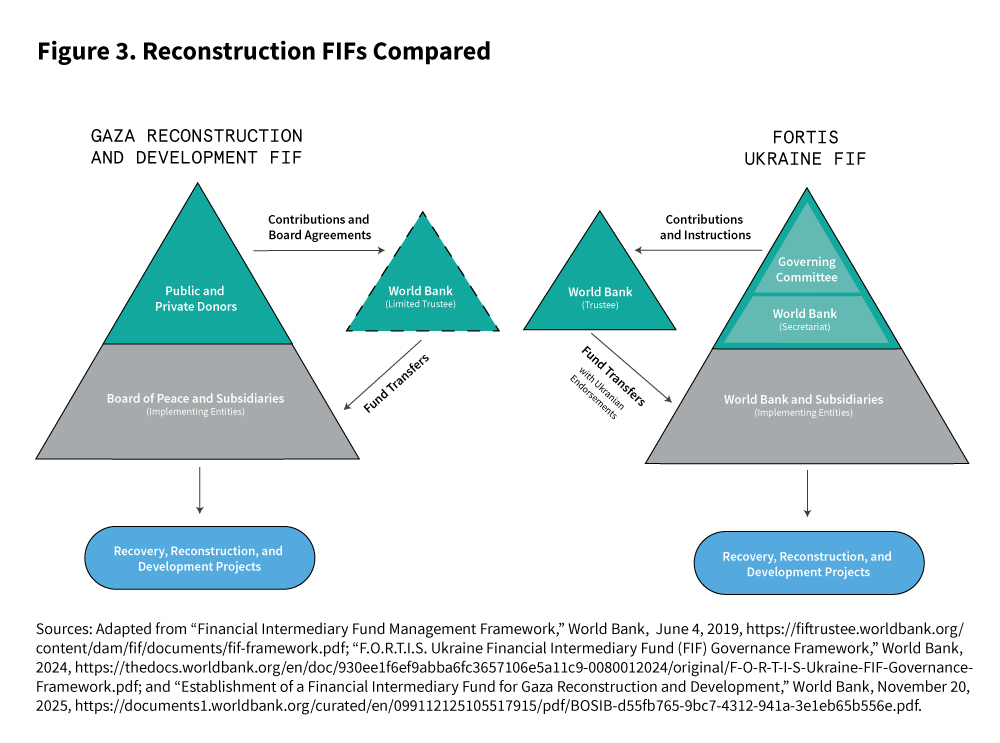
Establishing a FIF for reconstruction purposes is unusual for the World Bank. FIFs are generally reserved “for the purpose of supporting global programs,” typically related to public health and climate issues, not to support localized development. Only two of the World Bank’s thirty-two FIFs have been used to fund reconstruction of a territory: one related to damage sustained by Ukraine in its ongoing war with Russia and the other concerning earthquake-related damage in Haiti. However, in neither case did the bank act as a limited trustee; rather, it formed part of the fund’s governing group and assumed the role of fiduciary to ensure proper use of the funds. These FIFs are also distinguished from the one established for Gaza in that a Ukrainian and Haitian government official either chaired or occupied a non-voting member seat in the respective governance group, and in both cases, the country’s own plans for reconstruction and development guided implementation.
Trump’s Comprehensive Plan sidelines Palestinians in favor of an “apolitical” and “technocratic” administration in Gaza that will implement the Board of Peace’s agenda. In fact, the GRAD fund may have been established precisely because existing World Bank funds require the Palestinian Authority’s (PA) agreement. The fund fails to reference the PA’s reconstruction and development plan for Gaza and avoids requirements to align with World Bank strategy for supporting Palestinian development and state-building efforts. The Palestinian national plans for rehabilitating the lives of the population in Gaza would interfere with the Board of Peace’s “Master Plan” for a “New Gaza,” with skyscrapers, tourism zones, and industrial parks, as unveiled in Davos by Jared Kushner, an Executive Board member and Trump’s son-in-law.
In addition, the existing World Bank multi-donor funds link Gaza and the West Bank as one territorial unit to support a “well-connected Palestine.” In contrast, “New Gaza,” as conceived by the Board of Peace, is treated as wholly separate from the rest of the occupied Palestinian territories. In fact, residents of “New Gaza” entitled to benefits from reconstruction are referred to as “the people of Gaza,” defined as “solely . . . those who regard Gaza as their home and place of residence.” They are not referred to as “Palestinians,” nor is Palestine mentioned anywhere in the document. Because the resolution prohibits discrimination on the basis of religion or ethnic origin in the laws of New Gaza, non-Palestinians who view Gaza as their home or who once lived in illegal settlements there may be deemed residents. Thus, an opening exists for the Israeli recolonization of Gaza, something the extreme right in the Israeli coalition government have been demanding from Trump as a “real estate bonanza.”
Alongside the expansive notions of who are considered “the people of Gaza” exist vague eligibility requirements for the indigenous Palestinian population. The only Palestinians in Gaza entitled to participate in the development or administration of the enclave are those vetted by the Board of Peace. A person is excludable (and disqualified from receiving even humanitarian assistance) if they “supported” or have been “influence[d]” by “terror groups.” Given Israeli government efforts to boost notions that all Palestinians in Gaza are guilty of supporting terrorism—also documented in the ICJ provisional measures case brought by South Africa against Israel—and the U.S. deference to Israeli security concerns, many Palestinians are likely to be found wanting. Taken together, what the Board of Peace seems to envision is the forced displacement of at least part of the Palestinian population and the demographic re-engineering of the territory.
The GRAD also differs from the FIF for Ukraine with respect to certain limitations on the use of funds. The fund for Ukraine explicitly requires it be used solely for non-military purposes. No such restriction exists for the GRAD. While the World Bank indicated the new fund for Gaza would go to early recovery, reconstruction, and development activities, with a focus in the first 18 months on housing and education, High Representative Mladenov has stated that before any reconstruction in Gaza can take place, disarmament activities will be required for “all factions in Gaza, not just Hamas,” an undertaking that will likely extend beyond the less than two years left until the Security Council resolution sunsets on the Board of Peace. Thus, three scenarios exist for how the GRAD funds might be spent: for stabilization including policing and demilitarization, for humanitarian relief, or for whatever else the chairman and his Executive Board might decide. With the Bank acting only as a pass-through and limited trustee, it has no power to prevent funds from being used for stabilization activities in Gaza, which would be inherently political in nature and in violation of the bank’s Articles of Agreement with members. The commitment from the World Bank to second staff to act as controller over funds provides little assurance over the chairman and his appointed Executive Board’s unrestrained authority.
With Israel’s on-and-off-again closure orders over Gaza and Board of Peace plans to restrict aid and reconstruction to only qualifying Palestinians, the GRAD runs the risk of undermining the Bank’s Strategy for Fragility, Conflict and Violence and its critical mission to “end[] extreme poverty and boost[] shared prosperity.” Though the Bank stated that the GRAD is in alignment, how the board-directed fund will alleviate vulnerability and mitigate displacement in Gaza is hard to discern. A recent report from the UN High Commissioner for Human Rights covering a period that includes the first month of the Gaza ceasefire documents ethnic cleansing in both Gaza and the West Bank, while the World Food Program continues to categorize Palestine in 2026 as in a state of emergency with around 77 percent of the population in Gaza facing acute food insecurity. If the Trump Comprehensive Plan could not halt displacement and affect even basic aid delivery, the GRAD fund cannot promise that either.
Beyond the little hope of impact from the GRAD, the Bank and donor countries must consider the legal risk. A limited trustee role may not be sufficient to shield the Bank from liability associated with a development plan in which the commission of war crimes and crimes against humanity is likely to be facilitated. Recent findings of a UN independent commission of inquiry that genocide has taken place in Gaza, along with Israel’s imposition of a highly problematic new humanitarian regime with U.S. support, makes World Bank financing of Board of Peace activities in Gaza extremely fraught. Even if robust mechanisms for oversight and accountability were put in place they are likely to be ineffective so long as the board’s mandate is fluid, Trump’s power unchecked, and treatment of Israel’s actions permissive.
As war rages in the Middle East, the bandwidth for policymakers is limited. Neglecting to properly scrutinize the capacity of the United States–led Board of Peace to fulfill its objective in support of regional security and peacebuilding, however, would be a grave mistake. Failure to do so is likely to not only perpetuate conflict and war crimes in Israel/Palestine but also continue to fuel the dangerous developments unfolding throughout the region.
As a first order matter, and until and unless the Board of Peace is reformed, donor countries should direct funds for Gaza away from the GRAD and toward preexisting multi-donor World Bank funds for both Gaza and the West Bank that are subject to bank scrutiny and to which the bank owes fiduciary responsibility. Because such funds have the benefit of direct PA involvement and are guided by Palestinian national development plans, they are more likely to benefit the Palestinian people than the current Board of Peace proposal for a “New Gaza.” As the World Bank has noted, these funding mechanisms would “complement” any post-conflict recovery initiative and do not prevent Board of Peace efforts. And since they are unlinked to the Board of Peace, these parallel funds will survive the board’s likely dissolution, be available for the decades of reconstruction required in Gaza, and are less prone to management and oversight concerns.
Donor countries and stakeholders should also recommit to the New York Declaration and multilateral frameworks such as the Saudi- and French-led High Level Conference for the Peaceful Settlement of the Palestine Question and the Two-State Solution and the Norwegian-, Saudi-, and EU-led Global Alliance for the Implementation of the Two-State Solution. Both platforms align with international law, support Palestinian self-determination, and bolster the United Nations and its mechanisms. Under the platforms’ auspices, stakeholders should work together to develop strategies on how to steer the work of the Board of Peace in a way consistent with the recent rulings and advisory opinions of the International Court of Justice concerning Gaza and Palestinian self-determination. Stakeholders can also work together to formulate a take-it-or-leave-it reform agenda for the structure and mandate of the Board of Peace, leveraging their collective influence and donor dollars. These reforms should include revisions to the Board of Peace Charter so that its mandate is limited to Gaza, gives all member states equal standing and authorities, restricts the chairman’s role, and institutes oversight and controls on management of the board’s budget. Stakeholders should also demand that the PA—acting on behalf of the Palestine Liberation Organization, the recognized representative of the Palestinian people, and the World Bank counterpart on the multi-donor bank funds—be invited to join the board even if only as a non-voting member.
The U.S. Congress also has a role to play in reforming the mandate, structure, and agenda of the board. Trump asserted authority for U.S. participation on the Board of Peace under the International Organizations Immunity Act (IOIA) in Executive Order 14375. The IOIA provides U.S. participation in a public international organization must be pursuant to a U.S. treaty or under the authority of an Act of Congress. Despite the IOIA’s plain terms, the Senate has not ratified the Board of Peace Charter as a treaty, nor has Congress authorized U.S. participation. If the president refuses to acknowledge the charter as an international agreement and the board as an international public organization, Congress should ensure no U.S. taxpayer funds are appropriated for the body. With Trump’s pledge of $10 billion, Congress also retains oversight over the funds drawn from U.S. accounts.
Together, stakeholders and donors have the power to direct relief, recovery, and reconstruction in Gaza and peacebuilding in the region in a way that benefits the people on the ground, ensuring security for all. Multilateral frameworks and financing mechanisms that place all authority at the sole discretion of one state or individual are not fit for purpose.
Senior Fellow, Middle East Program
Zaha Hassan is a human rights attorney, policy analyst, and senior fellow at the Carnegie Endowment for International Peace.
Charles H. Johnson
Research Assistant, Middle East Program
Charles H. Johnson is a research assistant in the Carnegie Middle East Program.
Carnegie does not take institutional positions on public policy issues; the views represented herein are those of the author(s) and do not necessarily reflect the views of Carnegie, its staff, or its trustees.
The Trump-led board has laid out blueprints for “voluntary emigration” and land confiscation.
Zaha Hassan

By failing to address Palestinian representation, the current process is bound to lead to just another temporary arrangement.

Nathan J. Brown
Policy discussion is ignoring that the Palestinian national project is hollowed out and apartheid is a present danger.
Nathan J. Brown
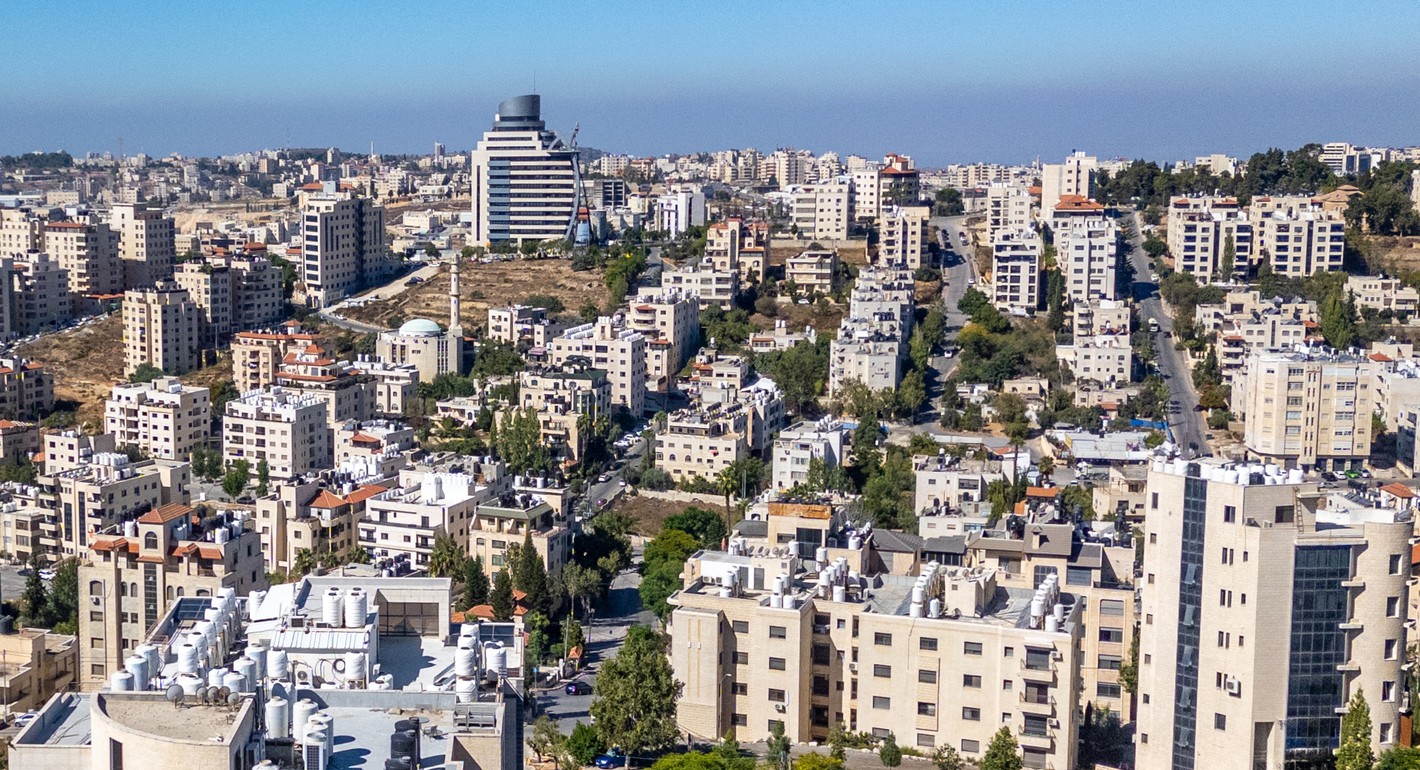
Barriers ranging from weak legal frameworks to ongoing, occupation-related limitations are constraining Palestine from achieving its ambitious climate targets.

Joy Arkeh, Nabil Nasser
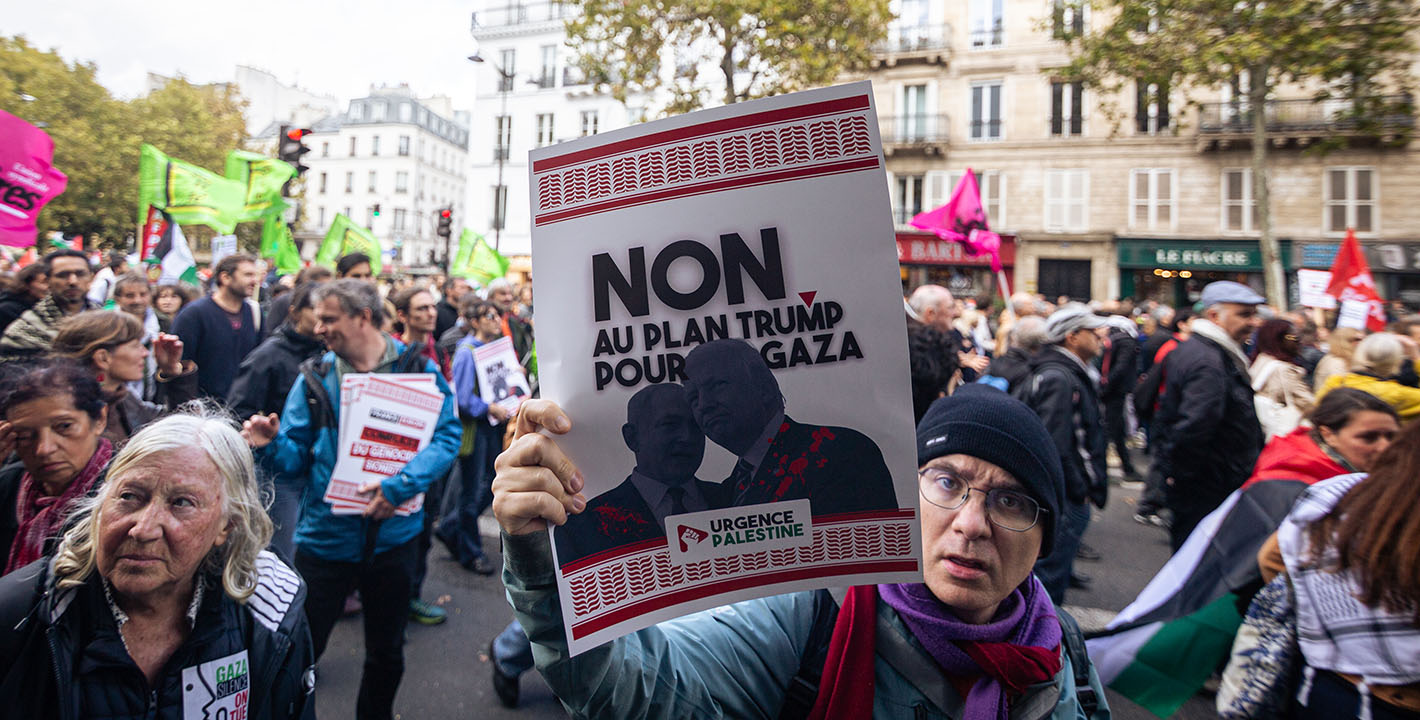
The simple conclusion is that the scheme will bring neither peace nor prosperity, but will institutionalize devastation.
Nathan J. Brown