

Commentary
Katherine Wilkens
{
  "authors": [
    "Katherine Wilkens"
  ],
  "type": "commentary",
  "blog": "Diwan",
  "centerAffiliationAll": "",
  "centers": [
    "Carnegie Endowment for International Peace"
  ],
  "collections": [],
  "englishNewsletterAll": "",
  "nonEnglishNewsletterAll": "",
  "primaryCenter": "Carnegie Endowment for International Peace",
  "programAffiliation": "",
  "programs": [],
  "projects": [],
  "regions": [
    "Iraq",
    "Syria"
  ],
  "topics": []
}
Source: Getty
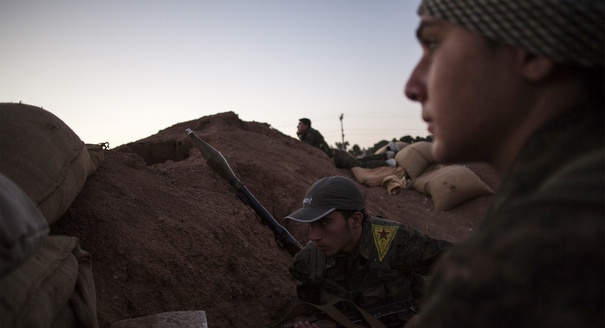
The battle for al-Yarubiya, a border crossing point along the Syrian-Iraqi border, is an extension of the broader regional battle for control of Iraq, Syria, and Lebanon by jihadists.
At first glance the announcement last week that the Syrian Kurdish People’s Defense Units (YPG), the military arm of the Democratic Union Party (PYD) party, had captured al-Yarubiya (Til Koçer), a border crossing point along the Syrian-Iraqi border, looked like just another battle between Kurdish forces and jihadists vying for control of strategic territory in the north. But, the battle for al-Yarubiya is an extension of the broader regional battle for control of Iraq, Syria, and Lebanon by jihadists such as the Islamic State of Iraq and Al Sham (ISIS) and was significant for the coordination between Iraqi forces and the YPG.
In recent weeks the Iraqi army pushed back two attempts by ISIS forces to control the towns of Anan and Raqah along one of the main transit routes from Baghdad to Syria. Al Yarubiya lies along the route from Mosul to the strategic Syrian Kurdish town of Qamishli in the north. On Friday as the fighting heated up one Saudi jihadist tweeted, “Enormous military support from the Iraqi army for the secular Kurdish forces fighting the mujahedin and occupying the border city of Al-Ya’rubiya. My brothers: aiding the mujahedin is obligatory.”
The PYD, which has been increasingly engaged in direct fighting with the ISIS and other jihadist forces in Syria, is a natural ally for Baghdad. Both sides are eager for the defeat of the jihadists. Both also see Bashar Assad as a necessary element of any Syria solution. In an interview with Turkish press on October 26th, PYD leader Salih Muslim stated that the increased polarization in Syria has now made it impossible for a solution in Syria that does not include Assad.
The PYD control of al-Yarubiya/Til Koçer could open up a much needed door to the outside world through Baghdad and help neutralize the embargo on the Syrian Kurds imposed by KRG President Massoud Barzani in May 2013. The Barzani blockade was prompted by the PYD’s arrest of 74 Kurdish peshmerga trying to cross back into Syria from the KRG and is part of the Barzani’s on-going efforts to exert control over the Syrian Kurds. The peshmerga, arrested and returned to the KRG, were affiliated with the pro-Barzani KDP-S and they received military training from the KDP to return to Syria and help challenge the rising power of the PKK-supported PYD.
Increased cooperation between the PYD and Baghdad against the ISIS could also turn the heat up on Turkey and KRG whose regional policies have had the effect of enabling jihadists in an attempt to do anything to undermine Assad and the PYD. But the group has emerged as the primary force contesting jihadist control over the north and Syrian Kurds of all stripes have begun to see it that way. The recent death of PYD leader Salih Muslim’s son while battling jihadists along the Turkish border further elevated his standing among Kurds and prompted strong criticism of Barzani’s refusals to permit Muslim to transit the KRG following his son’s funeral. After waiting for 6 days to cross into the KRG, Muslim eventually left for Europe through Baghdad—perhaps a sign of the times.

Nonresident Scholar, Middle East Program
Katherine Wilkens is a nonresident scholar at the Carnegie Endowment for International Peace where she formerly served as deputy director of the Middle East Program.
Recent Work
Katherine Wilkens
Katherine Wilkens
The Zaidi government’s objective to collect weapons is constrained by regional conflict, but it can take certain measures at home.
Ali Al-Mawlawi
In an interview, Sohaib Jawhar analyzes the profound changes in the ties between the neighboring countries.

Michael Young
Following its deal with the United States, Iran may act against Iraq-based dissidents.
Wladimir van Wilgenburg
Any move by the United States to make good on Trump’s suggestion that Washington persuade Damascus to confront Hezbollah militarily would have catastrophic consequences.

Kheder Khaddour
In an interview, Elizabeth Thompson recalls how the country formulated a liberal constitution in 1920, before being denied by France and Britain.
Michael Young