

Commentary
Trade statistics show why Amman has more reason than Damascus to welcome the improvement in bilateral commerce.
Armenak Tokmajyan
{
  "authors": [
    "Carl Drott"
  ],
  "type": "commentary",
  "blog": "Diwan",
  "centerAffiliationAll": "",
  "centers": [
    "Carnegie Endowment for International Peace"
  ],
  "collections": [],
  "englishNewsletterAll": "",
  "nonEnglishNewsletterAll": "",
  "primaryCenter": "Carnegie Endowment for International Peace",
  "programAffiliation": "",
  "programs": [],
  "projects": [],
  "regions": [
    "Middle East",
    "Syria"
  ],
  "topics": []
}
Source: Getty
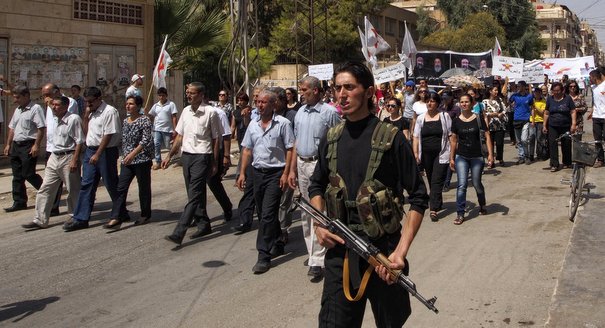
Different areas of Qamishli are controlled by either regular regime forces or a collection of rival militias, including the Syriacs’ own militia force, the Sutoro.
Qamishli, in northeastern Syria, is a world of its own in this uprising. Inhabited by a mix of Kurds, Arabs, and Christian Syriacs, the city has the potential for severe ethnic and religious strife. There is certainly a history of ethnic conflict in Qamishli, where the 2004 Kurdish-Arab riots are still a fresh memory. Yet, after two and a half years of conflict in Syria, Qamishli’s inhabitants remain untouched by major fighting.
Even so, the situation is very tense. Different areas of Qamishli are controlled by either regular regime forces or a collection of rival militias: the National Defense Forces, which are staffed by pro-regime Arabs; the Kurdish Asayish Security Forces, which are related to the People’s Protection Units, a Kurdish militia; and the Syriacs’ own militia force, the Sutoro.
Most visible remnants of the regime have been removed from the Kurdish areas of Qamishli, which are controlled by the Asayish, but sculpture busts and portraits of former Syrian president Hafez al-Assad still stand untouched in the predominantly Christian neighborhood of Wusta.
While the Syriacs in this area have been able to stick together as a community, they have maintained ambiguous relations with the regime. Some Syriacs clearly support the regime, but others are ambivalent or strongly against it. However, even opposition activists in this community do not seem particularly keen on confronting the government of Syrian President Bashar al-Assad at the present moment, since they fear it would lead to nothing but bloodshed.
Kino, a twenty-three-year-old member of the Syriac Union Party (SUP), which stands in nonviolent opposition to the regime, takes a pragmatic stand: “Syriacs used to be divided between supporters and opponents of the regime, but in the last year and a half we have stopped arguing about this. Instead we ask ourselves what we need to do.”
A rare example of a Christian militia in Syria, the Sutoro was founded by the SUP as a response to the increased targeting of Christians by criminal and radical Islamist groups. However, while the Sutoro branches in al-Qahtaniyah and al-Malikiyah continue to oppose the regime and remain under SUP control, the Qamishli branch has gradually been overtaken by regime-friendly elements.
Inside its base in Qamishli, which carries the red, white, and black Syrian flag, I met with some of the Sutoro’s young members, many of whom are university students who had to abort their studies because of the war. One of them studied in the city of Deir ez-Zor, which is now controlled partly by the regime and partly by rebel groups, including al-Qaeda’s Nusra Front and the Islamic State of Iraq and the Levant. He tells me that Syria used to be a great place to live and that recent regime advances in other parts of the country have made some areas safe again.
Indeed, while the regime seemed utterly weak last year, it is gaining strength again. Its clients in the Qamishli branch of the Sutoro now want to drive the Syriac community back into the regime’s fold—and those who want to remain neutral or in opposition have little to set against.
This is the second report from Qamishli by Swedish journalist Carl Drott. For part one, click here.
Carl Drott
Carnegie does not take institutional positions on public policy issues; the views represented herein are those of the author(s) and do not necessarily reflect the views of Carnegie, its staff, or its trustees.
Trade statistics show why Amman has more reason than Damascus to welcome the improvement in bilateral commerce.

Armenak Tokmajyan
In an interview, Kheder Khaddour explains that Damascus is trying to stabilize its borders, but avoiding war isn’t guaranteed.

Michael Young
As Iran defends its interests in the region and its regime’s survival, it may push Hezbollah into the abyss.
Michael Young
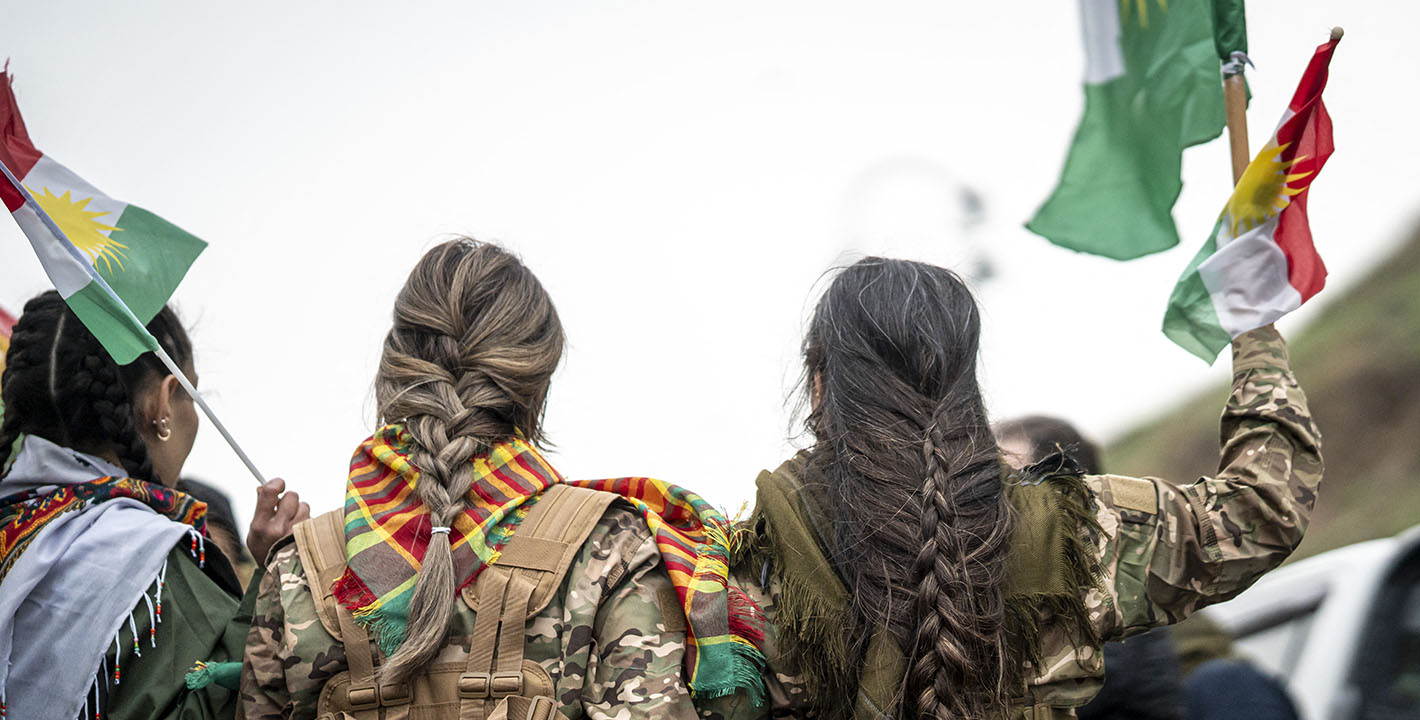
A recent offensive by Damascus and the Kurds’ abandonment by Arab allies have left a sense of betrayal.
Wladimir van Wilgenburg
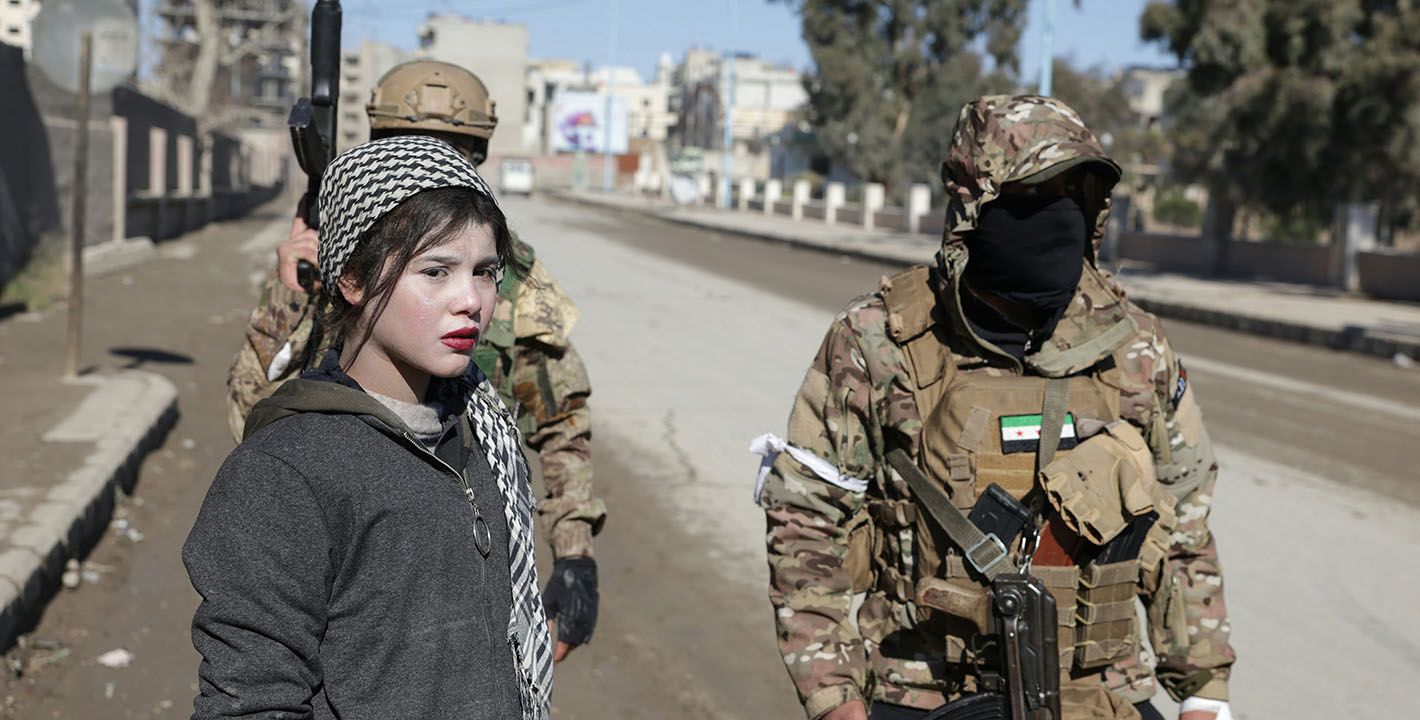
The government’s gains in the northwest will have an echo nationally, but will they alter Israeli calculations?
Armenak Tokmajyan