

Commentary
As the U.S.-led Coalition withdraws, the Kurds’ reliance on Baghdad, and on themselves, will only increase.
Wladimir van Wilgenburg
{
  "authors": [
    "Wladimir van Wilgenburg"
  ],
  "type": "commentary",
  "blog": "Diwan",
  "centerAffiliationAll": "",
  "centers": [
    "Carnegie Endowment for International Peace"
  ],
  "collections": [],
  "englishNewsletterAll": "",
  "nonEnglishNewsletterAll": "",
  "primaryCenter": "Carnegie Endowment for International Peace",
  "programAffiliation": "",
  "programs": [],
  "projects": [],
  "regions": [
    "Middle East",
    "Iraq",
    "Syria"
  ],
  "topics": []
}
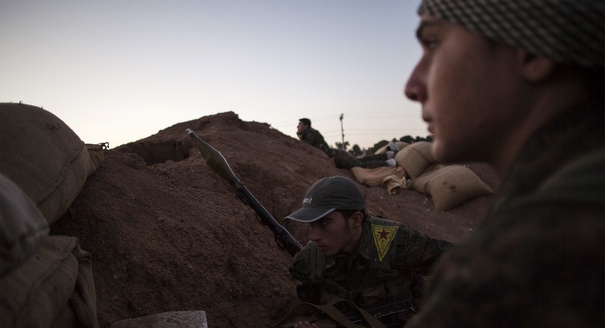
Source: Getty
Syrian Kurds fear that the Kurdish issue will be ignored in the Geneva II Syrian peace conference, despite the fact that Kurds control a significant part of northern Syria, including many oil-producing areas.
The Syrian Kurds have failed to get support from the United States and Russia to have an independent delegation for the upcoming Geneva II Syrian peace conference, slated to begin on January 22. They now fear that the Kurdish issue will be ignored in the conference, despite the fact that Kurds control a significant part of northern Syria, including many oil-producing areas.
At first it was unclear if the Syrian Kurdish political organizations could solve their differences, which have been exacerbated by tension between Kurdish groups in Iraq and Turkey. Competition between Kurdistan Democratic Party leader Massoud Barzani, the president of the Kurdistan region of Iraq, and the Kurdistan Workers Party (PKK), the main Kurdish party in Turkey, over the leadership of the Kurds, were at the core of the differences between Kurdish parties in Syria.
The PKK backs the powerful Syrian Kurdish Democratic Union Party (PYD) and it’s armed wing, the People’s Defense Units (YPG), that control significant parts of the Kurdish areas in Syria. Its main rival, the Kurdish National Council (KNC), which brings together several Kurdish parties, is backed by Barzani.
Since 2011, the PYD has become the largest Kurdish party in Syria, as a result of its military power through the YPG. The KNC, on the other hand, has been increasingly marginalized as a result of its corresponding lack of military influence. Its leadership is now based outside of Syria and it has affiliated itself with the National Coalition of Syrian Revolutionary and Opposition Forces, Syria’s main exile leadership, which is endorsed by several Western and Arab nations, as well as by the PKK’s and PYD’s main enemy, Turkey.
As I have previously written at Al Monitor, the KDP and PKK managed to solve some of their differences in December 2013, and they agreed that the Syrian Kurds should have a united voice in Geneva II as part of an independent Kurdish delegation. However, the National Coalition and several influential foreign nations have opposed the idea of a separate Kurdish delegation. In the end, it appears that only the Kurdish National Council (KNC) will go to Geneva II, as part of the National Coalition’s delegation—assuming the conference is held and the National Coalition attends—while the PYD is left out entirely.
The PYD argues that if the Kurds do not have an independent delegation at the Geneva II talks, there will be no recognition of special status for the Kurds in Syria. There is historical precedent for such fears, considering how the Kurdish national tragedy began in the 1920s. The PYD-leader Saleh Muslim Mohammed has warned of a repetition of the 1923 treaty of Lausanne that created a Turkish state and ignored the option of Kurdish independence that had been promised in the earlier treaty of Sèvres in 1920.
Ultimately, the PYD seeks international recognition for its plan to form a transitional Kurdish government in northern Syria, similar to the autonomous Kurdish Regional Government in Iraq. The West has so far opposed this idea, and it has been harshly criticized by the National Coalition. But for the PYD and many Syrian Kurds, it is of crucial importance. Having their own delegation at the talks would have allowed the PYD to raise this demand and bargain for its approval in the proceedings.
“There is frustration towards Washington, Moscow, and the UN,” says the Washington-based Kurdish affairs specialist Mutlu Civiroglu, who argues that Syrian Kurds now feel left out of the Geneva II process. “To provide the Kurdish point of view, Kurds should be there and they should be allowed to speak and raise their own demands. The Kurds have stopped radicals, protected their own areas, and protected ethnic minorities. Not allowing Kurds to come [in a separate Kurdish delegation], means that they want Kurds to live the same life as they did during Syrian President Bashar al-Assad’s rule before the revolution.”
At the end of the day, the YPG is the clearly dominant military power in Syrian Kurdistan and the Geneva conference will not change the reality on the ground. Even the KNC realizes that the Kurdish issue will most likely not be discussed during Geneva II, and the PYD and its affiliates are turning hostile to the entire process.
On January 16, a pan-Kurdish body controlled by the PKK said that since the Geneva II meeting is “ostracizing” Syrian Kurds, its outcome “will not be recognized by the Kurds.” This hardening of the PKK’s position didn’t take long to filter down to its affiliates in Syria. Earlier on Monday, a PYD-affiliated organization threatened the KNC by saying that if it goes to Geneva without trying to secure “well-deserved Kurdish rights,” this “will be considered high treason against the Kurdish people and against all of Syria.”
It seems that after its demand for a separate Kurdish delegation was refused, the PYD has now decided to reject the Geneva II meeting entirely.
Wladimir van Wilgenburg is a contributor to Al-Monitor and a political analyst specializing in Kurdish politics.
Wladimir van Wilgenburg
Wladimir van Wilgenburg is a Dutch journalist and author writing predominantly about Kurdistan.
Carnegie does not take institutional positions on public policy issues; the views represented herein are those of the author(s) and do not necessarily reflect the views of Carnegie, its staff, or its trustees.
As the U.S.-led Coalition withdraws, the Kurds’ reliance on Baghdad, and on themselves, will only increase.
Wladimir van Wilgenburg

As the U.S. stumbles in its war with Iran, we are likely to see an acceleration of its disengagement from the region.

Michael Young
The Zaidi government’s objective to collect weapons is constrained by regional conflict, but it can take certain measures at home.
Ali Al-Mawlawi

Huawei pushed hard to enter the Egyptian data centers market, until the Americans made a better offer.

Angie Omar

The accord represents a pivotal moment in the region to avert a security vacuum in the Gulf.


Azeema Cheema, Mohanad Hage Ali