

Commentary
Aron Lund
{
  "authors": [
    "Aron Lund"
  ],
  "type": "commentary",
  "blog": "Diwan",
  "centerAffiliationAll": "",
  "centers": [
    "Carnegie Endowment for International Peace"
  ],
  "collections": [],
  "englishNewsletterAll": "",
  "nonEnglishNewsletterAll": "",
  "primaryCenter": "Carnegie Endowment for International Peace",
  "programAffiliation": "",
  "programs": [],
  "projects": [],
  "regions": [
    "Middle East",
    "Syria"
  ],
  "topics": []
}
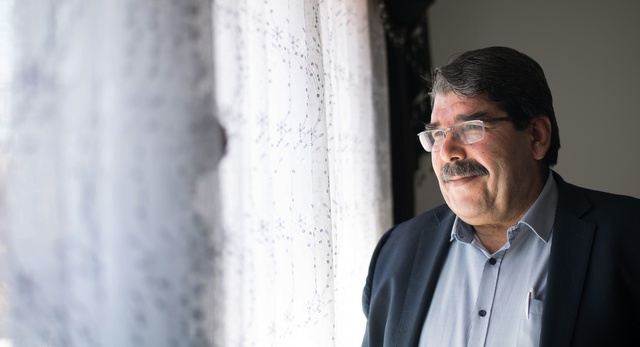
Source: Getty
This is the second part of my interview with Saleh Muslim Mohammed, the co-chair of the Democratic Union Party (PYD), Syria’s most powerful Kurdish movement. For part one, which includes a backgrounder on the PYD, click here.
The PYD says it supports a negotiated transition, but it boycotted the Geneva II conference for peace in Syria. Why?
We wanted to go, but . . . [those organizing the conference] didn’t allow us. If you invite somebody to come, you have to invite them in accordance with their identity. We would like to go there identified as Kurdish people, saying that the delegation has one member of the Kurdish people representing the Kurds. But they didn’t allow us to do this. But we are ready to join Geneva II or Geneva III anytime—as soon as they accept the Kurdish being.
The PYD is part of the National Coordination Body for Democratic Change (NCB), an alliance of opposition groups based inside Syria, alongside Arab leftists and nationalists. Would you go to peace negotiations as a part of an NCB delegation?
Yes, but with a Kurdish identity. We have an agreement between the NCB and the Kurdish people, the transitional administration that we have established in Rojava, [the Kurdish areas of northern Syria]. The NCB has proposed that the NCB and the transitional democratic administration could go together, in a joint delegation.
The NCB Executive Office recently criticized your self-administration project in northern Syria.
Oh, it was just some members of the NCB who have these ideas. It’s a very normal thing that we have these types of discussions. When we first began on the project for democratic self-rule, we had the same type of discussions, but it was accepted in the end.
Both the PYD and the United States would prefer a negotiated transition in a secular Syria, and you are both fighting al-Qaeda, for example. Could there be cooperation between the PYD and the West, and why hasn’t that happened yet?
Yes, this is really a problem. We are trying to understand what the problem is. We are knocking on every door in the West, from the United States to the United Kingdom and France, saying, “Hey, we are fighting against terrorists who are a danger to everybody, so let’s work together.” But they’re not opening the door. If you know any way to get them to open the door, let us know! [laughs]
Well, Western nations consider you to be a branch of the Kurdistan Workers’ Party (PKK), an armed movement that has fought the government of Turkey since the 1980s and that is blacklisted in Europe and the United States.
I don’t agree with that. We have no organizational relations with the PKK. But hypothetically, let’s say that there was a relationship—what has the PKK ever done against the West? Has it kidnapped soldiers from the West? Has it killed anyone from the West? Has it committed terrorist actions in the West? No!
It didn’t do anything against the Western countries, so why is it considered a terrorist organization? I really cannot understand it.
So you’re open to contacts with the West?
Sure, sure, sure—it’s not a problem. The West is wrong if it considers us a PKK group and feels that we shouldn’t have relations. I think there are some other forces that would not like to see the West have relations with the Kurds and with us.
Lots of people say that we are separatists—we are not separatists. They accuse us of looking for [an independent nation-state of] Greater Kurdistan, but we are not. What we are trying to do is implement democracy in our lands—it could be a radical democracy for the people. We really think it is the only solution. The example that we have established in our areas is very clear, and everybody is sharing in it—we’re not excluding the Arabs or Syriacs or Turkmens, it’s for everybody to share. This is the democratic way of life, and it is the best way for everybody.
Former Nonresident Fellow, Middle East Program
Aron Lund was a nonresident fellow in the Middle East Program and the author of several reports and books on the Syrian opposition movement.
Recent Work
Aron Lund
Aron Lund
Carnegie does not take institutional positions on public policy issues; the views represented herein are those of the author(s) and do not necessarily reflect the views of Carnegie, its staff, or its trustees.

Huawei pushed hard to enter the Egyptian data centers market, until the Americans made a better offer.

Angie Omar

The accord represents a pivotal moment in the region to avert a security vacuum in the Gulf.


Azeema Cheema, Mohanad Hage Ali

In an interview, Jason Burke discusses his sweeping account of the “revolutionists” who so shaped the 1970s and early 1980s.

Michael Young
In an interview, Sohaib Jawhar analyzes the profound changes in the ties between the neighboring countries.
Michael Young
There is a disturbing structural parallel between the old global energy economy and the new green transition.
Angie Omar