

Article
Amr Adly, Hamza Meddeb
{
  "authors": [
    "Amr Adly"
  ],
  "type": "commentary",
  "blog": "Diwan",
  "centerAffiliationAll": "dc",
  "centers": [
    "Carnegie Endowment for International Peace",
    "Malcolm H. Kerr Carnegie Middle East Center"
  ],
  "collections": [],
  "englishNewsletterAll": "menaTransitions",
  "nonEnglishNewsletterAll": "",
  "primaryCenter": "Carnegie Endowment for International Peace",
  "programAffiliation": "MEP",
  "programs": [
    "Middle East"
  ],
  "projects": [],
  "regions": [
    "Egypt",
    "North Africa"
  ],
  "topics": [
    "Political Reform",
    "Economy"
  ]
}
Source: Getty
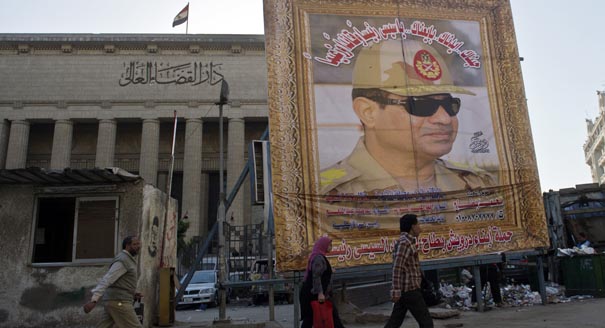
In a cover story published in August, The Economist magazine had this to say about Egypt’s regime, under a headline that provocatively read “The Ruining of Egypt”: “Nowhere is the poisonous mix of demographic stress, political repression and economic incompetence more worrying than in Egypt under its strongman, Abdel-Fattah al-Sisi.”
Even though the article did not blame Egypt’s regime for all of the country’s problems, it held the government responsible for excessive repression and considerable ineptitude in managing the economy after five long years of economic slowdown and political upheaval. The mix of demographic stress, despotism, and economic hardship was creating conditions for the “next explosion,” the magazine warned.
If one has learned anything about Egypt and the Middle East in general, it is that predictions are often wrong. This applied to those who dismissed the chances of a revolutionary upheaval before 2011. It applies today to those who see an inevitable link between Egypt’s grim economic reality and renewed political protest. The shortcomings of Egypt’s economy may well be conducive to future instability, but that is not a certainty. Misery and hardship do not, on their own, spark uprisings.
It is with this in mind that I wrote a paper recently titled Egypt’s Regime Faces an Authoritarian Catch-22, examining the dilemma the Sisi regime is facing in consolidating its authoritarian control. I argued that “[t]he country’s economic and fiscal challenges deny its leadership the resources needed to maintain its base of support among public sector employees, but at the same time, the regime is reluctant to introduce reforms to address these constraints because they risk alienating that same key constituency.”
Prospects for the political and economic situations in Egypt can only be understood in the broader context of events since 2011. The country witnessed a political transformation that failed to produce a sustainable and functioning political apparatus. Popular support for the military takeover of July 2013 was an expression of disenchantment with politics and fear of disorder and civil strife. These factors are still there, especially given the ongoing wars that are taking place throughout the region. Moreover, the regime’s iron fist, the censoring of media, and the banning of public protests have all removed any margin for translating discontent into concerted political action.
What that means is that it is likely that Egypt’s regime will survive the country’s economic decay. This has happened in even more dramatic ways in Robert Mugabe’s Zimbabwe and Omar al-Bashir’s Sudan. The question is not whether the regime will last, but the kind of regime that is likely to emerge from the economic turmoil. The Sisi regime will remain in power only by continuing to rule by repression—but in the absence of clear interest representation among the social groups and constituencies it hopes or claims to represent. That is the Catch-22 the regime faces and it means that authoritarian rule will come with an increasingly high political, social, and economic price tag. Egypt’s future may contain not a bang, but a long whimper.
Former Nonresident Scholar, Middle East Center
Adly was a nonresident scholar at the Carnegie Middle East Center, where his research centers on political economy, development studies, and economic sociology of the Middle East, with a focus on Egypt.
Recent Work
Amr Adly, Hamza Meddeb
Robert Springborg, Ishac Diwan, Amr Adly, …
Carnegie does not take institutional positions on public policy issues; the views represented herein are those of the author(s) and do not necessarily reflect the views of Carnegie, its staff, or its trustees.
This will be the region’s most representative tournament, amid broad changes in its footballing landscape.

Issam Kayssi
The recent African Cup of Nations tournament in Morocco touched on issues that largely transcended the sport.

Issam Kayssi, Yasmine Zarhloule
In an interview, Ishac Diwan looks at the merits and flaws in the draft legislation distributing losses from the financial collapse.

Michael Young
Mustaqbal Misr has expanded its portfolio with remarkable speed, but a lack of transparency remains.

Yezid Sayigh
The burden of environmental degradation is felt not only through physical labor but also emotional and social loss.
Yasmine Zarhloule, Ella Williams