

Commentary
Marc Lynch
{
  "authors": [
    "Marc Lynch"
  ],
  "type": "commentary",
  "blog": "Diwan",
  "centerAffiliationAll": "dc",
  "centers": [
    "Carnegie Endowment for International Peace",
    "Malcolm H. Kerr Carnegie Middle East Center"
  ],
  "collections": [],
  "englishNewsletterAll": "menaTransitions",
  "nonEnglishNewsletterAll": "",
  "primaryCenter": "Carnegie Endowment for International Peace",
  "programAffiliation": "MEP",
  "programs": [
    "Middle East"
  ],
  "projects": [],
  "regions": [
    "Middle East",
    "North Africa",
    "Egypt",
    "Gulf",
    "Levant",
    "United States",
    "Syria",
    "Saudi Arabia"
  ],
  "topics": [
    "Political Reform"
  ]
}
Source: Getty
The Middle East may be a place where Donald Trump’s policies have the least impact.
It’s too soon to know what Donald Trump’s shocking election victory means for U.S. Middle East policy. Trump has offered few coherent ideas on the region until now and the identities of key officials are unknown. This makes his regional objectives something of a blank slate.
However, as Perry Cammack noted yesterday, some key themes seem likely to shape his initial policy. Without minimizing the probable cataclysmic effects Trump will have across most domestic and foreign policy areas, there are reasons to believe that the Middle East may be one place where, surprisingly, he has the least impact.
In Syria, he seems unlikely to intervene against the regime of President Bashar al-Assad, whatever its transgressions. Trump has frequently expressed skepticism about the intentions of the Syrian rebels and sharply criticized Hillary Clinton’s support for the establishment of a no-fly zone. That, combined with his seeming comfort with Russia, increases the chances that Trump will not support the idea of humanitarian intervention against the Syrian regime.
While he may well face significant pressure to intervene from the foreign policy community (and even from his own vice president), for now it appears that the American escalation in Syria, which virtually everyone expected, will probably not come. That means that something akin to the status quo could persist—which would not have been the case with a President Clinton. For those who believed that limited intervention would have made little positive difference anyway, instead paving the way towards even greater embroilment, that the U.S. isn’t going into Syria seems to be the one silver lining of this election.
Trump also seems unlikely to change much in the U.S.-led campaign against the Islamic State in Syria and Iraq. He will quickly recognize that the campaign is going quite well, especially in Iraq. And he will be happy to take credit for the fall of Mosul and Raqqa, if they occur after his inauguration.
It would be disruptive if Trump acts on his oft-repeated criticism of the Iran nuclear deal. It seems plausible, at least, that his views will change once he is fully briefed about the real benefits of the deal and the costs of trashing it, with sanctions unlikely to be restored. Rather than tearing up the accord with nothing to replace it, Trump may well settle for loud noises about renegotiation. This is one of the hardest issues to really judge in advance.
That’s where the good news ends, though. Barring some significant change in his orientation, Trump will probably continue to voice extreme views about “radical Islam” which will promote narratives about clashing civilizations, which can only enhance the appeal of jihadi groups. Disinterest in addressing wars such as those in Yemen and Libya will ensure new havens for jihadis fleeing the Islamic State’s broken caliphate. Trump’s very crude understanding of the complex strands in today’s Islamist world, including the fever swamp of conspiracy theories about the Muslim Brotherhood in his political base, will make effective policy more difficult.
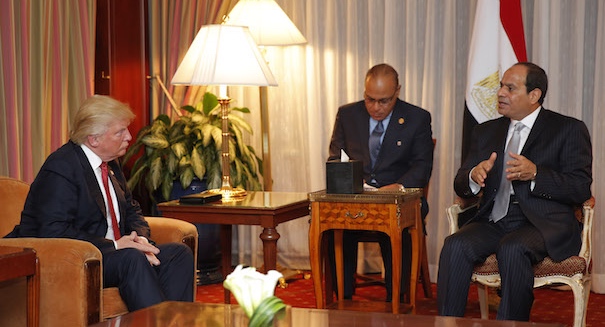
Trump’s caustic words about Saudi Arabia and his frequently voiced demands that allies carry a greater share of the burden may signal new tensions in regional alliances, but that too may be quickly set aside. America’s Middle Eastern allies might worry about Trump’s scornful words, erratic behavior, anti-Islamic views, and transactional view of alliances. But he is likely to get along well enough with the region’s anti-democratic strongmen. It is no surprise that Egypt’s President Abdel Fattah al-Sisi was one of the first world leaders to call the president-elect. Trump’s avowed admiration for strong autocratic leaders, his hawkish views on Iran, his skepticism about Arab democracy and mainstream Islamists, and the fact that he will prioritize counterterrorism will please many of the region’s autocrats immensely. However, reformers, civil society groups, activists, and those seeking greater freedoms are in for a rough ride.
Whatever Trump plans to do in the Middle East is unlikely to survive contact with reality. George W. Bush promised a humble foreign policy and soon found himself trying to transform the region by force. Barack Obama promised to get out of Iraq and reset relations with the Muslim world, only to be dragged back into Iraq, as well as Syria, by the Islamic State. Trump will face a region afflicted by multiple wars, massive refugee flows, and a profound crisis of governance for which the U.S. presidential campaign did little to prepare him.
Trump will have great freedom to pursue his preferred policies in his first few months in office, at least, but will soon encounter new crises and resistance from all quarters. This will pull his policy in directions very different than the ones he expected.
Former Nonresident Senior Fellow, Middle East Program
Marc Lynch was a nonresident senior fellow in Carnegie’s Middle East Program where his work focuses on the politics of the Arab world.
Recent Work
Marc Lynch
Marc Lynch
Carnegie does not take institutional positions on public policy issues; the views represented herein are those of the author(s) and do not necessarily reflect the views of Carnegie, its staff, or its trustees.

Middle Eastern states should welcome an accelerated U.S. disengagement from their region.

Michael Young

In an interview, former ambassador Charles Freeman assesses the Trump administration’s war against Iran.
Michael Young

The accord represents a pivotal moment in the region to avert a security vacuum in the Gulf.


Azeema Cheema, Mohanad Hage Ali

In an interview, Jason Burke discusses his sweeping account of the “revolutionists” who so shaped the 1970s and early 1980s.
Michael Young
In an interview, Sohaib Jawhar analyzes the profound changes in the ties between the neighboring countries.
Michael Young