

Commentary
Azeema Cheema, Mohanad Hage Ali
{
  "authors": [
    "Mohanad Hage Ali"
  ],
  "type": "commentary",
  "blog": "Diwan",
  "centerAffiliationAll": "dc",
  "centers": [
    "Carnegie Endowment for International Peace",
    "Malcolm H. Kerr Carnegie Middle East Center"
  ],
  "collections": [],
  "englishNewsletterAll": "menaTransitions",
  "nonEnglishNewsletterAll": "",
  "primaryCenter": "Carnegie Endowment for International Peace",
  "programAffiliation": "MEP",
  "programs": [
    "Middle East"
  ],
  "projects": [],
  "regions": [
    "Middle East",
    "Türkiye",
    "Iraq",
    "Syria",
    "Levant"
  ],
  "topics": [
    "Political Reform"
  ]
}
Source: Getty
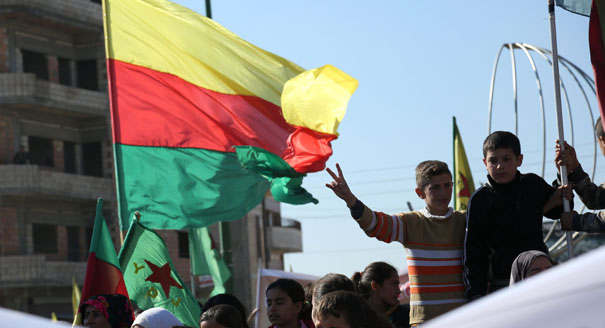
Carnegie Middle East recently hosted a roundtable on the self-declared Federation of Northern Syria-Rojava.
On March 17, 2016, the de facto Kurdish administration in three Kurdish areas of concentration in northern Syria, the Jazira, Kobane, and Afrin, declared the establishment of a Federation of Northern Syria-Rojava. This was an attempt on their part to bring the geographically distinct areas under one political umbrella controlled by the Democratic Union Party (PYD) and its military branch, the People’s Protection Units (YPG), both closely affiliated with the Kurdistan Workers Party (PKK).
However, since March 2016, regional alliances have shifted, casting doubts on Rojava’s viability in any final solution to the Syrian conflict. Turkey deployed its army into Syria last August, establishing its own military zone, and began a rapprochement with Russia. These developments further isolated the PYD and its allies, excluding them from the recent Astana talks designed to bring about a final settlement of the Syrian conflict.
To discuss these developments, and the Rojava experience so far, Carnegie Middle East Center held a roundtable discussion at its offices in Beirut last February 13, with Fawza Yousef, the co-president of the Executive Committee of the Democratic Federal System for Rojava-Northern Syria, and committee member Naamat Agha. Yousef, a former political prisoner under the Assad regime, addressed allegations of ethnic cleansing of the Arab population, and the repression of dissent within the Kurdish community. She highlighted the tensions with the Kurdistan Regional Government in Iraq, in particular with the Kurdistan Democratic Party.
Finally, the panel discussed women’s enrollment in the fight against the Islamic State, which has altered gender relations in a conservative patriarchal society. Diwan posts the roundtable discussion, which took place in Arabic, on its English site for those who are bilingual.

Deputy Director for Research, Malcolm H. Kerr Carnegie Middle East Center
Mohanad Hage Ali is the deputy director for research at the Malcolm H. Kerr Carnegie Middle East Center.
Recent Work

Azeema Cheema, Mohanad Hage Ali
Mohanad Hage Ali
Carnegie does not take institutional positions on public policy issues; the views represented herein are those of the author(s) and do not necessarily reflect the views of Carnegie, its staff, or its trustees.

As the U.S. stumbles in its war with Iran, we are likely to see an acceleration of its disengagement from the region.

Michael Young
The Zaidi government’s objective to collect weapons is constrained by regional conflict, but it can take certain measures at home.
Ali Al-Mawlawi

Huawei pushed hard to enter the Egyptian data centers market, until the Americans made a better offer.

Angie Omar

The accord represents a pivotal moment in the region to avert a security vacuum in the Gulf.
Azeema Cheema, Mohanad Hage Ali

In an interview, Jason Burke discusses his sweeping account of the “revolutionists” who so shaped the 1970s and early 1980s.
Michael Young