

Commentary
Michael Young
{
  "authors": [
    "Michael Young"
  ],
  "type": "commentary",
  "blog": "Diwan",
  "centerAffiliationAll": "dc",
  "centers": [
    "Carnegie Endowment for International Peace",
    "Malcolm H. Kerr Carnegie Middle East Center"
  ],
  "collections": [
    "Inquiring Minds"
  ],
  "englishNewsletterAll": "menaTransitions",
  "nonEnglishNewsletterAll": "",
  "primaryCenter": "Malcolm H. Kerr Carnegie Middle East Center",
  "programAffiliation": "MEP",
  "programs": [
    "Middle East"
  ],
  "projects": [],
  "regions": [
    "North America",
    "United States",
    "Russia",
    "Syria",
    "Levant",
    "Middle East",
    "Caucasus"
  ],
  "topics": [
    "Security",
    "Foreign Policy"
  ]
}
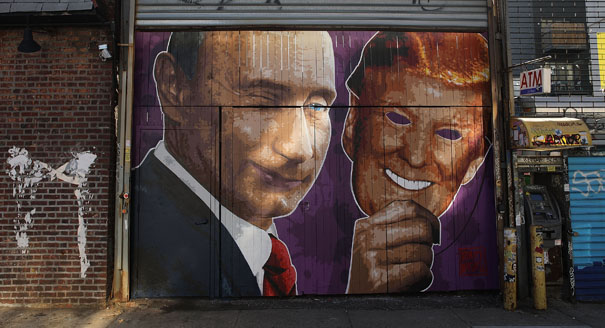
Source: Getty
A regular survey of experts on matters relating to Middle Eastern and North African politics and security.
Ziad Majed | Associate professor at the American University in Paris, author in 2014 of Syrie, La Révolution Orpheline, or “Syria, The Orphaned Revolution,” and co-founder, then coordinator, of the Arab Network for the Study of Democracy
It is not be easy to predict what message President Donald Trump will deliver to his Russian counterpart. However, Russia is more and more nervous about current U.S. policy in Syria. Moscow was hoping to find a political partner in Washington allowing Moscow to capitalize politically on its military achievements. This could have meant co-sponsoring a political process based on the Russian approach to Syria, officially recognizing that Syrian President Bashar al-Assad would remain in power (under certain conditions), and cooperating militarily with Russia against the Islamic State and the latest version of the Al-Qaeda affiliate, Jabhat al-Nusra. The fact that the Pentagon continues to reject such cooperation and to support the Kurdish militias against the Islamic State—conducting air raids against Assad’s forces and pro-Iran militias when they get close to the Kurds or to the Free Syrian Army in the southern desert around Tanf—hasn’t pleased the Russians.
The U.S. Secretary of State Rex Tillerson is now telling UN Secretary General Antonio Gutteres that the fate of Assad is in Russia’s hands. This means that Assad is now Moscow’s “problem,” that the U.S. is not interested in the fate of the Syrian dictator, and that no negotiated political solution will likely be reached soon. Moscow knows that to maintain Assad in power without a political solution approved by the U.S., Europe, and some regional actors would require its continued involvement on the ground in Syria. In the long run, this might create tensions between Russia and its current ally, Iran, each of which has different priorities. If the U.S. decides to put pressure on Iran, it might render more fragile the political-security order that Moscow is trying to impose through the Astana process, of which it is a main sponsor.
Dmitri Trenin | Director of the Carnegie Moscow Center
Presidents Donald Trump and Vladimir Putin will not have a full-fledged summit when they meet in Hamburg this week. Ironically, they have so much to discuss and so little to agree on. Syria will certainly take up some time of their conversation, but comprehensive agreements of the kind attempted during the Obama administration are unlikely to emerge from the meeting. Russia wants the United States to collaborate on the de-escalation zones it has agreed with Turkey and Iran, but Washington remains cool to the idea. Moscow has also invited the U.S. to join the Astana talks, in the company of Ankara and Tehran, to bring together the Syrian government and the opposition. The United States, however, does not have the habit of joining others. It expects them to follow America’s lead, when it is available. Putin and Trump will talk, and size each other up. This is no doubt important, but don’t hold your breath.
Yassin al-Haj Saleh | Syrian intellectual and writer, former political prisoner, author most recently of The Impossible Revolution: Making Sense of the Syrian Tragedy
U.S. Secretary of State Rex Tillerson recently said that the future of Syrian President Bashar al-Assad was in Russia’s hands. This statement means that Assad’s fate is in the hands of Bashar’s friends, and we, the American friends of the Syrian people, are leaving the fate of the Syrian people to the enemies of the Syrian people and the protectors of the butcher of the Syrian people. The Trump-Putin meeting will not alter this course, which is a course of genocide with international sponsorship and perpetrated under the banner of the war on terror. The Islamic State is the genocidal villain that helps many genocidal villains appear less villainous than they really are. I just wonder what they will come up with when the Islamic State is no longer here. We will see.
I think Trump and Putin will focus on the war on terror. The Syrian cause has been annexed to this war since the chemical deal in 2013 [when the United States called off retaliation against the Syria regime’s chemical weapons use in exchange for Russian assistance in removing Syria’s chemical weapons arsenal]. There will be no talks over a political transition in Syria. Both presidents are authoritarian leaders and prefer people of their type for Syria.

Editor, Diwan, Senior Editor, Malcolm H. Kerr Carnegie Middle East Center
Michael Young is the editor of Diwan and a senior editor at the Malcolm H. Kerr Carnegie Middle East Center.
Recent Work
Michael Young
Michael Young
Carnegie does not take institutional positions on public policy issues; the views represented herein are those of the author(s) and do not necessarily reflect the views of Carnegie, its staff, or its trustees.

As the U.S. stumbles in its war with Iran, we are likely to see an acceleration of its disengagement from the region.
Michael Young
The Zaidi government’s objective to collect weapons is constrained by regional conflict, but it can take certain measures at home.
Ali Al-Mawlawi

Huawei pushed hard to enter the Egyptian data centers market, until the Americans made a better offer.

Angie Omar

Middle Eastern states should welcome an accelerated U.S. disengagement from their region.
Michael Young

In an interview, former ambassador Charles Freeman assesses the Trump administration’s war against Iran.
Michael Young