

Commentary
Jake Walles
{
  "authors": [
    "Jake Walles"
  ],
  "type": "commentary",
  "blog": "Diwan",
  "centerAffiliationAll": "dc",
  "centers": [
    "Carnegie Endowment for International Peace",
    "Malcolm H. Kerr Carnegie Middle East Center"
  ],
  "collections": [],
  "englishNewsletterAll": "menaTransitions",
  "nonEnglishNewsletterAll": "",
  "primaryCenter": "Malcolm H. Kerr Carnegie Middle East Center",
  "programAffiliation": "MEP",
  "programs": [
    "Middle East"
  ],
  "projects": [
    "Tunisia Monitor"
  ],
  "regions": [
    "North Africa",
    "Tunisia",
    "Maghreb"
  ],
  "topics": [
    "Political Reform",
    "Economy",
    "Civil Society"
  ]
}
Source: Getty
Tunisia is a success story, however the economy continues to threaten the country’s progress.
Recent developments in Tunisia raise a fundamental question about the country’s future: Is it still on track as the Arab Spring’s only success story, or is it drifting back toward authoritarianism?
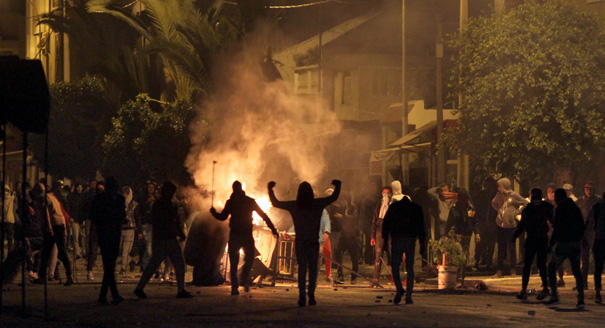
Optimists emphasize Tunisia’s free press, vibrant civil society, and multiparty political system as positive indications of continued progress. Pessimists point to widespread corruption, delays in developing democratic institutions, and heavy-handed security forces as signs of trouble ahead. Recent street protests that resulted in significant property damage, hundreds of arrests, and one dead protester raise new concerns about the country’s stability.
Tunisia deserves great credit for what it has accomplished since the revolution in 2011, but more needs to be done to solidify these gains and secure its fragile place among the world’s democracies. In particular, the Tunisian government needs to address more effectively the tough economic problems the country faces and that pose the greatest risk to its democratic advancement.
On the positive side of the ledger, the country has come a long way since the 2011 revolution. After the initial euphoria of the Arab Spring, Tunisia entered a period of profound crisis marked by the attack on the U.S. Embassy in 2012, the assassination of two political figures in 2013, and deadly attacks against tourist locations in 2015. Tunisia’s political system was also in turmoil, particularly in 2013 when the so-called Troika government came under widespread criticism for its mismanagement of the country’s transition.
Fortunately, Tunisia was able to turn the situation around. The mediation process begun by four leading civil society groups in 2013 resulted in the adoption of the country’s new democratic constitution, an interim handover of power to a technocratic government, and free and fair elections in 2014. Likewise, more effective efforts to combat terrorism, together with international assistance, resulted in a significant improvement in the security situation from 2016 onward. The political scene since has also been marked by pragmatic cooperation between the two largest parties—Ennahda and Nida’ Tounes—producing greater political stability than at any time since the revolution.
At the same time, the country’s progress remains incomplete, particularly in the economic sphere. Public dissatisfaction is widespread regarding the lack of economic growth, continuing high unemployment and social problems in the county’s interior, and corruption. Critics also point to problems in achieving key political milestones, such as the repeatedly delayed local elections and slow progress in establishing the Constitutional Court. Also troubling are the instances of harassment of some journalists and bloggers, the Administrative Reconciliation Law that allowed for amnesty for civil servants previously involved in corruption, and the return of several officials from the former regime to positions within the current government.
On balance, the optimists have a stronger case about Tunisia’s progress on political and security issues, while the pessimists win the argument over the economy. On security, the situation is clearly far better now than when terrorist attacks and political assassinations were common occurrences. Nevertheless, the political leadership needs to remain vigilant to ensure that the security forces operate only within the parameters of the law.
In the political sphere, the difficulties in implementing constitutional provisions and holding local elections are worrisome, but delays have been common during Tunisia’s political development since the revolution. All key steps along the democratic transition took longer than expected but were ultimately achieved. The new constitution, for example, was originally expected to be completed in one year but took three times as long. Maintaining forward progress is the key, not the precise timetable. However, one milestone that should not be allowed to slip is the presidential and legislative elections scheduled for 2019.
However, Tunisia’s progress is genuinely in danger because of the economy. For years, Tunisian governments put off difficult reforms, especially of public financing and public-sector employment, and relied on international assistance to buy time. Without these reforms, the economy continues to grow sluggishly and cannot produce the development necessary to ease poverty and unemployment. The government sought to address this with a package of financial austerity measures that went into effect on January 1, but the measures provoked widespread protests around the country. Since then, the government has tried to mollify protesters by increasing social welfare payments to needy families.
The economic task before the government is a difficult one. It must introduce reforms to spur economic growth and address regional imbalances, but in doing so it must not make life harder for marginalized communities, thereby provoking social and political upheaval. It will need to find ways to target reforms more narrowly at inefficient sectors—publicly owned corporations for example—and not impose measures in ways that disproportionally impact low income families. This will not be an easy task, but reforming the economy is essential to the country’s continued success.
In moving forward, Tunisians will need to build on the existing achievements of the democratic transition. The cooperation that has existed between the major political parties should continue as Tunisia tackles these difficult economic challenges. Likewise, the security forces will have to continue to act in a responsible manner, allowing legitimate protest and not overreacting if protests turn violent. Finding the right balance in all these areas will be challenging, but Tunisia’s record of success since the revolution offers hope that it can weather the current storms.

Former Nonresident Senior Fellow, Middle East Program
Jake Walles was a nonresident senior fellow in the Middle East Program at the Carnegie Endowment for International Peace, where he focuses on Israeli-Palestinian issues, Tunisia, and counterterrorism.
Recent Work
Jake Walles
Jake Walles
Carnegie does not take institutional positions on public policy issues; the views represented herein are those of the author(s) and do not necessarily reflect the views of Carnegie, its staff, or its trustees.
In Egypt’s dense cities, the disappearance of foliage has health implications and punishes daily commuters.

Angie Omar
This will be the region’s most representative tournament, amid broad changes in its footballing landscape.

Issam Kayssi

The recent African Cup of Nations tournament in Morocco touched on issues that largely transcended the sport.

Issam Kayssi, Yasmine Zarhloule
In an interview, Ishac Diwan looks at the merits and flaws in the draft legislation distributing losses from the financial collapse.

Michael Young
Mustaqbal Misr has expanded its portfolio with remarkable speed, but a lack of transparency remains.

Yezid Sayigh