

Commentary
Michael Young
{
  "authors": [
    "Michael Young"
  ],
  "type": "commentary",
  "blog": "Diwan",
  "centerAffiliationAll": "dc",
  "centers": [
    "Carnegie Endowment for International Peace",
    "Malcolm H. Kerr Carnegie Middle East Center"
  ],
  "collections": [],
  "englishNewsletterAll": "menaTransitions",
  "nonEnglishNewsletterAll": "",
  "primaryCenter": "Malcolm H. Kerr Carnegie Middle East Center",
  "programAffiliation": "MEP",
  "programs": [
    "Middle East"
  ],
  "projects": [],
  "regions": [
    "Levant",
    "Israel",
    "Saudi Arabia",
    "Palestine",
    "Middle East",
    "Gulf"
  ],
  "topics": [
    "Political Reform"
  ]
}
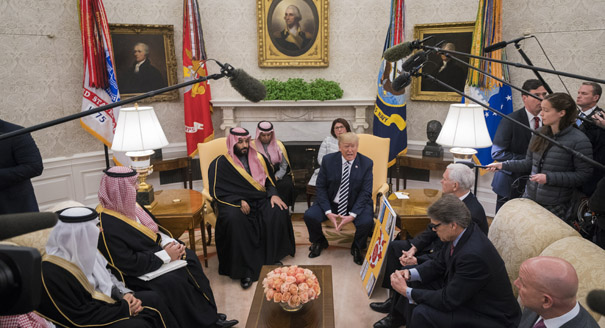
Source: Getty
Mohammed bin Salman’s recent remarks about Israel seemed to be old wine in a more attractive bottle.
In a recent interview with Jeffrey Goldberg of the Atlantic, Saudi Crown Prince Mohammed bin Salman invited much commentary for what he said about Israel. The crown prince recently completed a three-week tour of the United States, aimed as much at presenting a more modernist image of Saudi Arabia, and of himself, as to consolidating U.S. support for his eventual succession to the throne.
One statement on Israel, recounted by Goldberg, elicited considerable attention: “In fact, when I asked [the prince] whether he believed the Jewish people have a right to a nation-state in at least part of their ancestral homeland, he said: ‘I believe that each people, anywhere, has a right to live in their peaceful nation. I believe the Palestinians and the Israelis have the right to have their own land.’”
To Goldberg, this statement represented something new. The former U.S. peace negotiator Dennis Ross only reinforced this view. He explained that “moderate Arab leaders have spoken of the reality of Israel’s existence, but acknowledgement of any sort of ‘right’ to Jewish ancestral land has been a red line no leader has crossed until now.”
Perhaps, but in reading Mohammed bin Salman’s response, it appears that Goldberg and Ross may be engaging in interpretative overreach. It’s Goldberg who set up the question to include a mention of Jewish ancestral land, while the prince responded with what could be seen as a formulaic line, which the throwaway word ‘anywhere’ betrayed, about the right of Jews and Palestinians to live peacefully in a state of their own.
As the prince told Goldberg, when asked whether he had a religious-based objection to Israel: “We have religious concerns about the fate of the holy mosque in Jerusalem and about the rights of the Palestinian people. This is what we have. We don’t have any objection against any other people.”
There is no doubt that Saudi Arabia has taken a more conciliatory attitude toward Israel than it had previously. But until now, in its public statements the kingdom has been careful not to run afoul of the Arab consensus on Palestine. The Saudis have adopted a different approach to Israel because both share a common enemy in Iran, and the Saudis no longer trust the United States to help contain the Islamic Republic. But where some have regarded this attitude as a first step in normalization between the kingdom and Israel, it is likely that the Saudis are simply pursuing their own political interests, at a minimal cost to themselves.
Those who want to believe there is more than just Saudi opportunism at play here point to recent reports that the Saudis have signed off on a U.S. draft peace plan between Israelis and Palestinians that is reportedly much more favorable to Israel than to the Palestinians. The Saudis have denied this, but there have also been persistent suspicions that the kingdom was aware of, and did not oppose, the Trump administration’s decision to recognize Jerusalem as Israel’s capital. Maybe, but it may not tell us as much as some people think. The kingdom needs to string the Israelis along, and appear believable in doing so. At the same time, knowing that President Donald Trump was adamant about his decision on Jerusalem, the Saudis may have seen no interest in expressing displeasure, senselessly alienating him and Israel, when their main focus remains building a coalition against Iran.
It seems more sensible to place Prince Mohammed’s statements in the context of the Arab Peace Initiative agreed by the Arab states at their summit in Beirut in March 2002. While the Saudis’ purported views of the forthcoming U.S. proposal on Palestinian-Israeli peace may conceivably contradict this, until we know to what the Saudis will agree, it’s best to stick to what has been publicly stated. And the prince’s remarks to Goldberg lie within the parameters of the Arab initiative, first pushed a decade and a half ago by then-crown prince Abdullah, who later became king.
The Arab Peace Initiative opens with a mention of Abdullah’s peace overtures to Israel, first floated in an interview with the New York Times columnist Thomas Friedman. Abdullah had called for a full Israeli withdrawal from Arab land occupied since June 1967, in line with United Nations Security Council Resolutions 242 and 338 and reaffirmed by the Madrid conference of 1991 and the land for peace principle. In return, the Arab states would agree to comprehensive peace with Israel.
With respect to Israeli withdrawals, the Arab plan restates Resolution 242, without mentioning it specifically, and calls for resolving the Palestinian refugee problem according to General Assembly Resolution 194. It also calls for a sovereign independent Palestinian state in the Palestinian territories occupied since June 4, 1967, namely the West Bank and Gaza, with East Jerusalem as its capital. In return, the Arabs would consider their conflict with Israel over, and would sign peace agreements, providing security for all states in the region. The initiative urges Israelis to accept these conditions, so that the Arabs and Israel “can live in peace and good neighborliness and provide future generations with security, stability, and prosperity.”
There was nothing in Prince Mohammed’s remarks to Goldberg that specifically departed from the Arab initiative. In underlining the reciprocity of the rights of Israelis and Palestinians to live in peaceful nations, the prince echoed what was said in 2002, placing both communities on par with one another. In other words, Prince Mohammed’s remarks restated past Saudi policy, albeit in a form packaged somewhat differently than previously.
Packaging is doubtless important in the Saudi-Israeli relationship. But there was more to the Arab Peace Initiative than packaging. It was a bona fide Arab peace proposal, one secured by the Saudis against stubborn initial opposition from some Arab parties, notably Syrian President Bashar al-Assad, and that came out of a contentious Arab summit chaired by an Assad ally, Lebanese president Emile Lahoud. Israel never responded with any enthusiasm to the Arab plan, describing it as a “non-starter.” The reaction was in no way commensurate with what the initiative merited.
It’s revealing that no one recalls the Arab Peace Initiative anymore, even as they give undue importance to Prince Mohammed’s comments. Goldberg underlined that the prince was the first Arab leader to acknowledge the right of the Jewish people to have a state of their own. Whether Arab leaders mentioned the term “Jewish people” or not in Beirut, to them recognizing Israel’s right to exist in peace was pretty much the same thing. That’s why Goldberg’s statement is incorrect.

Editor, Diwan, Senior Editor, Malcolm H. Kerr Carnegie Middle East Center
Michael Young is the editor of Diwan and a senior editor at the Malcolm H. Kerr Carnegie Middle East Center.
Recent Work
Michael Young
Michael Young
Carnegie does not take institutional positions on public policy issues; the views represented herein are those of the author(s) and do not necessarily reflect the views of Carnegie, its staff, or its trustees.
The party’s objectives involve tying together the Lebanese and Iranian fronts, while surviving militarily and politically at home.
Mohamad Fawaz
While armed forces commander Rudolph Haykal’s caution is understandable, he is in a position to act, and must.
Michael Young
In an interview, Hamidreza Azizi discusses how Tehran has adapted in real time to the conflict with the United States and Israel.
Michael Young
The simple conclusion is that the scheme will bring neither peace nor prosperity, but will institutionalize devastation.

Nathan J. Brown
The Jamaa al-Islamiyya is the local Lebanese dimension of a broader struggle involving rival regional powers.
Issam Kayssi