

Commentary
Michael Young
{
  "authors": [
    "Michael Young"
  ],
  "type": "commentary",
  "blog": "Diwan",
  "centerAffiliationAll": "dc",
  "centers": [
    "Carnegie Endowment for International Peace",
    "Malcolm H. Kerr Carnegie Middle East Center"
  ],
  "collections": [
    "Inquiring Minds"
  ],
  "englishNewsletterAll": "menaTransitions",
  "nonEnglishNewsletterAll": "",
  "primaryCenter": "Malcolm H. Kerr Carnegie Middle East Center",
  "programAffiliation": "MEP",
  "programs": [
    "Middle East"
  ],
  "projects": [],
  "regions": [
    "Levant",
    "Israel",
    "Palestine",
    "Middle East",
    "North America",
    "United States"
  ],
  "topics": [
    "Political Reform",
    "Foreign Policy"
  ]
}
Source: Getty
A regular survey of experts on matters relating to Middle Eastern and North African politics and security.
Ghassan Khatib | Former Palestinian minister, lecturer in contemporary Arab studies and international studies at Birzeit University in the West Bank
The Trump administration will never announce its plan for Palestinian-Israeli peace that it has dubbed “the Deal of the Century,” mainly because it has realized that all the relevant parties are not interested in it.
Palestinian leaders have halted all contacts with U.S. government officials in a bold rejection of the administration’s intention to announce the plan. The main reason for this is the United States’ recognition of Jerusalem as the capital of Israel and the decision to move the U.S. embassy there. In addition, relevant Arab counties, particularly Jordan and Saudi Arabia, have recently announced critical rejection of the U.S. peace plan plan, especially that part of it that maintains all of Jerusalem as Israel’s capital.
More important is that the current Israeli coalition is not enthusiastic about shaking up the status quo that is allowing Israel to pursue its illegal colonization of occupied Palestinian land at a minimal political and security cost to itself. The Trump administration appears to be replacing the idea of announcing a peace plan with efforts to follow the Israeli lead in unilaterally implementing Israeli ideas—as the American steps on Jerusalem and Palestinian refugees can attest.
Adrien Jeaulmes | Reporter at the French daily Le Figaro
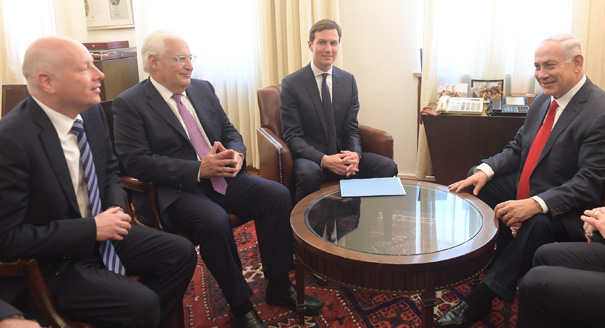
It seems to me quite doubtful that the Trump administration’s peace plan for Palestine will ever be announced, at least within its current parameters, if we are to believe the leaks. The plan’s framework, prepared by the president’s son in law Jared Kushner and special envoy Jason Greenblatt, has several major flaws.
The first and most important one is that it is not acceptable to Palestinians. No Palestinian leader will ever agree to renounce Jerusalem or the refugees’ right of return. While the Palestinians know well that there will never be a return of all refugees from the conflicts of 1948 and 1967, they will at least want recognition of the wrong done to them. The Trump plan appears only to buy them off. The Palestinians also understand that they won’t get back all of East Jerusalem, but no Palestinian state can be established without at least a small part of the city.
The second flaw is that it is not acceptable to the Arab states. Saudi Arabia and the other Gulf states might have established links with Israel against Iran and Syria, while paying lip service to Kushner. However, no sane Arab leader will offer a diplomatic victory to Iran by endorsing a plan that hands Jerusalem to Israel.
The third and final flaw is that the Trump plan is not likely to be acceptable to the Israelis. These days Israeli Prime Minister Benjamin Netanyahu is considered a moderate when compared to the majority of the Israeli cabinet. And most ministers have no interest whatsoever in any negotiations with the Palestinians.
Karim Makdisi | Associate professor of international politics and founding director of the Public Policy and International Affairs Program at the American University of Beirut
The Trump “peace plan,” whatever its form, is another attempt to impose on Palestinians the terms of what Edward Said long ago, and with great prescience, called the Palestinian “Versailles,” in reference to the 1993 Oslo agreements. Oslo was based on a sleight of hand: It insidiously replaced a rights-based political approach and international consensus—built on the political foundation of anti-colonialism, a plethora of United Nations resolutions, and an established body of international law—with direct bilateral negotiations between two vastly unequal actors.
Stripped of Oslo’s liberal veneer and the pretense of impartial U.S. mediation, the plan of U.S. President Donald Trump now draws on his son in law Jared Kushner’s extremist Israeli colonial-settler ideology, and on the regional hubris of Israeli and Saudi leaders. Its threadbare “peace” component seems to rest on another sleight of hand that Palestinians will apparently be asked to accept: Oslo’s tried and failed strategy of a more benevolent occupation—with talk of economic dividends, self-government, and humanitarian aid components. But Palestinians will be asked to curtail their national political aspirations even more than those already reduced by Oslo. For Kushner, there is likely to be no Oslo-style promise of “final-status” negotiations. Rather, based on his ideology and actions over recent months, his plan will likely mean no Palestinian state, no (real) Palestinian capital in Jerusalem, no removal of illegal Israeli settlement blocks, no refugee return, and no equal rights between Jews and Palestinians. Ultimately, the Trump-Kushner plan is designed to distract from Israel’s continued land grab and increasing apartheid-like conditions. It also seeks to strip Palestinians of their political aspirations and identity, their protected refugee status, their dignity, and their right to resist. Announced, or not, this plan is moot. The real battle will be fought on the ground.
Jake Walles | Nonresident senior fellow in the Middle East program at the Carnegie Endowment for International Peace, former ambassador to Tunisia and former consul general and chief of mission in Jerusalem (2005–2009)
It’s hard to predict what this most unpredictable of administrations might do. However, it seems highly improbable that it will announce a full-blown peace plan as a basis for negotiations at a time when Israel is headed into elections to the Knesset in 2019, the Palestinians are boycotting Washington, and the Saudis have said that they would not support a plan that doesn’t include East Jerusalem as the capital of Palestine. All this is a recipe for certain failure.
What is more likely is a piecemeal elaboration of the Trump administration’s views on key permanent-status issues. It began doing that last December in announcing support for Jerusalem as Israel’s capital and continued more recently in its confrontational approach toward the United Nations Relief and Works Agency and its suggestions for redefining the status of Palestinian refugees. We might see more of this in the year ahead, particularly on territorial issues in the West Bank, with the administration seeking to reframe another key issue in ways favorable to Israel in the run-up to Israeli elections next year.

Editor, Diwan, Senior Editor, Malcolm H. Kerr Carnegie Middle East Center
Michael Young is the editor of Diwan and a senior editor at the Malcolm H. Kerr Carnegie Middle East Center.
Recent Work
Michael Young
Michael Young
Carnegie does not take institutional positions on public policy issues; the views represented herein are those of the author(s) and do not necessarily reflect the views of Carnegie, its staff, or its trustees.
Reconciliation councils are emerging throughout the country to mediate in intracommunal disputes, many from the war years.
Natacha Danon
In an interview, Rozina Ali discusses her new book on the rise and manifestations of Islamophobia in the United States.
Michael Young
As the U.S.-led Coalition withdraws, the Kurds’ reliance on Baghdad, and on themselves, will only increase.
Wladimir van Wilgenburg

In an interview, Ian Lustick and Eli Clifton discuss their new book on why a prominent ally has so much influence in America.
Michael Young

As the U.S. stumbles in its war with Iran, we are likely to see an acceleration of its disengagement from the region.
Michael Young