

Article
Dalia Ghanem
{
  "authors": [
    "Dalia Ghanem"
  ],
  "type": "commentary",
  "blog": "Diwan",
  "centerAffiliationAll": "dc",
  "centers": [
    "Carnegie Endowment for International Peace",
    "Malcolm H. Kerr Carnegie Middle East Center"
  ],
  "collections": [],
  "englishNewsletterAll": "menaTransitions",
  "nonEnglishNewsletterAll": "",
  "primaryCenter": "Malcolm H. Kerr Carnegie Middle East Center",
  "programAffiliation": "MEP",
  "programs": [
    "Middle East"
  ],
  "projects": [],
  "regions": [
    "Maghreb",
    "North Africa",
    "Algeria"
  ],
  "topics": [
    "Political Reform"
  ]
}
Source: Getty
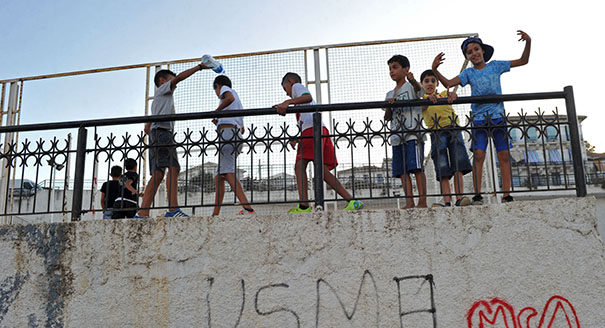
Many children of jihadis in Algeria are being denied an identity, education, and much more.
Recently, Algeria celebrated the anniversary of the Charter for Peace and National Reconciliation. The document, adopted on September 29, 2005, put an end to the country’s civil war, “the great fitna [civil strife] that struck Algeria,” and sought to “transcend the national tragedy once and for all.”
The charter allowed for the demobilization and reintegration into society of 15,000 former combatants, offering them the possibility of a life after jihadism. While the government’s reconciliation policies achieved a great deal, they failed to address what would happen to the children born in the hideouts of Algeria’s jihadi insurgents. Thirteen years after the Charter for Peace and National Reconciliation, even if there are children who have been granted legal recognition, hundreds of others still have no legal existence, no education, and no future in a society that seems to have forgotten them. In fact, the Algerian state and society consider the subject of the children a taboo.
During the conflict, the children were born as the offspring of consensual yet invalid marriages—contracted solely through a reading of the Fatiha, the first chapter of the Qur’an—or in circumstances of a forced union or rape. Precise figures are hard to come by, but Merouane Azzi, who heads the commission that implements the Charter for Peace and National Reconciliation, says there were around 500 children born in the hideouts.
It is almost certain, however, that this figure is lower than the real number, as many children were never declared by their parents or identified by the state. Some of these children lost one or both of their parents, while others never got a chance to know them. Yet others followed their parents as they accepted the government’s demobilization policy and were integrated into society. The children have no legal existence as they do not appear in Algerian civil registries. For them to gain civil recognition, their parents’ marriage must be legalized, since in many cases the authorities consider them null and void. This process is necessary for recognition of paternity. Marriage legalization can only be done if both parents are present and if two witnesses corroborate that a marriage took place. Only then can a judge issue an order to authorize the marital status of the parties and grant permission to register the child. Once this procedure is finalized, a family booklet (livret de famille) can be issued.
However, the procedure is burdensome, especially for women who were victims of rape and widows who cannot prove the paternity of their children. Neither the law nor the charter has offered a practical mechanism to extricate families and children from this dilemma. In 2008, the Ministry of National Solidarity made a commitment to identify children through DNA tests and a draft law was prepared in this regard. However, a decade later nothing has been done.
The institutional violence against the children runs deep, denying them a basic human right, namely education. In 2006, then-education minister Aboubakr Benbouzid pledged to provide some 600 children born in the hideouts with an educational plan and psychological treatment. An agreement was signed with the Ministry of National Solidarity to enroll them all in school. Yet, despite such efforts, there are hundreds who do not go to school because they were never granted legal status. This complicates their social integration further.
In addition to the institutional discrimination against the children, there is also a psychological price to pay. Because of the difficult environment in which they were born and raised and their direct experience with violence, many suffer from suicidal tendencies, psychological and psychosomatic disorders, trauma, and antisocial behavior. Things are only made worse by the fact that they are socially stigmatized because of their background and their being born to jihadis, so that they are often blamed for their parents’ actions. As a result of such treatment, the children are constantly facing a combination of rejection and alienation.
There is a need to place these children in a protective social and therapeutic environment where they can be assisted by professionals both socially and medically. It is crucial to do so in order to avoid reproducing the extreme violence in which these children were born and raised. At the same time, the children need to be integrated into society, which requires that the Algerian authorities legally acknowledge their existence and their need for help. When thousands of children in Iraq and Syria were members of the Islamic State, the importance of allowing the children of former Algerian jihadis to lead a normal life becomes all the more obvious.
Former Senior Resident Scholar, Malcolm H. Kerr Carnegie Middle East Center
Dalia Ghanem was a senior resident scholar at the Malcolm H. Kerr Carnegie Middle East Center in Beirut, where her research focuses on Algeria’s political, economic, social, and security developments. Her research also examines political violence, radicalization, civil-military relationships, transborder dynamics, and gender.
Recent Work
Dalia Ghanem


Frances Z. Brown, Judy Dempsey, Dalia Ghanem, …
Carnegie does not take institutional positions on public policy issues; the views represented herein are those of the author(s) and do not necessarily reflect the views of Carnegie, its staff, or its trustees.
In Egypt’s dense cities, the disappearance of foliage has health implications and punishes daily commuters.

Angie Omar
This will be the region’s most representative tournament, amid broad changes in its footballing landscape.

Issam Kayssi
The recent African Cup of Nations tournament in Morocco touched on issues that largely transcended the sport.

Issam Kayssi, Yasmine Zarhloule
Mustaqbal Misr has expanded its portfolio with remarkable speed, but a lack of transparency remains.

Yezid Sayigh
The burden of environmental degradation is felt not only through physical labor but also emotional and social loss.
Yasmine Zarhloule, Ella Williams