

Commentary
Kheder Khaddour
{
  "authors": [
    "Kheder Khaddour"
  ],
  "type": "commentary",
  "blog": "Diwan",
  "centerAffiliationAll": "dc",
  "centers": [
    "Carnegie Endowment for International Peace",
    "Malcolm H. Kerr Carnegie Middle East Center"
  ],
  "collections": [
    "Civil-Military Relations in Arab States"
  ],
  "englishNewsletterAll": "menaTransitions",
  "nonEnglishNewsletterAll": "",
  "primaryCenter": "Malcolm H. Kerr Carnegie Middle East Center",
  "programAffiliation": "MEP",
  "programs": [
    "Middle East"
  ],
  "projects": [
    "X-Border Local Research Network"
  ],
  "regions": [
    "Levant",
    "Syria",
    "Middle East",
    "Iraq"
  ],
  "topics": [
    "Political Reform",
    "Security"
  ]
}
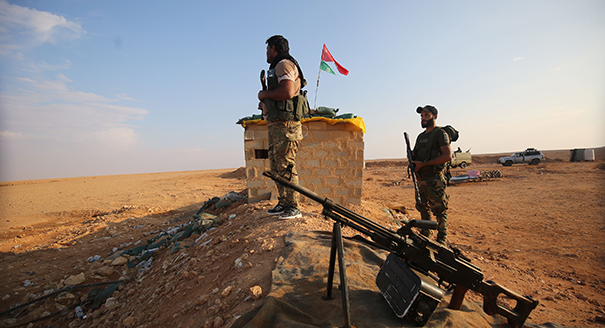
Source: Getty
The Syrian-Iraqi border has become a point of confrontation among regional and international powers.
The continuing threat of a resurgence by the Islamic State group, and its efforts to exert influence in Syria and Iraq, has played out most noticeably along the Syrian-Iraqi border. Yet that border, extending all the way up to the frontier with Turkey, is about more than the Islamic State. It has emerged as a main point of confrontation among regional and international powers.
Over 600 kilometers of the border formerly controlled by the Islamic State are currently held by a patchwork of political actors. On the Iraqi side, the major forces are Iraq’s regular army, Arab Sunni tribes, as well as Shi‘a and Yezidi militias tied to Iran, which also share a connection with the Kurdistan Workers Party (PKK) operating in western Sinjar. On the Syrian side, the U.S.-backed Kurdish-dominated Syrian Democratic Forces (SDF) controls large parts of the border. The Syrian regime, allied with local partners, holds other areas, while the Islamic State rules over a small pocket of territory.
This complex mix of forces is reshaping the border area, even as the border itself is reshaping how the different parties are interacting with one another as they compete for spheres of influence. Cross-border interaction and a mutual need to prevent a return of the Islamic State have also brought Damascus and Baghdad closer together, which ultimately works to the benefit of Iran. Indeed, today Iran is the only actor that has a significant presence, and influence, on both sides of the Syrian-Iraqi border.
In 2014, during the phase of expansion by the Islamic State and the initial fight to oppose it, Iraqi Kurdish forces counterattacked and took some 30 kilometers of territory beyond their former area of control, almost reaching Sinjar. Following the failed referendum on Kurdish independence in 2017, the Iraqi government recaptured nearly all of those areas and stationed government troops and units of the Popular Mobilization Forces (PMF)—quasi-official militias composed primarily of Iraqi Shi‘a—on the border. The dilemma for the Iraqi government today is that those forces require food and fuel, creating a major drain on the national budget. If these funds are cut, as is possible, it might allow the Islamic State to regain territory and reignite conflict in the border region.
On the Syrian side, the regime of President Bashar al-Assad does not have the same problem. After retaking the highly strategic Al-Bukamal border crossing in November 2017, the regime employed a model that involves collaboration between the Republican Guard’s 104th Brigade and local tribal elements in Deir Ezzor. Because the system is more financially sustainable, it allows the regime to maintain a strong presence on the border.
Geopolitical rivalries on the Syrian-Iraqi border have only intensified as a result of mounting tensions between the United States and Iran. Complicating matters in the broader border area that stretches northward toward Turkey are the conflict between Turkey and U.S.-backed Syrian Kurdish groups and the rivalry between the United States and Russia. The United States has also possibly intervened militarily against the PMF, which has crossed the Iraqi border into Syria to conduct operations against the Islamic State. Washington considers them to be an extension of Iran and in June 2018 U.S. aircraft reportedly bombed PMF forces between Al-Bukamal and the Tanf crossing, which the Americans control, on the Syrian side of the border. However, the U.S. denied that it was involved.
These clashing agendas underline that the Iraqi-Syrian border plays a far more intricate role than delineating the boundaries between two sovereign states. The presence of nonstate actors who are disputing state control over borders—or indeed who sometimes share border control with states—has produced new military relationships.
That is increasingly the case on the Iraqi side of the border, where Shi‘a militias and the Kurdish Peshmerga operate alongside Iraqi military forces. According to one its leaders, the PMF deployed along the Syrian-Iraqi border in coordination with the Iraqi government. Other reports estimate that 80 percent of the 140,000 PMF members are stationed in northern and western Iraq, close to Syria and far from areas where they were recruited. This figure has not been confirmed, but to some observers the deployment, if the numbers are corroborated, is part of an Iranian attempt to secure a corridor between Iran and Syria.
At the same time, the Turkish armed forces continue to carry out cross-border operations against the PKK in areas such as Sinjar. The Turkish intervention is affecting relations between Kurdish factions. The Kurdistan Democratic Party, which leads the Kurdistan Regional Government in Iraq, is coordinating with Turkey to deny the PKK and its allies a safe haven in northern Iraq. However, this attitude is not shared by the other major Iraqi Kurdish party, the Patriotic Union of Kurdistan (PUK), which controls the city of Suleimaniyya and has a strong presence in Kirkuk. The PUK is a close ally of Iran and is believed to have developed a more sympathetic attitude toward the PKK and its Syrian affiliate, the Democratic Union Party.
The Islamic State’s priority has been to preserve its caliph minus a caliphate. It still controls a small strip of territory on the Syrian side of the Syrian-Iraqi border, which is at risk of imminently falling. Last December, U.S. President Donald Trump ordered the withdrawal of the 2,000 American troops in Syria. Most of the units are stationed along the border and are scheduled to have completed their withdrawal by the end of April, except for around 200 troops.
If this new situation creates a vacuum, it could lead to military advances by Iran and its proxies, the Syrian government, Kurdish militias, Turkey, or Russia. That is why the Syrian-Iraqi border is likely to remain highly militarized, a consequence both of geopolitical rivalries and local crises.
Nonresident Scholar, Malcolm H. Kerr Carnegie Middle East Center
Kheder Khaddour is a nonresident scholar at the Malcolm H. Kerr Carnegie Middle East Center in Beirut. His research focuses on tribal structures in the Levant, civil-military relations in Syria, and the role of borders in shaping local and national identities across the Middle East.
Recent Work
Kheder Khaddour
Kheder Khaddour
Carnegie does not take institutional positions on public policy issues; the views represented herein are those of the author(s) and do not necessarily reflect the views of Carnegie, its staff, or its trustees.

As the U.S. stumbles in its war with Iran, we are likely to see an acceleration of its disengagement from the region.

Michael Young
The Zaidi government’s objective to collect weapons is constrained by regional conflict, but it can take certain measures at home.
Ali Al-Mawlawi

Huawei pushed hard to enter the Egyptian data centers market, until the Americans made a better offer.

Angie Omar

The accord represents a pivotal moment in the region to avert a security vacuum in the Gulf.


Azeema Cheema, Mohanad Hage Ali

In an interview, Jason Burke discusses his sweeping account of the “revolutionists” who so shaped the 1970s and early 1980s.
Michael Young